Algeria has officially launched construction on its section of the long-awaited Trans-Saharan Gas Pipeline (TSGP), marking a major milestone for one of Africa’s most ambitious energy infrastructure projects aimed at transporting Nigerian natural gas to Europe through Niger and Algeria.
Work on the project began in Algeria’s far south under the supervision of the energy ministers of Algeria, Nigeria, and Niger, alongside executives from state-owned energy companies Sonatrach, Nigerian National Petroleum Company, and SONIDEP.
According to Algeria’s Ministry of Energy, the start of construction on the Algerian section of the more than 4,000-kilometre pipeline represents a “historic event” and a “turning point” in implementing the strategic continental energy project.
The launch ceremony took place in Algeria’s Adrar region following a ministerial steering committee meeting in Algiers, where officials adopted the final feasibility study prepared by British consultancy Penspen. The Trans-Saharan Gas Pipeline is designed to transport between 20 billion and 30 billion cubic metres of natural gas annually from Nigeria through Niger into Algeria, where it will connect to existing export infrastructure serving regional and international markets, particularly Europe.
READ: Dangote Group eyes new African oil pipeline network
Trans-Saharan Gas Pipeline
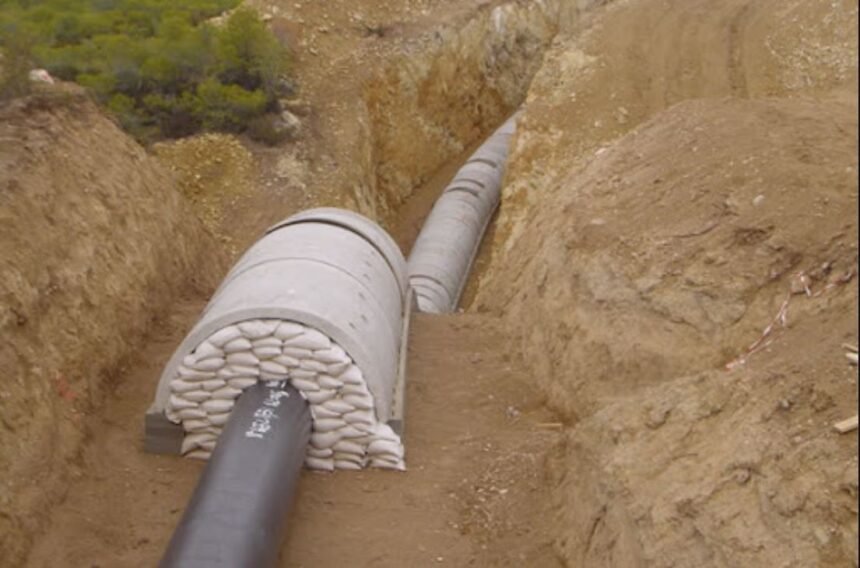
The broader project, jointly developed by Sonatrach, NNPC, and SONIDEP, will span approximately 4,128 kilometres. In Algeria, the pipeline will follow the Trans-Saharan Road corridor from the Algerian-Nigerien border to the National Gas Dispatching Center at the Hassi R’Mel gas hub, linking into Algeria’s national gas transportation network and export terminals.
Sonatrach said the route was optimized to leverage existing infrastructure, including road networks and gas pipelines, in order to reduce logistical and technical costs while improving implementation efficiency. Algeria’s energy ministry noted that the pipeline will not only transport Nigerian gas but will also carry additional Algerian gas volumes from newly developed basins, particularly the Ahnet field.
The project is expected to strengthen regional energy integration, improve the commercialization of African natural gas resources, and support economic development across the continent. The pipeline is also intended to supply Sahel countries along its route. Originally launched in 2009 with an estimated cost of about US $10bn, the TSGP’s projected investment has since risen to between US $13bn and US $19.5bn.
Momentum behind the project accelerated following the global energy crisis triggered by Russia’s invasion of Ukraine in 2022, which increased European demand for alternative gas suppliers. Algeria has since emerged as one of Europe’s major gas suppliers, accounting for roughly 12% of European gas imports after the continent reduced dependence on Russian gas.
The TSGP also forms part of a broader regional competition between Algeria and Morocco over gas export routes from Nigeria to Europe. Morocco is separately advancing the Nigeria-Morocco Gas Pipeline (NMGP), a proposed 6,000-kilometre pipeline that would cross 13 West African countries along the Atlantic coast before connecting to the Maghreb-Europe gas pipeline. The NMGP is estimated to cost around US $25bn.