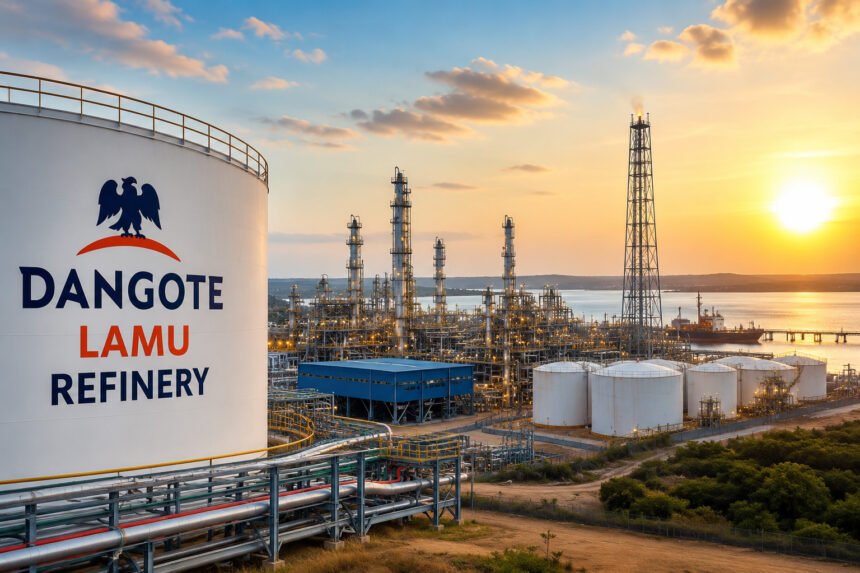
Global energy markets are watching Africa’s richest man again. Aliko Dangote, fresh from reshaping Nigeria’s fuel economy in Lagos, has now picked Kenya as his next battleground. The Dangote Lamu Refinery is a proposed $17 billion, 700,000-barrel-a-day facility on Kenya’s northern coast. It could end East Africa’s near-total dependence on imported fuel.
For industry players tracking industrial and infrastructure investment across the continent, this is more than a refinery announcement. It is a test case for how private African capital, regional politics, and environmental scrutiny collide on projects of this scale.
What Is the Dangote Lamu Refinery?
The Dangote Lamu Refinery is a planned petroleum processing plant on Lamu Island, off Kenya’s coast. Dangote Industries confirmed the site selection on Tuesday, July 7, 2026, ending months of uncertainty over whether the project would land in Kenya or Tanzania.
Edwin Devakumar, Dangote’s Vice President for Oil and Gas, told Reuters and Bloomberg that soil testing and preliminary engineering work are already under way. “The site has been selected, soil tests are underway, and design and engineering work has commenced,” he said. “Kenya was the choice from the beginning.”
The project would become the largest refinery in East Africa and the second-largest on the continent, trailing only Dangote’s own Lekki facility outside Lagos.
Scale and Specifications
- Location: Lamu Island, Lamu County, Kenya
- Estimated cost: Up to $17 billion (approximately Sh2.2 trillion)
- Capacity: 700,000 barrels per day
- Comparable facility: Dangote Petroleum Refinery, Lagos (650,000 bpd, expanding to 1.4 million bpd by 2028)
- Combined Dangote refining capacity once complete: 2.1 million barrels per day
- Construction timeline: Estimated at three to five years, depending on financing and approvals
- Financing structure: Internal cash flow, corporate bond issuances, and proceeds from a planned Dangote initial public offering (IPO)
- Anchor infrastructure: Lamu Port-South Sudan-Ethiopia Transport (LAPSSET) Corridor and its deep-water port
Dangote has not disclosed a final, binding cost figure. He has instead pointed to Lagos as the benchmark, a plant that eventually exceeded $20 billion after starting at an estimated $9 billion in 2013. That history is already shaping expectations for how much Lamu will ultimately cost.
READ: https://pumps-africa.com/dangote-group-eyes-new-african-oil-pipeline-network/
Why Lamu Was Chosen
Kenya beat out Tanzania’s Tanga region, which had been considered an early front-runner for the project. Dangote cited commercial and technical reasons for the switch, without elaborating in detail.
Lamu’s deep-water port, built to serve the LAPSSET corridor, gives the refinery direct access to large crude carriers. The corridor was designed to link Ethiopia, South Sudan, and northern Kenya to global shipping routes, making it a logical anchor for a refinery of this scale.
Kenya has not operated a commercial crude-oil refinery since the Kenya Petroleum Refineries Limited plant in Mombasa stopped processing crude over a decade ago. That plant now functions only as a storage facility, leaving Kenya reliant on imported petrol, diesel, and jet fuel.
Regional Supply and Why It Matters
If completed, the Dangote Lamu Refinery would supply refined petroleum products to Kenya, Uganda, Tanzania, South Sudan, and the Democratic Republic of Congo. Some reports extend the target market as far as Ethiopia, Rwanda, and Burundi.
East Africa currently imports nearly all its refined fuel, exposing the region to global price shocks and shipping disruptions. Recent tensions in the Middle East have underscored those risks. A functioning regional refinery could reduce that exposure, though supporters and skeptics disagree on how much it will actually lower pump prices for consumers.
Ruto’s 60,000-Jobs Promise
Kenyan President William Ruto has publicly backed the project. Speaking on July 10 during the rollout of the second tranche of the Nyota programme, Ruto said the refinery would require 60,000 workers, mostly youth, for construction and operations.
“That refinery in Lamu that I have agreed with the Investor Aliko Dangote will create jobs for our young people,” Ruto said. He has appointed Deputy President Kithure Kindiki to chair a government committee coordinating with investors and agencies ahead of implementation. Kenya has also set aside Sh21.5 billion in seed capital to support the project.
Dewji’s $100 Million Pledge
Tanzanian billionaire Mohammed Dewji, chief executive of the MeTL Group and East Africa’s richest person, has signalled interest in investing $100 million in the refinery. He disclosed the pledge in a Bloomberg interview published July 10.
Dewji made clear he would have preferred the plant built in his home country. “I would lean more toward Tanzania than in Kenya,” he said, adding that formal talks with Dangote have not yet begun. Despite the preference, he praised Dangote’s track record in Nigeria and said he intends to reach out directly to discuss co-investing.
Environmental and Heritage Concerns
Not everyone is celebrating. Lamu Old Town is a UNESCO World Heritage Site, recognised as the oldest and best-preserved Swahili settlement in East Africa. Environmental groups warn the refinery threatens that status, along with the surrounding mangrove forests, coral reefs, and fishing grounds that sustain thousands of local livelihoods.
Power Shift Africa director Mohamed Adow called the project “an extraordinary act of environmental recklessness and economic short-sightedness.” He argues that Africa’s energy transition is already visible in surging solar imports, which jumped 238% year-on-year by March 2026, and warns that a fossil-fuel megaproject risks becoming a stranded asset as electric vehicle adoption accelerates globally.
Local advocacy groups have also raised concerns about land acquisition and potential displacement of fishing communities, drawing comparisons to disputes that followed Dangote’s Lekki refinery development in Nigeria.
What Comes Next
Nothing has been built yet. The project remains in a preparatory phase, with soil investigations, design work, and engineering studies under way but no confirmed groundbreaking date. Key milestones to watch include:
- Publication of an Environmental and Social Impact Assessment (ESIA)
- Any formal investment agreement or memorandum of understanding with the Kenyan government
- Progress on Dangote’s planned IPO, a key funding source
- Crude feedstock and offtake agreements with regional governments
- UNESCO’s response regarding Lamu Old Town’s heritage status
For now, the Dangote Lamu Refinery stands as one of the most consequential industrial announcements in East Africa’s recent history — a project that could secure regional fuel supply for a generation, or become a costly and contested experiment in coastal industrialisation.