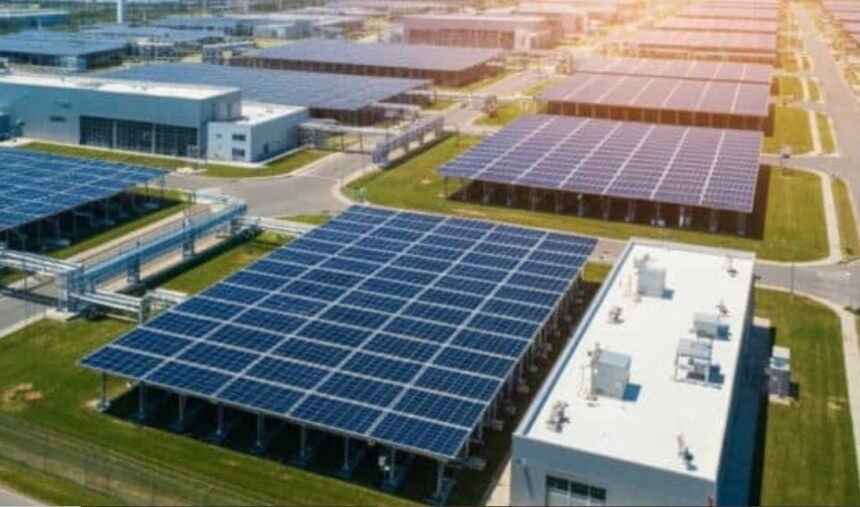
Egypt is accelerating its clean energy transition with the development of the Nefer Benban solar-plus-storage project in Aswan. Located within the vast Benban Solar Park, one of the largest solar complexes globally the project highlights the country’s shift toward integrating renewable power with battery storage to improve reliability.
The project, led by Hassan Allam Constructions, will deliver a total capacity of 258.5 MWp of solar power alongside a 120 MWh battery energy storage system (BESS). This hybrid setup will allow excess solar energy generated during peak sunlight hours to be stored and dispatched when demand is higher or sunlight is unavailable, strengthening grid stability.
To support efficient operations, Hassan Allam has secured key supply agreements with global technology providers. GameChange Solar will supply its advanced Genius Tracker systems, enabling solar panels to follow the sun and maximize energy output. Meanwhile, Sineng Electric will provide 249 MW of central inverters along with medium-voltage turnkey stations, critical for converting and managing electricity. The battery storage component will be supplied by HiTHIUM Energy Storage.
READ: UN to advance clean energy transition in Nigeria
NWFE initiative
The development is being driven by Infinity Power in partnership with Hassan Allam Utilities through their joint investment platform HAU Energy. Infinity Power itself is a joint venture between Masdar and Infinity Holding, combining regional and international expertise. Financial backing includes a bridge loan of up to US $65M from the European Bank for Reconstruction and Development, contributing to the project’s estimated total cost of US $180M.
Nefer Benban is one of two major hybrid projects under development, alongside the larger Nefer Minya project in Minya Governorate, which will feature 1,000 MW of solar capacity and 600 MWh of storage. Both projects have secured power purchase agreements with the Egyptian Electricity Transmission Company, with commercial operations targeted for the third quarter of 2027.
The project is part of Egypt’s broader Nexus of Water, Food and Energy (NWFE) initiative, which aims to add 10 GW of renewable energy capacity to the national grid. This aligns with the country’s long-term targets of generating 42% of electricity from renewables by 2030 and 65% by 2040. Once operational, Nefer Benban will not only expand Egypt’s renewable capacity but also enhance energy reliability, reduce dependence on fossil fuels, and position the country as a regional leader in clean energy development.