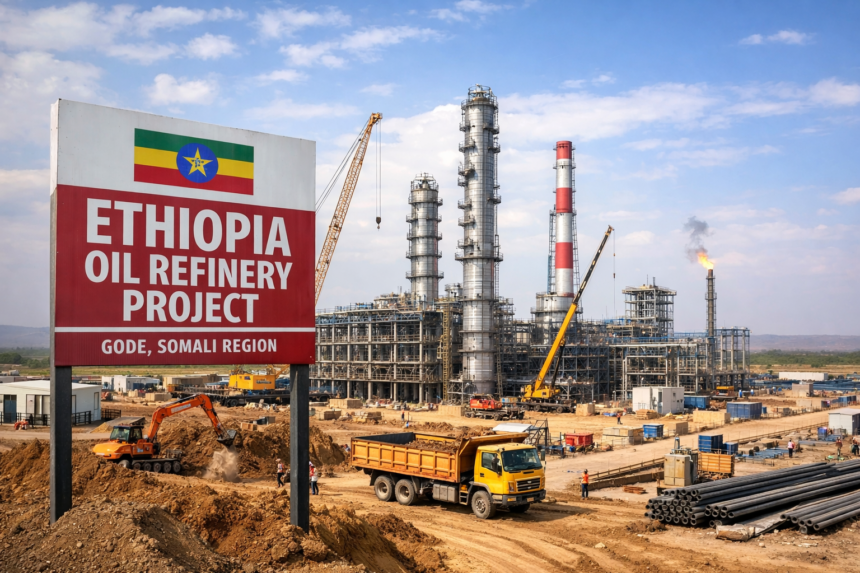
Ethiopia has launched construction of the Ethiopia Oil Refinery Project, a $2.5 billion facility set to become the country’s first oil refinery and a landmark development for its fuel security strategy. The refinery, located in Gode in the Somali Region, is being developed by China’s Golden Concord Group (GCL) and will be built in two phases beginning with core processing infrastructure.
Construction began in late 2025 after government approvals and feasibility work. Officials say the refinery is designed to process crude from domestic fields and will eventually produce 3.5 million tonnes of fuel annually, including diesel and other refined products. Ethiopia currently relies almost entirely on imported petroleum products, an ongoing fiscal and logistical challenge for a country with a fast-growing population, expanding transport sector and rising industrial ambitions.
Analysts argue that even incremental substitution of fuel imports could relieve foreign exchange pressure and reduce exposure to global price volatility. Ethiopia’s energy imports have long been factored into economic forecasts and fiscal planning, making self-sufficiency in refining an important strategic objective. However, officials have not disclosed detailed commissioning timelines, and market observers note that refining projects often encounter technical and financing complexities before full-scale operation.
The launch of the Ethiopia Oil Refinery Project also signals a broader shift in the Horn of Africa’s infrastructure map. For years, the region has depended on international refineries for fuel supply, transported through coastal ports such as Djibouti. The refinery could, once operational, support domestic consumption and potentially supply neighboring markets through existing trade corridors. Ethiopian authorities have indicated downstream distribution networks could later extend eastwards toward Djibouti and Somaliland, although plans remain at an early stage.
GCL’s involvement reflects China’s continued investment across African hydrocarbons and industrial sectors. The group has expanded its footprint in East Africa as part of Beijing’s wider engagement with energy-intensive industries, logistics, and natural resources. Ethiopia has emerged as a favored destination for such partnerships due to its geographic position, labor market, and state-led industrial policies. In parallel, Western energy companies and lenders have shown renewed interest in African downstream integration as demand in advanced economies plateaus.
The refinery project aligns with Ethiopia’s long-term economic strategy to diversify beyond agriculture and leverage large-scale infrastructure to attract manufacturing and logistics investments. It joins other major industrial undertakings—most notably hydropower assets including the Grand Ethiopian Renaissance Dam, fertilizer production plants, and industrial parks aimed at export-oriented manufacturing. Together, these efforts are intended to reduce structural vulnerabilities and build an industrial base capable of absorbing a rapidly expanding workforce.
Global context further underscores the project’s significance. While advanced economies accelerate electrification and renewable deployment, emerging markets continue to record higher oil and fuel consumption due to demographic growth and infrastructure expansion. Africa’s refining deficit—long viewed as a structural bottleneck—has prompted new investment cycles, including Nigeria’s Dangote refinery and Uganda’s planned Kabaale refinery. Ethiopia’s entry into refining follows this trend and adds another node to Africa’s downstream capacity pipeline.
However, the commercial viability of refineries in developing markets has historically depended on feedstock stability, product pricing frameworks, and regional logistics. Ethiopia’s domestic crude output remains limited, and exploration efforts are ongoing. Officials argue that refining local crude could enable value addition and create export potential over time, though industry analysts caution that integrated supply chains will be crucial.
The government has not issued a definitive operational date, and procurement details for technology and engineering services are likely to emerge as construction progresses through 2026. Further clarity on financing structures, public-private arrangements, and regulatory frameworks is also expected. For now, authorities emphasize that reducing fuel import dependency and enhancing energy security remain core motivations.
The launch of the Ethiopia Oil Refinery Project adds momentum to Ethiopia’s industrialization narrative at a time when the Horn of Africa is competing for investment inflows and logistics dominance. If delivered at scale, the refinery could reshape regional fuel markets, strengthen Ethiopia’s external position and improve macroeconomic resilience.
Pumps Africa will continue monitoring developments related to the refinery’s phasing, downstream distribution, financing partners and regulatory environment as the project advances.
Share