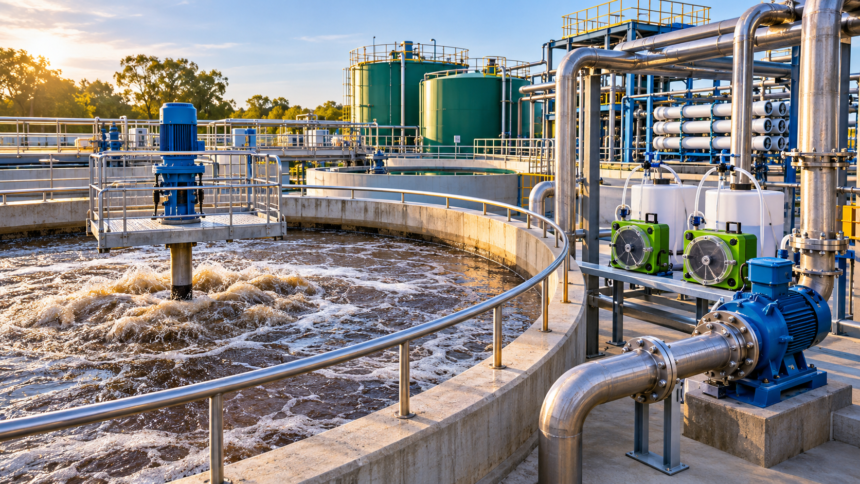
Industrial wastewater management is evolving beyond conventional treatment and discharge. Across manufacturing, mining, food processing and energy production, industries are increasingly exploring ways to recover water, stabilise treatment processes and reduce dependence on freshwater supplies.
- Industrial wastewater: A growing challenge for African industries
- Understanding blending technologies in wastewater treatment
- Technologies driving industrial wastewater blending
- Mechanical mixers and tank agitators
- Pump-driven blending and recirculation
- Static mixers and inline blending
- Automated chemical dosing and process control
- The critical role of industrial pumps
- Integrating blending with advanced wastewater treatment
- Industrial applications across Africa
- Verder Pumps South Africa: Pumping technology in wastewater and process applications
- Designing wastewater systems for reliability
- The African opportunity: Towards more sustainable industrial water use
- Engineering a more water-secure industrial future
Blending technologies are becoming an important part of this transition. By combining controlled wastewater streams, managing variations in effluent quality and integrating treated water into reuse systems, industries can improve treatment reliability and achieve more efficient water management.
However, blending alone does not deliver effective wastewater treatment. Its success depends on the integration of equalisation tanks, industrial pumps, mechanical mixers, chemical dosing systems, filtration technologies and automated process controls.
For African industries operating under growing water-security and environmental pressures, these technologies present an opportunity to transform wastewater from an operational liability into a recoverable resource.
Industrial wastewater: A growing challenge for African industries
Industrial wastewater varies considerably depending on the processes involved. Manufacturing facilities may generate effluent containing oils, chemicals, suspended solids and cleaning agents. Food processors produce wastewater rich in organic matter, fats and nutrients, while mining operations deal with mineral residues, abrasive particles and process chemicals.
These variations make industrial wastewater treatment particularly challenging. A treatment system designed for one wastewater composition may struggle when incoming concentrations, temperatures or flow rates change.
The problem becomes more pronounced in facilities operating continuous production processes. Equipment cleaning, production changes, batch processing and unexpected shutdowns can create sudden variations in wastewater volumes and contaminant concentrations.
Such fluctuations can affect biological treatment, chemical reactions and membrane filtration. They may also increase chemical consumption, accelerate equipment wear and create operational interruptions.
Consequently, industrial wastewater management requires more than installing treatment equipment. Operators must understand wastewater characteristics, anticipate changes and maintain consistent conditions throughout the treatment process.
From wastewater disposal to resource recovery
The traditional approach to industrial wastewater focused primarily on removing contaminants before discharge. Increasingly, however, industries are considering how treated effluent can be recovered and reused.
This shift is particularly relevant to water-stressed African economies. Mining, manufacturing and agricultural processing require substantial water volumes, often in locations where freshwater availability is constrained.
Recovering wastewater for suitable industrial applications can reduce freshwater abstraction and improve operational resilience.
Potential applications include equipment washing, cooling systems, selected production processes and other non-potable requirements. The required treatment quality depends on the intended application.
The International Water Association’s 2026 global trends report highlights the growing importance of separation technologies, membrane filtration, resource recovery and appropriate management of concentrated waste streams in industrial water treatment.
The opportunity is therefore not simply to treat more wastewater. It is to design systems that recover more value from the water already being used.
Understanding blending technologies in wastewater treatment
Blending involves the controlled mixing of two or more liquid streams to achieve a defined treatment or water-quality objective.
In industrial applications, this may involve combining wastewater streams with different pollutant concentrations, mixing chemicals into effluent, recirculating wastewater within equalisation tanks or combining treated water streams to achieve a required process-water specification.
The purpose depends on the treatment stage.
At the beginning of a treatment process, blending helps manage variations in incoming wastewater. During chemical treatment, it promotes uniform distribution of reagents. At the water-recovery stage, blending can help achieve the required quality for specific industrial applications.
It is important to distinguish blending from dilution. Simply adding cleaner water to contaminated effluent does not remove pollutants. Effective wastewater blending must support genuine treatment, process stability or controlled water recovery.
Equalisation: Creating consistent treatment conditions
Flow equalisation is among the most important applications of blending technology.
Industrial wastewater rarely enters treatment facilities at a perfectly consistent rate. Equalisation tanks provide temporary storage, allowing incoming variations to be managed before wastewater moves into subsequent treatment stages.
The United States Environmental Protection Agency identifies equalisation as a means of stabilising both wastewater volume and strength before downstream treatment.
These tanks commonly incorporate mechanical agitators or aeration systems to maintain mixing and prevent suspended solids from settling.
Consider a food-processing facility that generates concentrated wastewater during equipment cleaning. During normal production, the wastewater may have considerably different organic concentrations.
An equalisation tank receives these streams and provides a more consistent feed to the treatment system. This reduces sudden loading variations and helps biological and chemical processes operate under more predictable conditions.
The same principle applies to mining and manufacturing facilities where production schedules influence wastewater generation.
Equalisation does not eliminate pollutants. Instead, it creates more favourable conditions for their subsequent removal.
Blending for chemical conditioning
Chemical treatment requires accurate dosing and effective distribution of reagents.
Coagulants, flocculants, lime, acids and alkalis are commonly used to adjust wastewater characteristics and facilitate contaminant removal.
Coagulation destabilises suspended particles, while flocculation encourages smaller particles to form larger aggregates. These can then be separated through sedimentation or dissolved air flotation.
The mixing requirements differ between the two processes. Coagulation requires effective chemical dispersion, while flocculation generally requires gentler agitation to avoid breaking developing flocs.
Poor chemical distribution can result in inconsistent treatment, excessive reagent consumption and reduced separation efficiency.
This is where mechanical mixers, static mixers and precision dosing pumps become particularly important.
Technologies driving industrial wastewater blending
Modern wastewater blending systems combine mechanical, hydraulic and automated technologies. Equipment selection depends on tank dimensions, flow requirements, fluid properties and the required mixing intensity.
Mechanical mixers and tank agitators
Mechanical mixers use rotating impellers or blades to create movement within wastewater tanks.
Their primary functions include maintaining suspended solids, distributing chemicals and preventing sediment accumulation.
Different impeller designs generate different flow patterns. Axial-flow configurations promote movement along the shaft direction, while radial-flow designs create outward circulation.
In equalisation tanks, appropriate agitation helps maintain more uniform wastewater characteristics.
However, mixing intensity must be carefully controlled. Excessive agitation increases energy consumption and may damage delicate flocs during chemical treatment. Insufficient agitation can create stagnant zones and allow solids to settle.
Pump-driven blending and recirculation
Pumps offer another approach to maintaining uniform wastewater conditions.
Instead of relying exclusively on submerged mechanical mixers, operators can circulate wastewater through external pipework before returning it to the tank.
This arrangement creates hydraulic movement and helps distribute suspended materials and chemicals.
Pump-driven recirculation can be particularly useful in large equalisation tanks or applications where external equipment offers easier maintenance access.
The pump must match the fluid characteristics. Abrasive particles, corrosive chemicals, high viscosity and varying solids concentrations can influence pump performance and component life.
Centrifugal, peristaltic, progressive cavity and diaphragm pumps each have different operating characteristics.
Selecting the correct technology requires evaluating the required flow, pressure, solids-handling capability and chemical compatibility.
Static mixers and inline blending
Static mixers provide continuous mixing without requiring a separate motor-driven agitator.
They contain stationary elements installed inside a pipeline. As wastewater and injected chemicals pass through, these elements repeatedly divide and redirect the flow.
This promotes mixing between the different streams.
Static mixers are useful in chemical dosing lines, pH correction systems and applications requiring continuous blending.
Their performance depends on flow velocity, fluid viscosity and pressure-drop requirements. Engineers must ensure the pumping system can accommodate the additional hydraulic resistance.
Automated chemical dosing and process control
Automated dosing systems regulate the quantity of chemicals introduced into wastewater.
They can respond to flow measurements and signals from pH, conductivity and other process instruments.
This is particularly valuable where wastewater characteristics change throughout the production cycle.
For example, a pH-control system can adjust acid or alkali dosing according to measured conditions. A flow-proportional dosing arrangement can regulate reagent delivery as wastewater volumes change.
Modern metering pumps support this level of control through adjustable output and integration with process automation systems.
The result is more consistent chemical distribution, reduced manual intervention and better control over treatment conditions.
The critical role of industrial pumps
Pumps are central to the operation of industrial wastewater treatment facilities.
They transfer wastewater between treatment stages, circulate liquids within tanks, move sludge and deliver chemicals at controlled rates.
Their performance influences the reliability of the entire installation.
An incorrectly selected pump can cause inconsistent dosing, blockages, excessive wear and unnecessary maintenance. These problems can disrupt treatment processes and increase operating costs.
Industrial wastewater applications require different pumping characteristics.
| Pump technology | Typical wastewater application | Key consideration |
|---|---|---|
| Centrifugal pumps | Wastewater transfer and recirculation | Flow requirements and solids handling |
| Peristaltic pumps | Chemical dosing, abrasive slurries and sludge | Hose compatibility and operating pressure |
| Progressive cavity pumps | Viscous sludge and concentrated wastewater | Stator compatibility and wear |
| Diaphragm pumps | Chemical transfer and dosing | Chemical compatibility and pulsation |
| Submersible pumps | Collection sumps and wastewater transfer | Solids passage and clogging resistance |
Why peristaltic pumps are relevant
Peristaltic pumps are particularly useful in applications involving abrasive, viscous or chemically challenging fluids.
Their operating principle involves compressing and releasing a flexible hose or tube to move the contained liquid.
The pumped medium contacts the hose rather than conventional rotating wetted components. This arrangement can simplify maintenance and reduce exposure of internal pump components to aggressive fluids.
Applications include lime slurry dosing, polymer handling, sludge transfer and chemical metering.
However, hose selection remains critical. Engineers must consider chemical compatibility, temperature, pressure and the abrasive characteristics of the fluid.
Precision dosing and operational efficiency
Accurate chemical dosing is essential for consistent wastewater treatment.
Overdosing can increase operating costs and generate additional sludge. Underdosing can compromise contaminant removal and affect downstream processes.
Metering pumps provide controlled chemical delivery, helping maintain the required treatment conditions.
Their integration with flow meters, pH sensors and automated controllers allows operators to respond to changing wastewater characteristics.
For industrial facilities, the objective is not simply to install a pump with the required capacity. It is to select equipment that delivers reliable performance throughout its operating life.
Integrating blending with advanced wastewater treatment
Blending and equalisation are most effective when incorporated into a wider treatment strategy.
Industrial wastewater facilities commonly combine physical, chemical and biological processes, followed by advanced filtration where required.
Each stage addresses different contaminants.
Primary treatment removes larger solids and separates certain suspended materials. Chemical treatment supports the removal of dissolved and suspended contaminants. Biological treatment uses microorganisms to break down biodegradable organic matter.
Advanced treatment technologies provide additional purification where higher-quality recovered water is required.
Biological treatment
Biological treatment uses microorganisms to break down organic pollutants.
Common technologies include activated sludge systems, sequencing batch reactors and attached-growth biological processes.
These systems require controlled operating conditions to maintain microbial activity.
Sudden changes in organic loading, pH or temperature can affect treatment performance.
Equalisation therefore provides an important buffer, helping stabilise the wastewater entering biological reactors.
Membrane filtration and water recovery
Membrane technologies are increasingly important in industrial water reuse.
Ultrafiltration removes fine suspended solids and certain microorganisms, while reverse osmosis can remove dissolved salts and other contaminants.
The technologies are often combined in integrated treatment trains.
A 2026 study published in the Journal of Water Process Engineering evaluated a flotation-ultrafiltration-reverse osmosis system for industrial laundry wastewater reuse. The research demonstrated the potential to recover water for operational reuse while identifying the importance of managing contaminants in the concentrated reject stream.
Another 2026 study in Case Studies in Chemical and Environmental Engineering examined industrial wastewater reuse through reverse osmosis. It found that feedwater quality and recovery rates influenced membrane performance, fouling and energy consumption.
These findings reinforce the importance of proper pretreatment before wastewater reaches membrane systems.
Blending can also support recovered-water management. For example, appropriately treated ultrafiltration water may be combined with reverse-osmosis permeate to achieve a defined industrial water specification.
The suitability of such an arrangement depends on water-quality testing and the requirements of the receiving process.
Industrial applications across Africa
The benefits of blending technologies extend across several industrial sectors.
Mining and mineral processing
Mining operations generate wastewater containing mineral residues, suspended solids, process chemicals and abrasive particles.
Equalisation helps stabilise wastewater before clarification, thickening and further treatment.
Pumping systems must also handle concentrated slurries and sludge reliably. Peristaltic pumps can be particularly relevant in reagent dosing and certain abrasive slurry applications.
Manufacturing and chemicals
Manufacturing facilities generate wastewater with varying chemical compositions, oils, suspended solids and dissolved contaminants.
Controlled blending and pH adjustment help prepare these streams for chemical treatment and filtration.
Food and beverage processing
Dairy plants, breweries, slaughterhouses and food processors generate wastewater containing fats, proteins and biodegradable organic matter.
Equalisation helps manage variations in organic loading before biological treatment.
Oil, gas and energy
Oil and gas facilities may generate wastewater containing hydrocarbons, dissolved salts, suspended solids and treatment chemicals.
Treatment systems require appropriate separation, chemical conditioning and specialised pumping arrangements.
Across these sectors, the common requirement is consistent process control. The combination of pumps, mixers, dosing systems and monitoring equipment provides the foundation.
Verder Pumps South Africa: Pumping technology in wastewater and process applications
Verder Pumps South Africa provides a practical example of how specialised pumping technologies can address operational challenges associated with industrial wastewater treatment.
One documented application involved a multinational electronics manufacturer operating wastewater treatment facilities across South Korea. The company experienced inconsistent aluminium sulphate dosing, particularly when tank levels were low. Unscheduled maintenance and high operating costs also affected the existing metering pump installation.
Following an assessment, eight Verderflex Rapide R2S peristaltic tube pumps replaced the existing equipment. The pumps operated at flow rates between 78 ml/min and 1,080 ml/min, with discharge pressures of up to 1.5 bar. According to the published case study, the service interval increased from 600 to 1,000 operating hours, reducing maintenance requirements and process downtime. The application demonstrates how pump selection can improve chemical dosing reliability in wastewater treatment operations.
Verder’s pumping technologies also have applications in mining. At large-scale copper flotation plants in the Democratic Republic of Congo, Verder Dura 25 hose pumps have been used for reagent dosing. The company has also highlighted the potential of peristaltic technology in wastewater applications involving flocculants and other treatment chemicals. These applications demonstrate the relevance of robust positive-displacement pumping in demanding industrial processes.
The company’s wider portfolio includes peristaltic, diaphragm and other industrial pumping technologies for different fluid-handling requirements.
For African industrial operators, these examples underline an important engineering consideration: pump selection should account for fluid characteristics, dosing accuracy, maintenance requirements and total lifecycle costs, rather than purchase price alone.
Designing wastewater systems for reliability
Successful wastewater management begins with understanding the wastewater itself.
Before selecting pumps, mixers or treatment equipment, operators should establish the characteristics of each incoming stream.
This includes flow rates, pollutant concentrations, solids content, pH, temperature and variations associated with production schedules.
These measurements inform equalisation capacity, chemical requirements and the selection of downstream treatment technologies.
Several considerations are particularly important:
- Hydraulic flexibility: Systems should accommodate production-related variations in wastewater volumes.
- Chemical compatibility: Pumps, hoses, seals and pipework must withstand the chemicals being handled.
- Dosing accuracy: Chemical metering equipment should provide consistent delivery under actual operating conditions.
- Mixing efficiency: Agitation should prevent settling without excessive energy consumption.
- Maintenance accessibility: Equipment should allow straightforward inspection and replacement of wearing components.
- Monitoring and automation: Flow, pH, turbidity and conductivity measurements should support appropriate process adjustments.
- Energy efficiency: Pumping and mixing systems should be evaluated against overall operating requirements.
Sludge and concentrate management must also form part of the design. Water recovery does not eliminate the need to manage the contaminants separated during treatment.
An effective installation therefore requires coordination between process engineers, environmental specialists, equipment suppliers and plant operators.
The African opportunity: Towards more sustainable industrial water use
Africa’s industrial expansion will increase demand for reliable water infrastructure.
Mining, manufacturing, agriculture and energy production all depend on water availability. In water-stressed regions, wastewater recovery offers an opportunity to reduce pressure on freshwater sources.
Blending technologies provide a practical component of this transition.
They allow operators to manage variations in wastewater quality, improve chemical treatment and prepare water for appropriate reuse applications.
The commercial opportunity also extends to equipment suppliers and engineering companies. Demand for reliable pumps, dosing systems, mixers, membranes and automation technologies is likely to remain important as industries modernise their water-management infrastructure.
For African operators, the investment decision should consider the complete treatment system rather than individual equipment purchases.
The objective is to achieve reliable treatment, manageable operating costs and water quality appropriate for the intended use.
Engineering a more water-secure industrial future
Industrial wastewater management is becoming a strategic consideration for African industries.
The combination of blending, equalisation, precision dosing and advanced treatment technologies offers a pathway towards more reliable operations and improved water recovery.
However, successful implementation depends on integrating the right equipment and processes. Pumps, mixers, dosing systems and monitoring technologies must work together to maintain consistent treatment conditions.
As industries face increasing pressure to manage water resources responsibly, wastewater treatment will become more than an environmental compliance requirement. It will increasingly form part of production efficiency, operational resilience and long-term industrial competitiveness.
For the African pump and water-treatment industry, this presents an important opportunity to support the transition towards more efficient, sustainable and water-secure industrial operations.