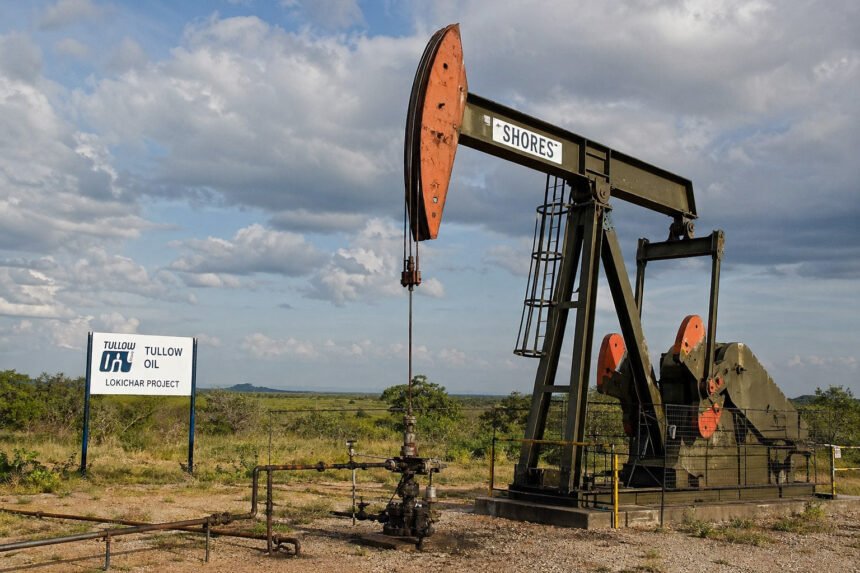
Kenya has officially broken ground on the long-awaited Lokichar Oil Project in Turkana County, marking the country’s transition from oil exploration to commercial production after nearly a decade and a half of delays.
The groundbreaking ceremony, held on April 24, 2026, at the Amosing site in Turkana East, sets in motion a development that will see Kenya export its first crude oil by the first week of December 2026, with first revenue expected in February 2027.
Energy and Petroleum Cabinet Secretary Opiyo Wandayi presided over the ceremony, joined by EAC and ASALs CS Beatrice Askul, Turkana Deputy Governor Dr. John Erus, Senator James Ekomwa, MPs Nicholas Ngikor and John Ariko, former Governor Josephat Nanok, and other local leaders.
“This marks renewed momentum by President William Ruto’s administration in leveraging natural resources for national development and shared prosperity,” Wandayi told the gathering.
From Discovery to Commercial Reality
Oil was first discovered in Kenya’s South Lokichar Basin in 2012 by Tullow Oil. However, the project faced years of delays related to commercial agreements, land acquisition disputes, security concerns, and infrastructure challenges.
The breakthrough came in September 2025, when Gulf Energy acquired Tullow Oil’s assets in the region for $120 million (Sh15.5 billion) . The government has since approved a comprehensive Field Development Plan (FDP) that charts the path to commercial production.
Key Project Milestones
The Lokichar Oil Project will be operated by Gulf Energy following its acquisition of Tullow Oil’s assets. Under the government-approved Field Development Plan, Phase One production is targeted at 20,000 barrels per day between 2026 and 2032. Phase Two will see production ramp up to 50,000 barrels per day from 2032 onward.
First crude oil export is scheduled for the first week of December 2026, with first revenue expected in February 2027. In the first year of operation alone, up to 43 wells are planned to be drilled. Over the life of the project, depending on global oil prices, the government projects potential earnings between $1.05 billion and $2.9 billion.
Gulf Energy Secures US$15 Million Drilling Rig to Fast-Track Kenya’s First Oil
What This Means for Pumps and Fluid Handling
For the pumps, valves, and fluid handling industry, the Lokichar project translates into immediate and significant procurement opportunities.
Phase 1 Pumping Requirements for 2026 to 2027
For well pad to central processing facility operations, an estimated 10 to 15 multiphase screw pumps will be required. For crude export via truck loading, approximately 4 to 6 high-flow API 610 centrifugal pumps are needed. Water injection for reservoir pressure maintenance will require 8 to 12 multistage barrel pumps rated between 300 and 500 bar. Chemical dosing for flow assurance calls for 15 to 20 diaphragm metering pumps. Additionally, remote field operations will need 5 to 8 solar-hybrid pumping skids designed for off-grid deployment.
Technical Considerations
Lokichar crude is known to be waxy with high viscosity and a high pour point. This presents specific engineering challenges that pump suppliers must address.
First, suppliers must provide heated pumping systems or heat tracing to maintain flow, as waxy crude can solidify at lower temperatures. Second, equipment must have remote operation capability to function reliably in arid Turkana terrain, where ambient temperatures frequently exceed 40 degrees Celsius. Third, corrosion-resistant materials are essential for long-term reliability in the region’s harsh conditions. Finally, all equipment must comply with API 610, API 674, and ISO 13709 standards, which are the industry benchmarks for petroleum, petrochemical, and natural gas industry pumping equipment.
Beyond Pumps: Ancillary Infrastructure
The Lokichar development will also drive demand for several categories of ancillary fluid handling equipment.
Storage tanks will be required, along with associated transfer pumps and vapour recovery units to minimise emissions. Metering skids for custody transfer at wellheads and truck loading points are another critical need, ensuring accurate measurement of crude oil for both operational and royalty purposes. Valves of various types – including ball valves, gate valves, and pressure relief valves – will be needed across the production chain. Finally, leak detection systems are essential for environmental protection in the ecologically sensitive Turkana region.
Local Content and Revenue Sharing
Turkana County Deputy Governor Dr. John Erus announced the formation of an all-inclusive committee to hold structured talks with Gulf Energy on revenue sharing.
Discussions will cover taxes, fees, and charges on land surface, county services, environment, and waste management. The talks will also address economic opportunities, infrastructure development, and environmental protection, as well as local employment and business procurement targets to ensure that Turkana residents benefit directly from the oil wealth beneath their land.
Land Acquisition Progress
The National Land Commission (NLC) , led by Chairperson Dr. Abdillahi Alawy, has engaged with the Kapese community regarding compulsory land acquisition for the project. NLC officials visited the area in mid-April to listen to residents’ concerns and assure them that their issues will be addressed through proper legal channels and fair compensation.
Security Operations
The government has initiated a security operation to address insecurity concerns in the Turkana region, which has been cited as a major challenge facing the project. Improved security is expected to facilitate smooth operations, protect infrastructure assets, and create a stable environment for both local communities and project workers.
Economic Impact and Projections
The Lokichar Oil Project is expected to deliver significant economic benefits to Kenya.
Direct employment will be created for hundreds of Kenyans during construction and operations phases. Local procurement of goods and services from Turkana County businesses will generate secondary economic activity. Government revenues will flow through taxes, royalties, and profit-sharing arrangements. Additionally, foreign exchange earnings from crude oil exports will help stabilise Kenya’s balance of payments and reduce pressure on the Kenyan shilling.
Depending on global oil prices, the government projects potential earnings between $1.05 billion and $2.9 billion over the life of the project.
Challenges Ahead
Despite the groundbreaking, significant challenges remain on the path to full commercial production.
Security in Turkana remains a concern, though a government operation has been initiated to address this issue. Land acquisition is progressing, with the NLC actively engaging affected communities. Export infrastructure, however, remains a major constraint – the project is currently truck-dependent, as a pipeline has not yet been funded or constructed. Finally, global oil price volatility remains largely beyond Kenya’s control and could affect the project’s profitability over time.
The absence of a pipeline from Lokichar to the coast means that early production will be transported by truck – a less efficient and more expensive option with higher environmental risks. A pipeline remains a long-term aspiration that will require substantial investment and, potentially, regional cooperation with neighbouring countries.
What This Means for Pump Suppliers
Pump manufacturers and distributors looking to participate in Kenya’s oil sector should take several immediate steps.
First, pre-qualify with Gulf Energy without delay, as the operator is already evaluating potential suppliers for Phase 1 equipment. Second, establish local service capacity in Nairobi or Lodwar by the third quarter of 2026 to provide maintenance and technical support. Third, register with Kenya Pipeline Company for future tenders by the fourth quarter of 2026. Finally, develop technical proposals specifically tailored for pumping waxy crude in remote, high-temperature environments.
Looking Ahead
Key dates for the industry diary include December 2026, when first crude oil export from Lokichar is scheduled, followed by February 2027, when first revenue from crude sales is expected. During 2027 to 2028, potential pipeline feasibility studies may commence if funding and regional agreements are secured. Finally, 2032 marks the planned Phase 2 production ramp-up to 50,000 barrels per day.
After 14 years of waiting, Kenya has finally broken ground on its first commercial oil project. The Lokichar development positions the country as East Africa’s newest crude oil producer and opens a new frontier for the pumps and fluid handling industry.
For suppliers with the right technical capabilities – particularly in handling waxy crude in remote, harsh environments – the opportunity is substantial. The next step is not more announcements, but tenders, contracts, and the steady work of building Kenya’s oil future.