Kenya’s water utilities are losing nearly half of all treated piped water before it reaches paying consumers, draining an estimated $106 million annually (Sh13.7 billion) through leakages, theft and systemic inefficiencies, new sector data shows. The crisis, highlighted in the latest regulatory assessments and recent industry reports, raises serious concerns for investment in pumps, networks and sustainable water services across the country.
Non-revenue water surges to 48 percent
Kenya’s non-revenue water (NRW) – the difference between water produced and the volume that is actually billed and paid for – has risen to about 48 percent, up from roughly 44 percent in previous reporting cycles. In practical terms, almost one out of every two litres of treated water pumped into distribution networks never generates income for utilities.
The trend is captured in WASREB’s Impact 18 performance report for the 2024/2025 period, which warns that rising NRW is undermining financial sustainability and slowing progress towards universal water coverage. Earlier assessments had already flagged high NRW levels – averaging 43–45 percent nationally and translating to more than $77–$85 million (Sh10–11 billion) in lost value each year – but the new figures confirm that the problem is deepening rather than improving.
~$106 million in water lost every year
New analyses accompanying the regulator’s report estimate that Kenya’s water providers are losing water worth about $106 million (Sh13.7 billion) annually through a combination of physical and commercial losses. One recent breakdown suggests that around 242 million cubic metres of treated water disappear each year, either leaking underground, flowing through illegal connections or ending up as unbilled consumption.
These findings build on earlier government disclosures indicating that utilities were already losing about 195 million cubic metres of water annually, valued at roughly $78 million (Sh10.2 billion), due to NRW. Taken together, the data shows that water firms are producing, treating and pumping very large volumes, but only about 52–57 percent of this water is converted into revenue that can fund operations, maintenance and future investments. The financial hole created by NRW directly affects the sector’s ability to upgrade infrastructure and extend services to underserved communities.
How Kenya is losing its water – and its revenue
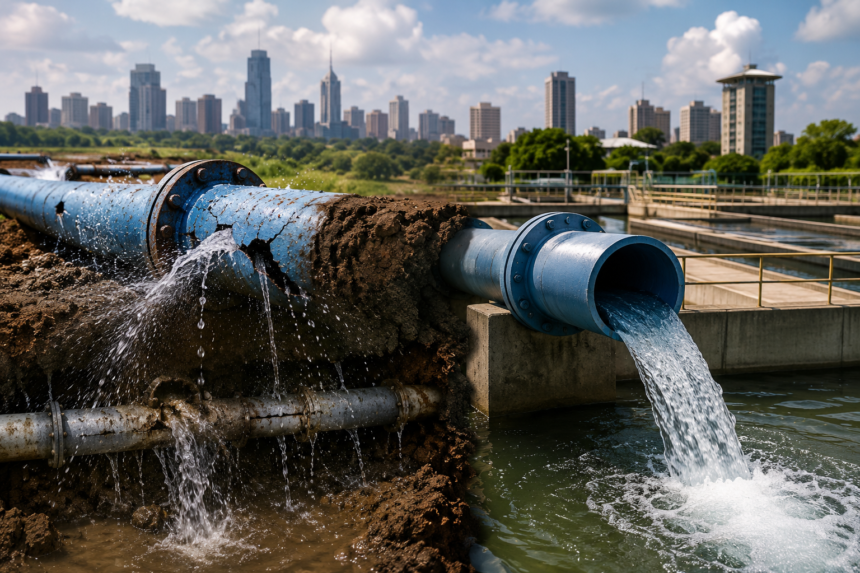
Regulators and sector experts point to a combination of physical and commercial drivers behind the surging NRW. Physically, ageing and poorly maintained pipelines result in frequent bursts and underground leakages that are often difficult and costly to detect, isolate and repair. In fast‑growing urban areas, overloaded and overstretched distribution lines further increase pressure on already fragile systems.
Commercial losses are just as significant. Illegal connections and outright theft divert substantial volumes of treated water away from metered, paying customers, while tampered or inaccurate meters distort consumption records. Unmetered public and institutional consumption widens the gap even further, and weaknesses in billing and revenue collection mean that some water that is metered is never fully paid for.
WASREB notes that Kenya’s NRW level is far above the international good‑practice benchmark of roughly 20 percent, highlighting an entrenched efficiency and governance challenge in the water services value chain. For utilities, every cubic metre of non‑revenue water represents not only the physical loss of water but also sunk costs in energy, treatment chemicals and labour that cannot be recovered through tariffs.
Pressure on utilities and pump infrastructure
The financial haemorrhage caused by NRW has direct implications for investment in pumping systems, network upgrades and technology solutions that companies in the pump and water technology space provide. With nearly half of their potential income lost, many utilities are struggling to allocate adequate budgets for replacing old pumps and motors, installing variable speed drives, or undertaking large‑scale pipe rehabilitation and district metering projects.
In several counties, sector data indicates that more than half of the water put into the system is lost, further weakening the business case for expanding coverage or adopting higher‑efficiency pumping technologies. Utilities, in effect, are paying for electricity to pump water they never sell, inflating operating costs and complicating efforts to keep tariffs affordable while still financing capital expenditure. This dynamic poses a strategic challenge for pump manufacturers, distributors and service providers that rely on robust project pipelines in municipal and utility markets.
Demand for technology-driven NRW solutions
At the same time, the growing attention on NRW is creating fresh opportunities for technology-driven solutions across the water value chain. The push to reduce losses is expected to fuel demand for advanced pumping systems with better efficiency and control, as well as smart metering, pressure management and leak detection technologies.
Industry stakeholders are already convening around these themes. The upcoming Kenya Conference on Non‑Revenue Water Management 2026, for instance, is centred on improving NRW management by leveraging technology, data and innovation. For suppliers of pumps, valves, meters and automation systems, such platforms offer a chance to demonstrate how integrated solutions – from high‑efficiency pumps to intelligent network monitoring – can help utilities bring NRW closer to global benchmarks.
Calls for policy, governance and investment reforms
Government agencies and regulators are now urging a coordinated response that couples technical upgrades with stronger governance. The Ministry of Water has underscored the need to modernise distribution infrastructure, including systematic replacement of old pipelines, improved pressure management and wider deployment of leak detection programmes. At the same time, utilities are being encouraged to adopt performance‑based management approaches that tie executive incentives to NRW reduction.
On the policy front, WASREB’s Impact 18 report calls for utilities to clamp down on illegal connections, regularise unmetered consumption and tighten billing and collection practices to protect hard‑won revenue. Parallel efforts to safeguard catchment areas and protect water sources are also seen as vital, as environmental degradation threatens long‑term water availability and adds further complexity to service delivery.
For the wider pump and water technology industry, the message is clear: unless Kenya’s water providers can plug the leaks and recover lost revenue, capital budgets for new equipment will remain under pressure. Yet, by partnering with utilities on targeted investments in efficient pumping, smart metering and network optimisation, the sector can play a decisive role in turning the tide on $106 million in annual losses and in building more resilient water systems across the country.