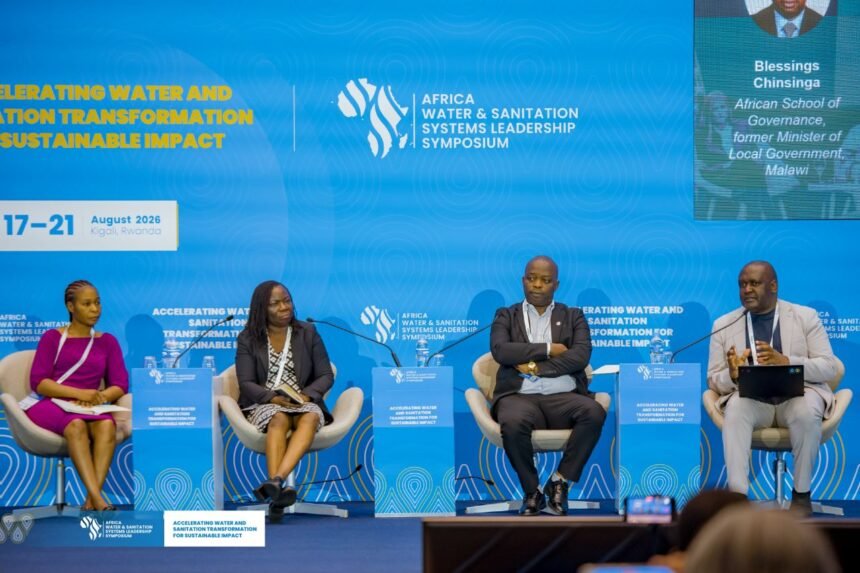
Water utility reform has become a global credibility test, from the ageing pipe networks of Western Europe to the drought-stressed grids of the American Southwest. In Africa, that test now has a name and a date: the Kigali Communiqué on Systems Transformation, adopted by acclamation on 20 August 2026 at the close of the Africa Water and Sanitation Systems Leadership Symposium.
- What the Kigali Communiqué Says — and Why It Matters
- Three Registers of Commitment
- 1. What the Sector Must Do for Itself
- 2. What Governments Must Decide
- 3. What the Continent Carries Forward
- From Kigali to Abu Dhabi: A Hundred-Day Countdown
- Impact on the Pumps and Water Infrastructure Sector
- Youth Recognition and the Road to Benin 2028
Held at the Kigali Convention Centre from 17 to 21 August, and jointly convened by the African Union, the African Ministers’ Council on Water (AMCOW) and the Government of Rwanda, the symposium brought together political leaders, mayors, regulators, utility executives, financiers, researchers, civil society organisations and young water professionals from across the continent. Its closing act marks a deliberate shift from dialogue to a measurable, time-bound reform agenda — one with direct implications for the pumps, water infrastructure and utility sectors that Pumps Africa readers operate in daily.
What the Kigali Communiqué Says — and Why It Matters
Harsen Nyambe, Director of Blue Economy and Sustainable Environment at the African Union Commission, read the Communiqué to the plenary. Its starting point is blunt: 418 million people across the continent still lack basic drinking water, and 779 million lack basic sanitation.
The text is equally blunt about causes. It cites findings from the International High-Level Panel on Water Investments for Africa, which estimates that better sector governance alone could unlock roughly USD 11.5 billion a year, with a further USD 17.5 billion available through domestic resource mobilisation — a combined figure approaching USD 29 billion annually. In other words, the gap is not, first, a capital gap. It is a governance and performance gap, and that reframing is the Communiqué’s central move.
That framing echoes what Rwandan Prime Minister Dr Justin Nsengiyumva told delegates at the symposium’s opening two days earlier: that building infrastructure “is important, but in large measure it is only the beginning.” He urged participants to make their commitments specific and measurable, warning that the gathering’s success should be judged not by the declaration itself, but by the changes in institutions, decisions and services delivered once delegates return home.
Three Registers of Commitment
The Communiqué is structured deliberately across three levels of responsibility, moving from the operational floor to the continental stage.
1. What the Sector Must Do for Itself
At the operational level, service providers commit to publishing operational and financial performance data and to cutting non-revenue water — the water lost to leaks, theft and poor metering that quietly drains utility revenue across the continent. Regulators are called on to extend oversight into rural, small-town and small-scale operators, the segment where regulatory reach has historically been weakest. Professional bodies are tasked with making certification of water sector staff a functioning reality rather than a formality, and the sector as a whole commits to documenting its reform experience honestly — including the reforms that failed.
2. What Governments Must Decide
At the national level, governments are called on to domesticate the Africa Water Vision 2063 and Policy into their own legal and budgetary frameworks, treating water as a strategic economic asset rather than a sectoral cost. The Kigali Communiqué pushes for tariff and subsidy reform that is financially sustainable without abandoning social fairness, recognising that viable utilities need predictable revenue for operations, maintenance and asset replacement. It also asks governments to finance sanitation directly — treating faecal sludge, wastewater and their by-products as recoverable assets with genuine resource-recovery and circular-economy value, rather than waste to be managed away.
3. What the Continent Carries Forward
At the continental level, the African Union Commission and AMCOW commit to working with member states across four pillars: leadership, regulation and accountability, professionalisation, and strategic public finance. Progress will be tracked and reported through the Water and Sanitation Sector Monitoring and Reporting System (WASSMO), AMCOW’s continent-wide platform for evaluating water and sanitation performance against national and continental commitments.
Crucially, the Kigali Communiqué also commits Africa to building a common negotiating position ahead of two major international moments: the UN Water Conference in Abu Dhabi this December, and the 11th World Water Forum in Riyadh in 2027.
From Kigali to Abu Dhabi: A Hundred-Day Countdown
Closing the symposium on behalf of the host government, Gemma Maniraruta, Director General for Water and Sanitation at Rwanda’s Ministry of Infrastructure, thanked delegates, organisers and volunteers — and reminded the hall that adoption is not the finish line.
“In a little more than a hundred days, Africa arrives at the United Nations Water Conference in Abu Dhabi, and what was decided in these rooms should reach that conference as one coordinated African position, carrying an investment-ready pipeline rather than a list of intentions,” she said.
That sentence carries the real stakes of Kigali. A communiqué is only as strong as the pipeline of bankable projects and coordinated positions that follows it. Utilities in Kenya, South Africa, Ghana, Zambia, DRC and Namibia — the same markets where Pumps Africa’s readership operates — now have a continental deadline to work toward: December 2026.
Impact on the Pumps and Water Infrastructure Sector
For utility executives and equipment suppliers, the Kigali Communiqué is not a distant diplomatic exercise — it points directly at capital and operating decisions already on the table.
The commitment to cutting non-revenue water is the clearest signal. Every cubic metre of water lost after abstraction, treatment and pumping represents wasted energy, wasted pumping capacity and wasted operating expenditure. Delivering on that commitment will require sustained investment in network monitoring, pressure management, leak detection, accurate metering, pump system efficiency, automation and predictive maintenance — precisely the technologies and services the pumps industry supplies. Reducing commercial losses, through better customer databases, billing systems and meter accuracy, will matter just as much as fixing physical leaks.
The Communiqué’s insistence that regulatory oversight extend to small-town and rural operators also signals where the next wave of formalisation — and procurement — is likely to happen, as smaller schemes are brought under governance frameworks that previously left them informal. And its call to finance sanitation and treat wastewater by-products as assets opens a growing opportunity in reuse, resource recovery and circular-economy applications, alongside conventional treatment infrastructure.
The broader policy shift underpinning all of this is significant: water is increasingly being positioned as a strategic economic asset, not merely a social service or sectoral cost. Reliable water systems underpin agriculture, mining, manufacturing, energy production, urban development and public health — sectors where failures ripple far beyond the water utility itself, and where Pumps Africa’s coverage of pumps, mining and energy infrastructure intersects directly with this agenda.
Youth Recognition and the Road to Benin 2028
Beyond the policy text, the symposium’s closing session honoured young innovators through its Youth Awards, underscoring a recurring theme of the week: that systems transformation depends on the next generation of water professionals, not only on ministers and regulators.
Delegates also welcomed an offer from the Republic of Benin to host the next edition of the Symposium in 2028, giving the continent a fixed point to measure progress against the commitments made in Kigali.
Pumps Africa will track implementation of the Kigali Communiqué’s commitments across East and Southern African utilities in the lead-up to the UN Water Conference in Abu Dhabi. Subscribe to our newsletter for continued coverage of water sector governance, non-revenue water reduction, and infrastructure investment across the continent.