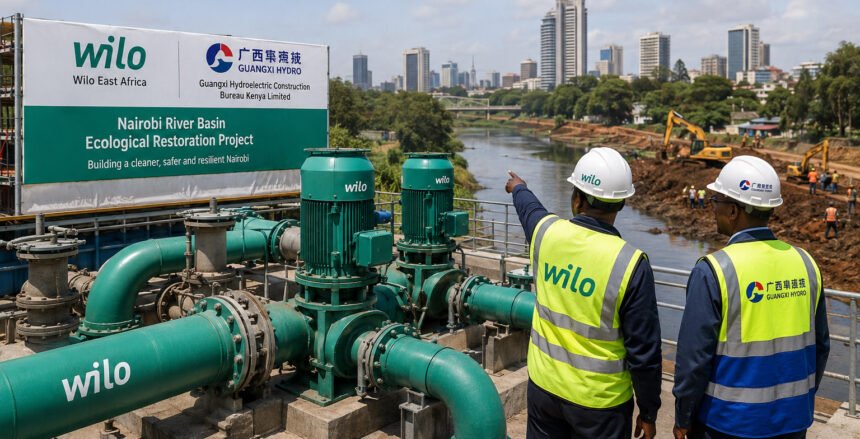
The Nairobi River Basin Ecological Restoration Project has secured a key infrastructure boost following the signing of an early-phase pump supply agreement between Wilo Group’s East Africa division and Guangxi Hydroelectric Construction Bureau Kenya Limited.
- Nairobi River Basin restoration gains momentum
- A shift toward integrated urban water solutions
- Wastewater infrastructure remains a critical gap
- Economic case for water investment
- Pump technology central to urban resilience
- Regional infrastructure partnerships expanding
- Growing demand for sustainable urban infrastructure
- Outlook for African cities
The agreement supports early-stage implementation of one of Kenya’s most ambitious integrated urban water and ecological restoration initiatives.
The project focuses on improving wastewater infrastructure, strengthening flood management capacity, and restoring degraded ecological systems along the Nairobi River Basin.
According to Belete A. Matebe, the initiative reflects the growing urgency to address urban water stress across Africa.
Nairobi River Basin restoration gains momentum
The Nairobi River Basin Ecological Restoration Project is expected to play a central role in improving sanitation systems, reducing flood risks, and restoring ecological balance along Nairobi’s river corridors.
The Nairobi River has for years been affected by:
- Untreated wastewater discharge
- Industrial effluent inflows
- Solid waste accumulation
Matebe emphasized that these challenges are not unique to Kenya but reflect a broader continental issue affecting rapidly urbanizing cities.
“Across Africa, over 80% of wastewater is discharged untreated, while rapid urbanization expected to double by 2050 continues to intensify pressure on urban rivers,” said Matebe.
He added that polluted waterways, recurring flooding, and associated economic losses are increasingly making river restoration projects critical infrastructure investments rather than optional environmental interventions.
A shift toward integrated urban water solutions
Matebe described the Nairobi River Basin project as part of a wider continental transition toward resilient and integrated water infrastructure systems.
“I am pleased to share Wilo East Africa’s signing of a supply agreement of pumps on early phase with Guangxi Hydroelectric Construction Bureau Kenya Limited for the Nairobi River Basin Ecological Restoration Project,” he said.
He noted that the initiative aligns with similar urban river rehabilitation programs across the region, including Ethiopia’s Addis Ababa River Park development.
These projects highlight a growing recognition that urban rivers can no longer be treated as waste channels but must be restored as functional ecological and social assets.
Wastewater infrastructure remains a critical gap
Wastewater management remains one of Africa’s most pressing infrastructure challenges.
In many cities, limited treatment capacity and incomplete sewer networks mean that large volumes of wastewater still flow untreated into natural waterways.
At the same time, rapid urban expansion continues to strain drainage systems, increasing flood vulnerability in densely populated areas.
Industry stakeholders increasingly view river restoration initiatives as long-term investments that combine environmental recovery with economic and public health benefits.
Economic case for water investment
The economic justification for investing in water and sanitation infrastructure remains strong.
Matebe referenced findings from the WHO and UN-Water, which indicate that investments in water and sanitation can generate significant economic returns.
“Projects like this go beyond environmental impact. They deliver measurable economic value,” Matebe said, citing WHO and UN-Water findings.
He noted that improved water systems reduce healthcare costs, enhance productivity, and reduce flood-related economic losses, reinforcing the importance of sustained infrastructure investment.
Pump technology central to urban resilience
Pump systems are expected to play a critical role in supporting wastewater transport, flood control, and water movement across the project area.
Matebe highlighted the importance of energy-efficient and reliable pumping technologies in addressing Africa’s evolving urban infrastructure needs.
“At Wilo East Africa, we strongly believe that smart and energy-efficient pumping technologies, backed by strong local availability, technical expertise, and reliable aftersales support, will play a critical role in supporting Africa’s growing wastewater, flood control, and urban infrastructure needs,” he said.
The company continues to collaborate with engineering, procurement, and construction (EPC) contractors, utilities, consultants, and wastewater solution providers across East Africa.
Regional infrastructure partnerships expanding
Wilo Group has been expanding its footprint across East Africa, with operations spanning Kenya, Ethiopia, Tanzania, Uganda, Rwanda, Burundi, South Sudan, Djibouti, Somalia, and Eritrea.
Its regional strategy emphasizes:
- Local stockholding of equipment
- Rapid technical response support
- Partnerships with EPC contractors and utilities
- Sustainable water infrastructure solutions
The Nairobi River Basin project adds to the company’s growing portfolio of infrastructure collaborations in the region.
Growing demand for sustainable urban infrastructure
Across Africa, governments and city authorities are increasingly prioritizing river rehabilitation, climate resilience, and improved urban water systems.
The Nairobi River Basin Ecological Restoration Project reflects this shift toward integrated planning approaches that combine:
- Wastewater management
- Flood mitigation
- Ecological restoration
Experts emphasize that successful river restoration requires coordinated investment across multiple infrastructure layers, including treatment systems, drainage networks, and pumping stations.
For Kenya, the Nairobi River initiative represents a key test case for large-scale ecological restoration in a rapidly expanding capital city.
Outlook for African cities
Matebe noted that such initiatives will shape the future of urban development across the continent.
“Africa’s future cities will be defined by resilient water systems, efficient wastewater management, and restored ecosystems,” he said.
As implementation progresses, the project is expected to attract increased interest from infrastructure developers, utilities, environmental agencies, and water technology providers seeking scalable urban water solutions.
The Nairobi River Basin Ecological Restoration Project marks a significant step in addressing Nairobi’s long-standing water and environmental challenges.
With early-phase pump supply now secured, the project moves closer to full-scale implementation, reinforcing the role of technology partnerships in advancing Africa’s urban water resilience agenda.