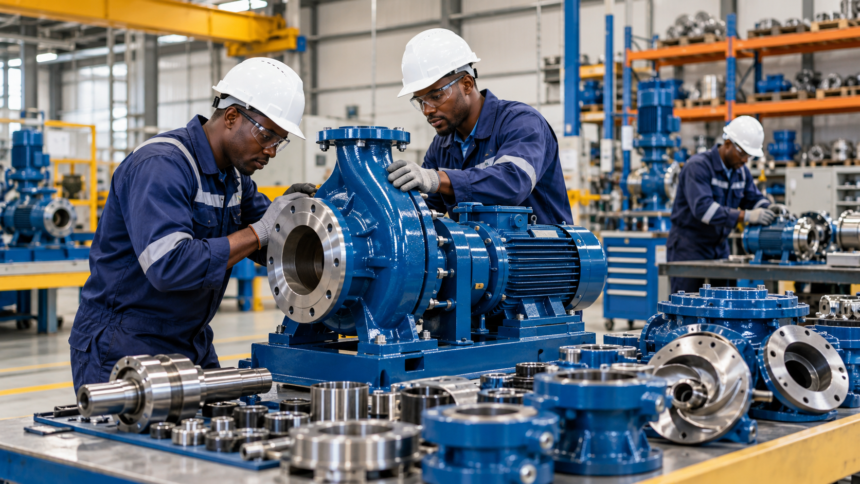
Uganda’s National Water and Sewerage Corporation (NWSC) has asked Danish pump manufacturer Grundfos to explore local pump assembly and spare-parts manufacturing with National Enterprise Corporation (NEC).
The proposed partnership could reduce dependence on imported components, shorten maintenance delays and strengthen Uganda’s industrial capabilities. Furthermore, NWSC sees potential for locally manufactured pump components to serve water utilities across East Africa and other African markets.
NWSC Managing Director Dr Eng. Silver Mugisha presented the proposal during meetings with Grundfos executives. The discussions took place alongside the International Water Association (IWA) World Water Congress and Exhibition in Glasgow, Scotland, held from 4 to 8 October 2026.
According to reports, Mugisha highlighted NWSC’s reliance on imported spare parts for its pumping equipment. Consequently, international procurement and shipping delays can complicate maintenance when critical components are unavailable.
He proposed that NEC collaborate with Grundfos to assemble pump components and manufacture spare parts locally. This arrangement could improve component availability while creating a potential regional supply base for water utilities.
Local Pump Manufacturing Could Reduce Maintenance Delays
Reliable access to genuine spare parts is essential for municipal water-supply operations. Pump failures can disrupt maintenance schedules and threaten service continuity when replacement components take too long to arrive.
Local assembly and authorised spare-parts production could help address these challenges. In particular, shorter supply chains could improve inventory responsiveness and reduce dependence on overseas shipments.
Moreover, the proposed arrangement could support technical training and create opportunities for skilled employment. Developing local engineering capabilities could also strengthen Uganda’s broader industrial manufacturing base.
However, these benefits would depend on the partnership’s technical and commercial feasibility. The proposed facilities would need appropriate equipment, skilled personnel and reliable access to essential components.
Grundfos Asked to Assess Energy-Efficient Pumping Solutions
The discussions reportedly extended beyond spare-parts manufacturing. NWSC also asked Grundfos to assess its hydraulic systems and explore energy-efficient pumping solutions suited to the utility’s operations.
Pumping systems account for a significant share of the energy used in water abstraction, treatment and distribution. Therefore, improving pump efficiency could help utilities manage electricity consumption and operating costs.
A hydraulic assessment could identify opportunities to optimise pump selection, system configuration and operating conditions. However, the potential savings would depend on the condition and performance of NWSC’s existing infrastructure.
NWSC also raised the possibility of collaboration around prepaid water metering technology. Such cooperation could complement wider efforts to improve water management and operational efficiency.
Nevertheless, the proposed activities remain subject to further discussions and technical evaluation. Grundfos has not announced a manufacturing investment, joint venture agreement or production schedule.
NEC Could Provide an Industrial Platform in Uganda
NEC operates as the commercial arm of Uganda’s Ministry of Defence and Veteran Affairs and the Uganda People’s Defence Forces. Its activities span several sectors, including engineering, construction, manufacturing and industrial services.
These capabilities could provide a potential foundation for discussions about local pump assembly. However, the parties have not publicly identified the specific NEC facilities or technical resources that would support the initiative.
The partners would also need to define their respective responsibilities. These could include manufacturing processes, equipment investment, component sourcing, quality assurance and after-sales support.
Furthermore, pump production requires strict technical controls. Components used in municipal water systems must meet appropriate performance and reliability requirements, particularly where equipment operates continuously.
Any manufacturing arrangement would therefore need to address intellectual-property licensing, product specifications and technical training. It would also require a clear commercial model to support sustainable production.
Regional Opportunities for African Water Utilities
If the discussions lead to a formal agreement, Uganda could develop a locally supported supply channel for approved pump components and related services.
For NWSC, the immediate priority would be more reliable access to spare parts. Meanwhile, regional water utilities could potentially benefit from shorter delivery times and improved access to technical support.
Local production could also create opportunities to retain more industrial value within Uganda. Additionally, a regional customer base could help support production volumes and improve the commercial viability of manufacturing.
However, these outcomes are not guaranteed. The initiative would need competitive pricing, consistent product quality and sufficient demand from utilities and other industrial customers.
Grundfos’ engineering expertise and NEC’s industrial capabilities could complement each other. Yet the extent of that collaboration will depend on the final agreement and the resources committed by each party.
Manufacturing Partnership Still at the Proposal Stage
The NWSC proposal highlights an opportunity to connect water infrastructure management with local industrial development. Nevertheless, the discussions have not yet resulted in a confirmed manufacturing partnership.
The next important milestones would include a feasibility assessment, a defined product scope and clarity on investment requirements. A memorandum of understanding or formal agreement could also establish the framework for further cooperation.
Ultimately, local pump assembly and spare-parts manufacturing could strengthen equipment availability and technical capacity in Uganda. If the initiative proves commercially viable, it could also support a broader regional supply network for African water utilities.
For now, the key question is whether Grundfos and NEC will advance the proposal into a concrete manufacturing programme. Their next announcements should clarify the project’s scope, investment commitments and potential implementation timeline.