Africa’s growing demand for reliable water is driving investment in groundwater infrastructure. Across rural communities, farms, institutions, property developments and industries, boreholes are becoming an important source of water.
- Why Submersible Borehole Pumps Matter in Africa
- 1. Franklin Electric Borehole Pump Systems
- 2. Grundfos SQ, SQFlex and SP Pumps
- 3. LORENTZ Solar Submersible Pumps
- 4. Pedrollo Submersible Pumps
- 5. Ebara Submersible Pumps
- 6. Dayliff and Davis & Shirtliff Borehole Pumps
- 7. SuperPump and Regional Pump Supply Networks
- Solar Pumping Is Changing Borehole Water Supply
- Frequently Asked Questions
- What is a submersible borehole pump?
- How do we choose the right
- submersible borehole pump?
- Are solar borehole pumps suitable for Africa?
- Is a deeper borehole always more difficult to pump?
- Why is local technical support important?
- What is the most important pump-sizing parameter?
- Industry Takeaway
However, drilling a borehole is only the beginning. The system needs a correctly selected pump, motor, power source, controls, rising main and storage solution.
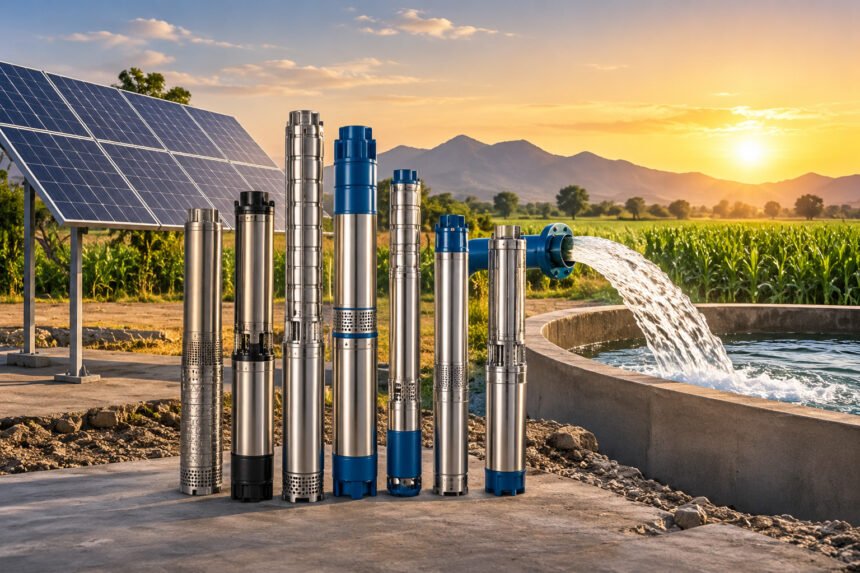
At the centre of this system is the submersible borehole pump.
Installed below the water level, the pump lifts groundwater through a rising main and delivers it to a storage tank, irrigation network, water-treatment plant or distribution system. The right pump can provide dependable service for years, while a poorly selected system can create excessive energy costs, frequent failures and expensive maintenance.
We examine seven submersible borehole pump options and supply categories relevant to Africa, while highlighting the engineering factors that should guide pump selection.
Why Submersible Borehole Pumps Matter in Africa
Borehole systems are increasingly important where conventional water infrastructure cannot consistently meet demand.
They support drinking-water supply, livestock production, irrigation, commercial developments, schools, healthcare facilities, hospitality businesses and industrial operations.
The source material notes that boreholes can become long-lived infrastructure assets, with one global analysis estimating average utilisation of approximately 35 years. Actual service life depends on hydrogeological conditions, design, operation and maintenance.
This makes pump selection an asset-management decision rather than simply a purchasing decision.
We need to consider the complete system.
That means looking at borehole yield, water levels, required flow, total dynamic head, energy supply, water quality, operating hours, controls, storage and after-sales support.
1. Franklin Electric Borehole Pump Systems
Franklin Electric is one of the established names in deep-well pumping, particularly for applications requiring robust motors and multi-stage submersible pumps.
Its portfolio covers a broad range of applications, with the source material identifying capacities reaching up to 478 cubic metres per hour and heads of up to 700 metres. This provides coverage across domestic, agricultural, commercial and municipal applications.
The Franklin SVM range is particularly relevant to demanding borehole installations.
Stainless-steel construction and rewindable motor options can be valuable in deep installations where pump removal is difficult and expensive.
For African projects, durability becomes particularly important when technicians, spare parts and lifting equipment are not immediately available.
2. Grundfos SQ, SQFlex and SP Pumps
Grundfos offers several borehole-pumping solutions, including the SQ and SQFlex ranges for smaller water-supply and solar applications and the SP range for higher-capacity installations.
The company’s approach places strong emphasis on energy efficiency, system guidance and digital support.
These characteristics are increasingly relevant as operators move beyond initial purchase price and consider total lifecycle cost.
Solar-compatible pumping is also becoming important for rural water supply and productive-use applications.
The SQ range, for example, has been highlighted for compact borehole applications, including three-inch configurations suitable for certain water-supply and irrigation requirements.
3. LORENTZ Solar Submersible Pumps
LORENTZ has a strong association with solar-powered water pumping.
Its systems are particularly relevant in off-grid applications involving drinking water, livestock watering and irrigation.
A solar borehole system can operate without depending entirely on grid electricity or diesel generators. This can be particularly useful in remote locations where electricity infrastructure is limited or unreliable.
However, solar pumping still requires careful engineering.
We need to match the solar array, pump duty point, borehole yield and water demand.
Storage is also important because solar generation varies throughout the day.
A properly designed system can therefore pump water during periods of strong solar generation and store it for later use.
4. Pedrollo Submersible Pumps
Pedrollo is another familiar name across African pump markets.
Its submersible products are used across domestic, commercial and agricultural applications.
For property developments, schools, lodges, farms and smaller irrigation schemes, availability through established distributors can be an important consideration.
However, brand recognition should never replace engineering calculations.
We must establish the actual pump duty point before selecting the equipment.
This includes the required flow rate, static water level, drawdown, discharge elevation, pipe losses and operating hours.
A pump that is readily available but incorrectly sized can perform poorly even when the equipment itself is technically sound.
5. Ebara Submersible Pumps
Ebara has an established presence in the wider water-pumping sector and offers stainless-steel submersible solutions for commercial, industrial and municipal applications.
Material selection becomes particularly important where water contains corrosive elements or other contaminants that can affect pump components.
For larger installations, we should evaluate the pump as part of a complete system.
This includes:
- Motor protection
- Dry-run protection
- Level controls
- Electrical protection
- Rising-main sizing
- Storage capacity
- Water-quality requirements
- Maintenance access
This approach helps prevent a common mistake: selecting a pump independently of the infrastructure around it.
6. Dayliff and Davis & Shirtliff Borehole Pumps
For East African projects, Dayliff products distributed through Davis & Shirtliff represent an important part of the borehole-pumping market.
Local availability can be a major advantage.
A borehole pump may require technical assessment, installation support, replacement parts or fault diagnosis during its operating life.
We therefore need to consider the supplier’s ability to provide these services.
The source material identifies brands including Dayliff, Pedrollo, Grundfos, Delan and Aico among products available in Kenya’s active borehole market.
For farms, homes, institutions and water kiosks, access to technical support can be as important as the pump’s nameplate specifications.
7. SuperPump and Regional Pump Supply Networks
Across Southern Africa, SuperPump and other regional suppliers form part of the broader network supporting borehole, agricultural, industrial and general pumping applications.
For contractors and asset owners, regional supply networks can make a significant difference.
We should assess whether the supplier can provide:
- Correct pump sizing
- Motors
- Cables
- Control panels
- Protection equipment
- Replacement components
- Installation support
- Qualified technicians
- Warranty assistance
A lower initial quotation does not necessarily represent lower lifecycle cost.
If a replacement motor or qualified technician is difficult to obtain, downtime can quickly become more expensive than the original equipment saving.
Solar Pumping Is Changing Borehole Water Supply
Solar-powered borehole pumps are changing how water infrastructure is designed in remote African locations.
A typical system uses photovoltaic panels to power a pump that transfers groundwater into a storage tank. The stored water can then be distributed when solar generation falls.
This approach can reduce dependence on diesel fuel.
Research cited in the source material has also found that solar pumping can achieve lower pumping costs per cubic metre than diesel in suitable remote applications. One assessment estimated US$0.40 per cubic metre for solar compared with US$0.61 for diesel. These figures should not be treated as universal benchmarks because actual economics vary according to system size, fuel prices, financing, solar resources, demand and maintenance.
For many projects, storage can be more practical than installing large battery systems.
We can pump when solar generation is strong and store the water for later consumption.
Frequently Asked Questions
What is a submersible borehole pump?
A submersible borehole pump is installed below the water level inside a borehole. It lifts groundwater through a rising pipe to a storage tank, distribution network, irrigation system or other point of use.
How do we choose the right
submersible borehole pump?
We should begin with the borehole yield, static water level, drawdown, required flow, total dynamic head, water quality, power source and operating requirements.
Are solar borehole pumps suitable for Africa?
Solar pumping can be particularly suitable for remote areas where grid electricity is unavailable or unreliable. System performance depends on correct sizing of the pump, solar array, borehole and storage system.
Is a deeper borehole always more difficult to pump?
Not necessarily. Pump selection depends on the actual pumping water level, required flow, total dynamic head, borehole yield and system design rather than depth alone.
Why is local technical support important?
Local support provides access to installation expertise, troubleshooting, spare parts and maintenance. This can significantly reduce downtime when a borehole system develops a fault.
What is the most important pump-sizing parameter?
There is no single parameter that determines pump selection. Flow rate and Total Dynamic Head, together with borehole yield and operating conditions, are fundamental to selecting a suitable pump.
Industry Takeaway
The future of water access will require more than drilling additional boreholes.
We need efficient pumping systems that are correctly engineered, energy-conscious, durable and serviceable.
For Africa’s communities, farms, institutions and industries, the value of a borehole ultimately depends on how reliably the complete system can deliver water.
The right pump is therefore not simply the pump that can lift water. It is the pump that can deliver the required water, at the required pressure, using the available energy, for the required operating life.