

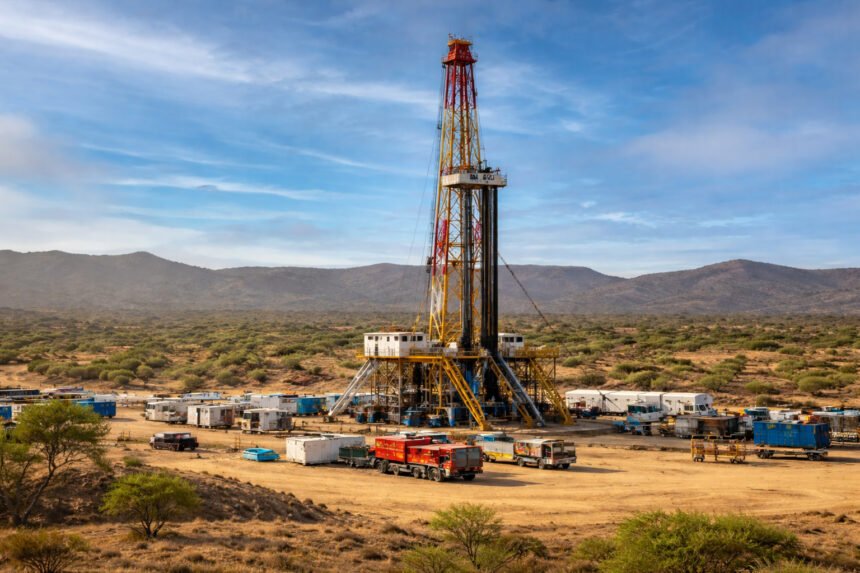
Gulf Energy E&P BV has secured a US$15 million onshore drilling rig in a decisive move to accelerate development of the South Lokichar oil project in Turkana County.
The acquisition marks one of the most significant upstream investments by a Kenyan-owned operator in recent years. It signals renewed momentum toward commercial oil production.
Rig Contracted from Great Wall Drilling Company
The company confirmed that it has contracted the GW70 land drilling rig from Great Wall Drilling Company under a long-term lease agreement.
The rig will be mobilised from the United Arab Emirates to Kenya in the coming months. Arrival at the Port of Mombasa is expected by June.
Commissioning and inspection processes will follow before drilling operations commence in the third quarter of 2026.
Industry analysts describe the GW70 as a modern, high-capacity onshore rig suited for medium-depth wells. It has previously operated in the Middle East under strict safety standards.
Advancing the South Lokichar Project
The drilling campaign will focus on Blocks T6 and T7 within the South Lokichar Basin.
Gulf Energy acquired the assets following the exit of Tullow Oil from Kenya’s upstream sector. The transition placed responsibility for delivering Kenya’s first commercial oil squarely on the local operator.
The South Lokichar project has faced delays over the past decade. These delays stemmed from funding gaps, infrastructure challenges, and investor uncertainty.
However, securing a drilling rig addresses one of the largest operational bottlenecks.
Without a confirmed rig, field development timelines would remain uncertain. Therefore, the lease agreement provides clarity to contractors, financiers, and regulators.
Commitment to Deliver First Oil
Gulf Energy has publicly committed to achieving first oil by 1 December 2026, subject to final regulatory approvals.
Chairman Francis Njogu described the rig contract as a milestone that demonstrates readiness to move from planning to execution.
Energy sector experts note that drilling activity will validate reservoir performance assumptions. It will also support early production system design.
Meanwhile, the government views the project as a strategic economic pillar.
Kenya has long sought to diversify its energy mix and reduce reliance on imported petroleum products. Commercial production from Turkana could strengthen foreign exchange earnings.
Economic and Industry Impact
The South Lokichar development is projected to require billions of dollars in total investment over its lifecycle.
If executed successfully, it could generate substantial government revenue through royalties, taxes, and profit-sharing mechanisms.
Beyond fiscal returns, the project promises wider industrial benefits.
Local engineering firms, transport operators, fabrication yards, and oilfield service providers are expected to benefit from increased activity.
The drilling phase alone will create direct and indirect employment opportunities in logistics, catering, security, and technical services.
Importantly, Gulf Energy stated that the agreement includes provisions for technical collaboration and skills transfer. This aspect could strengthen Kenya’s domestic oil and gas expertise.
Infrastructure and Logistics Considerations
Mobilising a land rig from the UAE to Turkana presents logistical complexity.
Heavy equipment components must be transported by sea to Mombasa, then hauled overland to northern Kenya.
Road upgrades and security coordination will be essential to ensure safe transit.
Previous early oil pilot schemes highlighted the importance of robust logistics planning.
Therefore, coordination between national government agencies and county authorities will be critical.
Market Context
Global demand for land drilling rigs has tightened in recent years. Increased upstream activity in the Middle East and North America has reduced available capacity.
Securing the GW70 ahead of peak demand demonstrates proactive planning.
Energy analysts say this move could shield the project from further scheduling disruptions.
At the same time, crude oil price volatility remains a factor. Sustained global price stability will be necessary to maintain investor confidence.
However, long-term energy demand forecasts for Africa remain strong.
What It Means for East Africa’s Oil Sector
Kenya’s progress toward commercial oil production could influence broader East African exploration sentiment.
Uganda is advancing its Tilenga and Kingfisher projects, while Tanzania continues offshore gas development.
If Gulf Energy succeeds, it will reinforce confidence in indigenous operators managing complex upstream assets.
This development also signals a shift from foreign-dominated exploration toward stronger local participation.
For suppliers in the pumps, valves, and rotating equipment sectors, drilling and production phases create opportunities for fluid handling systems, water management solutions, and process infrastructure.
The Road Ahead
Despite the positive momentum, challenges remain.
Financing full field development will require sustained capital flows. Infrastructure such as pipelines and export facilities must also be finalised.
Environmental and community engagement processes will continue to shape project timelines.
Nevertheless, securing the US$15 million drilling rig represents a concrete step forward.
After years of stalled expectations, tangible field activity is set to resume in Turkana.
For Kenya’s oil ambitions, the countdown to first oil has entered a decisive phase.