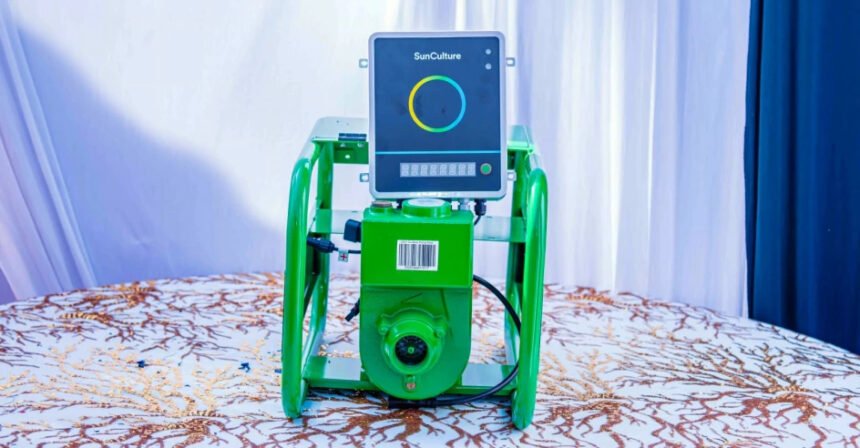
SunCulture has upgraded its Hydromax Solar Surface Pump, increasing its maximum water delivery capacity to 9,800 litres per hour (L/h). The revised system retains a maximum head of 20 metres and delivers approximately three times the output of the company’s legacy SR1 model.
- Higher pumping capacity targets smallholder irrigation
- Solar technology and protection features
- CSD2 controller introduces PAYG financing
- Solar pumping offers an alternative to diesel-powered irrigation
- Implications for agricultural water management in East Africa
- Technical specifications: SunCulture Hydromax Solar Surface Pump
- A move towards commercially accessible solar irrigation
The upgrade targets smallholder farmers using shallow water sources, including rivers, ponds and other accessible surface-water supplies. It combines higher pumping capacity with solar power, integrated protection features and a new CSD2 pay-as-you-go (PAYG) controller.
The development highlights the growing role of solar-powered pumping in agricultural water management across Kenya and the wider East African market. It also reflects increasing efforts to address the energy and financing barriers that limit irrigation adoption among small-scale farmers.
By increasing hydraulic output while incorporating flexible payment arrangements, SunCulture is positioning the Hydromax for broader commercial deployment beyond earlier pilot applications.
Higher pumping capacity targets smallholder irrigation
The upgraded Hydromax delivers up to 9,800 L/h, representing a substantial increase over the previous SR1 configuration.
Its maximum head of 20 metres makes it suitable for applications involving the movement of water from relatively shallow sources to agricultural fields. These include river abstraction, pond-based irrigation and other surface-water applications.
The higher flow rate could help farmers reduce the time required to transfer water to irrigation systems. This is particularly relevant for vegetable production, orchards and other crops requiring regular water application.
The pump is designed around two 360 W foldable solar panels, providing a combined installed solar capacity of 720 W.
This configuration allows the system to operate without depending on grid electricity or continuous diesel supply. It is particularly relevant in rural agricultural areas where electricity infrastructure remains limited or unreliable.
However, actual pumping output will depend on operating conditions. Solar irradiance, suction conditions, pipe diameter, friction losses and the required delivery head all influence system performance.
The stated maximum flow rate and maximum head should therefore be understood as equipment performance limits rather than necessarily simultaneous operating conditions.
Solar technology and protection features
The Hydromax incorporates maximum power point tracking (MPPT) technology to optimise the electrical power harvested from its solar panels.
MPPT adjusts the operating point of the solar array to maximise available power under changing sunlight conditions. This can improve energy utilisation as solar irradiance and panel operating temperatures fluctuate.
The system also incorporates dry-run protection. This feature helps protect the pump against damage when water availability becomes insufficient or the source runs dry.
Another protection feature is reverse-polarity protection, which reduces the risk of electrical damage resulting from incorrect wiring connections during installation or maintenance.
These features address important operational considerations for solar pumping equipment deployed in agricultural environments.
In remote farming locations, equipment reliability and ease of operation can influence the long-term viability of irrigation investments. Protection mechanisms can help reduce avoidable equipment failures and maintenance requirements.
The foldable solar panel configuration also offers potential practical advantages for transportation and field deployment, particularly where pumping equipment must be installed at different locations.
CSD2 controller introduces PAYG financing
A significant element of the upgrade is the introduction of SunCulture’s CSD2 controller, which supports its pay-as-you-go financing model.
The controller integrates payment-linked access controls into the pumping system. This enables farmers to access equipment through instalment-based arrangements rather than meeting the entire purchase cost upfront.
The approach addresses one of the major barriers to mechanised irrigation adoption: the initial investment required to acquire pumping equipment and supporting infrastructure.
For smallholder farmers operating with seasonal or irregular agricultural incomes, spreading equipment payments over time can make irrigation technology more accessible.
The PAYG model also represents an alternative equipment financing approach for agricultural technology providers seeking to expand their customer base.
Beyond the initial purchase, the commercial success of such systems will depend on affordability, financing terms, after-sales support and the reliability of payment and control infrastructure.
For the Hydromax, the integration of higher pumping capacity with PAYG financing brings together two important requirements for smallholder irrigation: productive water delivery and accessible equipment ownership.
Solar pumping offers an alternative to diesel-powered irrigation
Diesel-powered pumps remain widely used in agricultural areas where grid electricity is unavailable. However, their operating economics can be affected by fuel prices, transportation costs and routine maintenance.
Solar-powered pumping offers an alternative by using renewable energy to meet water delivery requirements during suitable sunlight conditions.
For farmers with accessible surface-water sources, solar surface pumps can reduce dependence on purchased fuel and provide greater flexibility in managing irrigation operations.
The economic benefits, however, depend on the complete pumping system. Farmers must consider the cost of installation, water distribution infrastructure, maintenance and any financing obligations.
System sizing is also important. A pump delivering higher volumes is not automatically suitable for every farm. Water requirements, irrigation methods, crop selection and available water resources must inform equipment selection.
For installers, irrigation dealers and agricultural water specialists, the Hydromax upgrade adds another option in the shallow-source, higher-flow solar pumping segment.
Implications for agricultural water management in East Africa
Agricultural productivity across East Africa remains closely linked to access to reliable water supplies. Dependence on rainfall exposes farmers to seasonal variations and increasingly unpredictable weather patterns.
Irrigation can help farmers manage water availability more effectively, support crop diversification and improve production planning.
However, the adoption of irrigation technologies among smallholder farmers remains influenced by several factors. These include equipment affordability, access to water, energy costs, technical support and the availability of appropriate distribution infrastructure.
SunCulture’s Hydromax development addresses some of these challenges through a combination of solar energy, increased pumping capacity and PAYG financing.
Its focus on shallow water sources is particularly relevant to farming communities with access to rivers and ponds but limited electricity infrastructure.
The upgrade also signals opportunities for suppliers of solar pumping equipment, irrigation systems and associated water management technologies in the regional market.
For the wider pumping industry, developments such as the Hydromax illustrate how equipment manufacturers and technology providers are increasingly combining hydraulic performance with digital controls and alternative financing models.
As solar irrigation expands, the ability to deliver reliable equipment, suitable technical support and commercially viable financing will remain important determinants of adoption.
Technical specifications: SunCulture Hydromax Solar Surface Pump
| Specification | Details |
|---|---|
| Maximum flow rate | 9,800 L/h |
| Maximum head | 20 metres |
| Solar array | Two 360 W foldable panels |
| Total solar capacity | 720 W |
| Controller | CSD2 PAYG controller |
| Power optimisation | Maximum power point tracking (MPPT) |
| Protection features | Dry-run and reverse-polarity protection |
| Water sources | Shallow sources, including rivers and ponds |
| Previous model comparison | Approximately 3x the legacy SR1 output |
| Target market | Smallholder irrigation |
A move towards commercially accessible solar irrigation
The Hydromax upgrade reflects a broader shift towards integrating renewable energy, pumping technology and flexible financing in agricultural applications.
For SunCulture, increasing the pump’s output to 9,800 L/h while retaining its 20-metre maximum head expands its offering for farmers seeking alternatives to conventional fuel-powered pumping.
The addition of the CSD2 PAYG controller also places equipment financing at the centre of the product’s commercial proposition.
Ultimately, the technology’s market impact will depend on its performance under actual field conditions, affordability and the availability of dependable technical support.
Nevertheless, the combination of higher water delivery capacity and payment flexibility highlights the potential of solar-powered surface pumps to support irrigation development among smallholder farmers in Kenya and across East Africa.