Kenya has commenced development drilling in the South Lokichar Basin, marking a major milestone towards commercial crude oil production. Gulf Energy is targeting first oil by December 1, with initial output expected to exceed 20,000 barrels per day.
Kenya has moved closer to becoming an oil-producing nation following the commencement of development drilling in Turkana County. The operation marks a transition from years of exploration and project preparation towards commercial production.
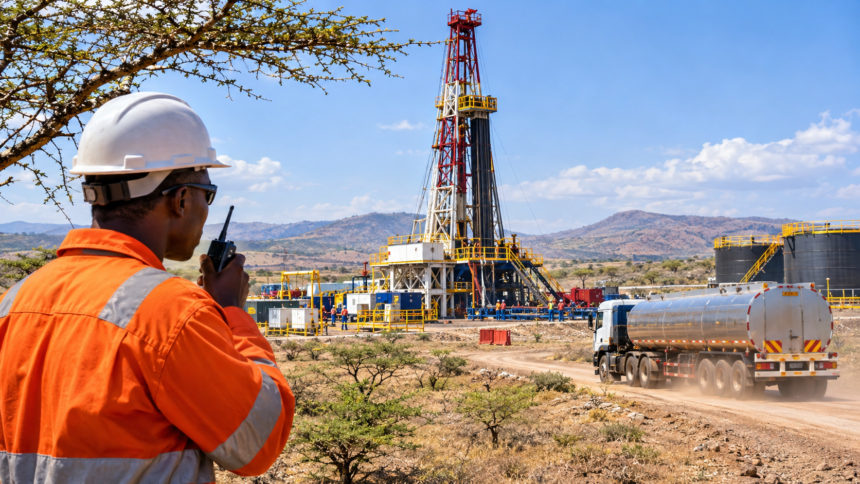
The drilling programme began on November 20, 2026, with the spudding of the Amosing 1 well pad in the South Lokichar Basin. Gulf Energy E&P BV SEZ is leading the development, with the government targeting the first crude oil production on December 1.
Energy and Petroleum Cabinet Secretary Opiyo Wandayi presided over the ceremony at the Amosing 1 and 2 oilfields. Spudding refers to the commencement of drilling operations on a new well.
Wandayi described the milestone as a significant achievement, noting that Kenya had waited more than 14 years since the discovery of crude oil in 2012.
South Lokichar development targets four oilfields
The initial development programme covers four fields: Ngamia, Amosing, Twiga and Ekales, collectively known as NEAT.
Gulf Energy plans to achieve initial production exceeding 20,000 barrels per day (bpd). A subsequent development phase is expected to increase production capacity to approximately 50,000 bpd.
The wider project encompasses six oil discoveries across Blocks T6 and T7. These resources are being developed under Production Sharing Contracts between Gulf Energy and the national government.
The State Department for Petroleum and the Energy and Petroleum Regulatory Authority (EPRA) provide government oversight.
The estimated recoverable resource stands at 326 million stock-tank barrels across the two blocks over a 25-year contract period.
Road transportation to support initial crude deliveries
Kenya will initially rely on road transportation to move crude oil from Turkana to Mombasa.
The crude will be transported by specialised tanker trucks to storage facilities at Kenya Petroleum Refineries Limited’s tank farms. President William Ruto is expected to flag off the first crude-carrying trucks during the first week of December.
This approach provides an initial transportation arrangement as the country advances its oil production and export programme.
However, the physical properties of Kenya’s crude present specific handling requirements.
The oil is classified as light-to-medium, sweet and paraffinic, with an API gravity of approximately 30.5 degrees. Its relatively high wax content creates potential flow assurance challenges, particularly when temperatures fall below its wax appearance point.
Maintaining suitable operating temperatures and managing crude viscosity will therefore be important during storage and transportation.
The crude is expected to be priced against the Dated Brent benchmark, exposing potential export revenues to movements in international oil markets.
Baker Hughes and SLB among key technology suppliers
The South Lokichar development brings together international oilfield service providers and drilling technology suppliers.
Gulf Energy has engaged Baker Hughes to provide integrated well services. SLB will supply the Early Production Facility (EPF), which will support the initial production operations.
The project also utilises the GW70 onshore drilling rig, leased from China’s Great Wall Drilling Company.
These partnerships bring together drilling expertise, well services and production-processing capabilities required to advance the development.
The first development phase forms part of a field development plan valued at approximately KSh 6 billion, according to the Energy Ministry’s account of the ceremony. Separately, broader reporting has placed the wider South Lokichar development programme at approximately US$6 billion.
Beyond the oilfield facilities, the government is investing more than KSh 24 billion in infrastructure across the oil-producing region. Transport Cabinet Secretary Davis Chirchir said the investment includes road projects intended to support petroleum operations and improve regional connectivity.
Kenya anticipates billions in potential oil revenues
The government estimates that the development could generate more than US$2.9 billion, equivalent to approximately KSh 371 billion, in lifetime earnings.
Realising this potential will depend on sustained production, operating efficiency, development expenditure, transportation costs and international crude prices.
Petroleum Principal Secretary Kello Harsama has indicated that Kenya is targeting its first crude export cargo in March 2027.
Nevertheless, the transition to commercial production involves more than establishing drilling and processing capacity.
Community representatives have raised concerns about compensation for land acquisition, local employment opportunities, access to procurement contracts and the distribution of economic benefits.
The transportation arrangements and independent verification of production volumes also remain important considerations.
Gulf Energy says it has installed a production-monitoring system that will allow the national government, Turkana County and EPRA to access operational records for verification and auditing.
New opportunities for Africa’s oilfield equipment and pumping sector
Kenya’s entry into commercial crude production could create opportunities across the regional petroleum supply chain.
The development introduces demand for specialised equipment and services covering drilling, artificial lift where required, fluid handling, crude transfer, storage and production monitoring.
Pumping systems will be particularly important in supporting fluid movement between production facilities, processing equipment and storage infrastructure.
The waxy characteristics of Kenya’s crude also place greater emphasis on flow assurance. Appropriate pumping technologies, temperature management and pipeline or transfer-system design will be essential considerations as production volumes increase.
For oilfield service companies, equipment manufacturers and engineering contractors, the South Lokichar development presents an emerging market for specialised solutions.
The immediate operational challenge is whether Gulf Energy can achieve the December 1 first-oil target and sustain production above 20,000 bpd.
The longer-term test will be the project’s ability to maintain efficient production, manage crude transportation and establish a commercially viable export operation.