Perhaps most importantly, AI helps the industry tackle growing technical challenges, such as complex reservoirs, increased requirements for optimal well placement, and the need for improved operational efficiency. The integration of data from multiple sources and disciplines trains our AI models and allows for more holistic, system-level optimization.
AI in Oil Pipeline Management
AI is revolutionizing oil pipeline management by enhancing safety, efficiency, and maintenance through real-time monitoring, predictive analytics, and automated inspection. Key uses include detecting leaks using AI-powered fiber optics, predicting corrosion to enable proactive maintenance, and optimizing flow rates. These technologies reduce downtime, prevent environmental disasters, and cut operational costs. Oil and gas pipeline networks require constant monitoring and inspections to prevent costly incidents. It’s an integral part of pipeline integrity management. Specialized equipment and techniques evaluate leaks, structural integrity, and the overall pipeline network health.
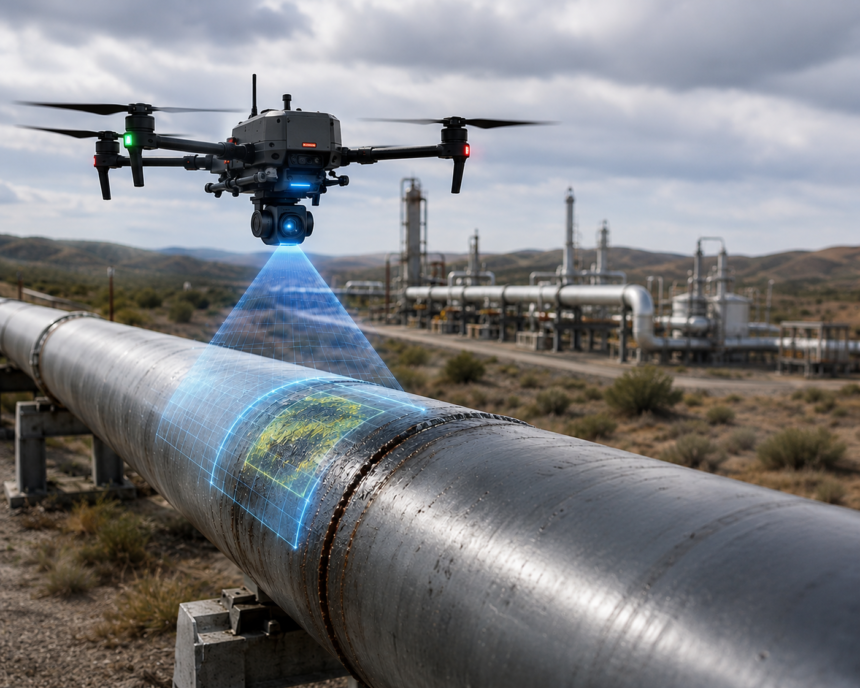
Pipeline inspection is typically done via visual methods or non-destructive testing (NDT) techniques like ultrasonic testing. AI can boost visual inspection using machine vision. Pipeline images and videos are captured by camera nodes, drones, or CCTV and analyzed using ML or deep learning algorithms.
The continuous monitoring of pipeline networks ensures that the computer vision models identify flaws. Deep learning algorithms like recurrent convolutional neural networks (R-CNN) can build models for such assessments. ML algorithms can also be used to analyze data using NDT techniques. Oil and gas companies can use historical data and operational benchmarks to inspect pipelines using AI-based models.
Additionally, when assembling oil and gas pipelines, AI-powered visual systems can inspect the pipeline network on a scale. AI can augment conventional visual methods to identify problems humans cannot perceive quickly. The use of AI boosts inspection rates and reduces costs while increasing defect detection rates.
AI-Powered Defect Detection
Pipeline defects mainly develop due to mechanical damage from different forces, leading to cracks, dents, and perforations. Delayed rehabilitation of these defects can result in environmental disasters, economic losses, and compromise human safety. For instance, the US lost $7.7 billion between 2005 and 2020 due to leaks.
Physical inspection, IoT sensors, ultrasound waves, and fiber optic cables are some ways operators detect defects. AI and ML algorithms can analyze data streams from these methods to determine anomalies in flow rate or physical changes at the leak site. SVM and genetic algorithms (GA) can be used to develop early leak detection systems in pipelines.
Traditional gas leak detection methodologies, such as optical gas imaging, are capital-intensive and demand human resources. However, computer vision techniques like convolutional neural networks can analyze images and quickly determine pipeline defects.
For instance, the National Energy Technology Lab in the US has developed an AI-powered smart leak detection solution to pinpoint defects. The system is capable of identifying leaks before significant damage occurs. Previously, gas utility companies used inspectors who used handheld devices to detect leaks.
Predictive Maintenance
Maintenance strategies in the oil and gas sector have evolved, allowing companies to draw maximum life from their equipment, minimize repair work, and avoid unplanned production downtimes. According to Puranik, an oil and gas analyst at GlobalData, a day-long unplanned pipeline outage can cost a company a million dollars. Corrosion, weld failure, excavation damage, old age, and natural force damage are some of the issues that cause pipeline malfunction.
AI-driven predictive modeling accurately forecasts pipeline failures, allowing midstream companies to take proactive maintenance measures. Advanced sensors collect real-time data such as flow rates, temperature, pressure, and vibration levels. ML and deep learning algorithms such as regression, neural networks, and classification analyze this data to detect anomalies and deviations from set operational benchmarks.
These predictive models constantly monitor the pipeline’s health, indicating potential points of failure and their severity. Additionally, by combining historical and telemetric data, predictive models can forecast the remaining useful life of different pipeline sections and components. With this information, operators can proactively schedule maintenance using data-driven decisions.
AI-Powered Corrosion Analysis
Corrosion is a naturally occurring process that arises from the interaction of the pipeline and corrosive elements in oil and gas. However, unchecked corrosion leads to pipe degradation, resulting in unplanned operational disruptions, safety issues, environmental damage, and valuable product loss. It’s estimated that corrosion causes 15% to 25% of pipeline incidents. For instance, in the US alone, pipeline corrosion cost companies $1.4 billion annually.
Corrosion assessment methods include ultrasonic testing (UT), radiographic testing, and in-line inspection (ILI) tools. These techniques and tools detect pipeline conditions and collect data such as corrosion levels, pressure, and temperature. However, they are carried out periodically and often fail to provide timely and accurate corrosion data.
AI and ML can be harnessed to analyze historical and data collected through these assessments. Some of the algorithms that can be used for this analysis include support vector machines (SVM), neural networks, and regression analysis. The overall effect is that companies can effectively analyze data, identify patterns, anomalies, and predict the pipe’s corrosion depths.
AI-based corrosion analysis enables early detection of pipe corrosion, helping oil and gas companies optimize maintenance schedules and extend asset lifespan. Additionally, AI can help analyze pipeline characteristics and corrosion data to decide the best corrosion prevention mechanism.
AI-Driven Optimization
Oil and gas pipeline integrity and optimization are critical for operators because they ensure continuous operations. Some of the ways AI can optimize the management of pipelines include:
Real-time intelligent support systems: By combining AI with technologies like cloud, digital twins, and data analytics, companies can continuously derive trends and insights from data. Such systems help operators in scenario analysis, risk assessment and mitigation.
Accelerated troubleshooting and responses: With the help of AI-powered computer vision and ML-based models, monitoring and inspection of pipelines has become easier. An integrated system can help detect flaws and alert operators for quick remediation. Pipeline flaws and breaches can be rapidly detected, minimizing product loss and operation outages.
Pipeline management is integral to oil and gas production, and any failure leads to catastrophic consequences. AI opens new possibilities, especially with processes and workflows that output a lot of data. AI enhances processes like corrosion analysis, helping in rapid identification and prediction of corroded parts of the pipeline. Computer vision and machine learning also introduce novel pipeline inspection methods, relieving companies of capital and labor-intensive processes. Going forward, advancements in AI and technologies like IoT promise better ways to manage pipelines.
As African oil and gas operators face increasing pressure to optimize mature fields and cross-border pipeline networks, the integration of AI-driven drilling and integrity management techniques is no longer optional. Pumps Africa notes that the same predictive maintenance and corrosion analysis frameworks deployed in the US and Europe are directly applicable to African operating environments — from Nigeria’s onshore pipelines to deepwater off Angola.
© Pumps Africa — Advanced Pipeline Drilling Techniques Enabled by Artificial Intelligence. All rights reserved.