Borehole pump selection is a critical engineering decision that directly affects water availability, energy consumption, equipment reliability and operating costs.
- 1. Selecting a Borehole Pump Based Only on Depth
- 2. Ignoring the Sustainable Borehole Yield
- 3. Selecting a Pump Using Maximum Head Instead of the Operating Point
- 4. Oversizing the Borehole Pump
- 5. Ignoring Pipe Friction and Total Dynamic Head
- 6. Neglecting Pump Protection and Control Systems
- 7. Choosing the Pump Based Only on Purchase Price
Across Africa, submersible borehole pumps support domestic water supplies, irrigation schemes, livestock projects, schools, healthcare facilities, industries and community water systems.
Yet pump selection is sometimes based on a single specification: borehole depth.
That approach can result in an unsuitable pump, excessive energy consumption or poor water delivery.
A reliable submersible borehole pump must match the characteristics of the borehole and the hydraulic requirements of the complete water system.
We need to consider borehole yield, static and dynamic water levels, flow requirements, Total Dynamic Head, pipework, power supply, water quality, controls and storage.
Here are seven critical mistakes we should avoid when selecting a borehole pump.
1. Selecting a Borehole Pump Based Only on Depth
Borehole depth is important, but it does not determine pump capacity on its own.
A borehole may be drilled to 100 metres, 200 metres or more without requiring a pump capable of delivering the same number of metres in head.
The key consideration is the pumping water level and the total hydraulic resistance within the system.
We should distinguish between the total drilled depth and the level from which water is actually being pumped.
A borehole may have considerable depth below the pump while the operating water level remains significantly higher.
This is why we should obtain accurate borehole information before specifying the pump.
Important data includes:
- Total borehole depth
- Borehole casing diameter
- Static water level
- Dynamic water level
- Drawdown
- Sustainable yield
- Pump installation depth
- Borehole construction details
Selecting a pump based only on depth can result in an unnecessarily large pump or a pump that does not operate at its intended efficiency.
Tip: Use the borehole test data and actual operating conditions rather than borehole depth alone.
2. Ignoring the Sustainable Borehole Yield
The second major mistake is overlooking how much water the borehole can sustainably produce.
A borehole is connected to an aquifer with a specific capacity and recharge behaviour.
The pump should therefore be matched to the sustainable yield of the water source.
If the pump attempts to extract water faster than the borehole can provide it, the pumping water level can fall significantly.
This may create unstable operation and increase the risk of the pump operating under unsuitable conditions.
It can also affect the long-term performance of the borehole.
A proper pumping test can provide valuable information about:
- Sustainable yield
- Drawdown
- Recovery
- Pumping water level
- Aquifer response
- Water quality
We should use this information when determining the appropriate pump flow rate.
A high-capacity pump does not necessarily provide a better water system.
The pump must be capable of meeting demand without exceeding the sustainable capacity of the borehole.
Tip: Never assume that a deeper or larger borehole automatically supports a higher pump flow rate.
3. Selecting a Pump Using Maximum Head Instead of the Operating Point
Pump catalogues commonly provide maximum head specifications.
However, maximum head should not be confused with the head at which the pump can deliver the required flow.
A pump’s performance is determined by its pump curve, which shows the relationship between flow and head.
For example, an application may require 8 m³/h at a particular Total Dynamic Head.
We should identify a pump that can deliver approximately 8 m³/h at that operating head.
A pump that reaches a very high maximum head at negligible flow may be unsuitable for the application.
The correct approach is to establish the required operating point and then compare it with the manufacturer’s performance curve.
The pump curve helps us determine whether the selected equipment can actually deliver the required water volume under real operating conditions.
Tip: Select the pump from its performance curve, not from its maximum head rating alone.
4. Oversizing the Borehole Pump
Oversizing is another common mistake.
There can be a temptation to select a larger pump because it appears to provide additional capacity.
However, a larger pump can create unnecessary costs and operating problems.
An oversized pump may:
- Consume more energy
- Increase electrical infrastructure requirements
- Require larger solar arrays
- Increase pipework requirements
- Extract water too rapidly
- Increase operating costs
- Operate away from its optimum efficiency range
This issue is particularly important for solar borehole pumping systems.
If the pump requires significantly more power, the photovoltaic system may also need to be larger.
This increases the capital cost of the complete installation.
Correct sizing is more important than maximum pumping capacity.
We should size the pump around actual demand, borehole yield and system head.
Tip: Avoid the assumption that a bigger pump provides a better solution.
5. Ignoring Pipe Friction and Total Dynamic Head
One of the most important concepts in borehole pump selection is Total Dynamic Head.
TDH is not simply the depth of the borehole.
It represents the total head that the pump must overcome during operation.
Depending on the system, this can include:
- Pumping water level
- Vertical elevation
- Rising-main friction
- Distribution-pipe friction
- Valves
- Bends
- Fittings
- Filters
- Treatment equipment
- Required outlet pressure
Long pipelines can create significant friction losses.
This is particularly relevant to irrigation schemes and community water projects where water may need to be transported considerable distances from the borehole.
A pump selected without accounting for these losses may fail to deliver the required flow at the final point of use.
A pump can appear suitable based on lifting height but still be undersized once the complete hydraulic system is considered.
Tip: Calculate TDH across the complete water system before selecting the pump.
6. Neglecting Pump Protection and Control Systems
Correct pump sizing does not guarantee reliable operation.
Submersible pumps can be exposed to dry running, voltage fluctuations, overloads, electrical surges and abnormal water levels.
We should therefore incorporate suitable protection into the system design.
Depending on the application, protection can include:
- Dry-run protection
- Motor overload protection
- Short-circuit protection
- Under-voltage protection
- Over-voltage protection
- Phase-loss protection
- Surge protection
- Water-level sensors
- Tank-level controls
- Automatic shutdown
Dry-run protection is especially important.
The pump depends on the surrounding water for appropriate operating conditions. If the water level falls excessively, continued operation can create serious equipment problems.
Tank-level controls can also prevent unnecessary pumping when the storage tank is full.
A relatively small investment in appropriate protection can help prevent expensive pump and motor failures.
Tip: Treat controls and protection as part of the pumping system rather than optional accessories.
7. Choosing the Pump Based Only on Purchase Price
The initial purchase price is only one component of the cost of a borehole pumping system.
A pump may operate for many years, making energy consumption, maintenance, spare parts and technical support important considerations.
We should therefore evaluate the lifecycle cost of the equipment.
This includes:
- Initial purchase cost
- Installation cost
- Energy consumption
- Maintenance
- Spare parts
- Repairs
- Replacement costs
- Technical support
- Expected service life
For irrigation and industrial applications, even small differences in energy efficiency can become significant over thousands of operating hours.
Local availability also matters.
A pump with limited access to spare parts or qualified technicians may experience longer downtime when a fault occurs.
The lowest purchase price does not necessarily represent the lowest cost over the equipment’s operating life.
Tip: Compare total lifecycle costs rather than comparing equipment prices alone.
Practical Borehole Pump Selection Checklist
Before purchasing or specifying a submersible borehole pump, we should confirm the following information.
| Parameter | Information Required |
|---|---|
| Borehole depth | Total drilled depth |
| Borehole diameter | Internal casing diameter |
| Borehole yield | Sustainable pumping rate |
| Static water level | Water level before pumping |
| Dynamic water level | Water level during pumping |
| Drawdown | Difference between static and pumping levels |
| Required flow | m³/h or litres/minute |
| Total Dynamic Head | Complete system head |
| Pipe size | Diameter and material |
| Pipeline length | Rising main and distribution distance |
| Power supply | Grid, solar, generator or hybrid |
| Motor power | kW or HP |
| Water quality | Chemistry and sediment |
| Storage | Required tank capacity |
| Controls | Protection and automation |
| Service | Local technical support and spare parts |
Having these parameters available gives the pump supplier or system designer a much stronger basis for equipment selection.
It also reduces the risk of making a costly decision from incomplete information.
Borehole Pump Selection Should Start With the Water Source
A reliable pumping system starts with an understanding of the borehole.
Before we discuss pump brands, motor ratings or solar capacity, we should establish what the water source can sustainably provide.
The borehole yield and pumping water level form the foundation for the hydraulic design.
From there, we can determine the required flow rate and calculate the Total Dynamic Head.
Only then should we compare pump models.
This approach helps prevent the common mistake of starting with a product catalogue instead of starting with the application.
Why Total Dynamic Head Matters in Pump Selection
Total Dynamic Head is one of the most important parameters in pump sizing.
Consider a borehole supplying a storage tank located some distance away.
The pump must overcome the vertical lift from the pumping water level to the discharge point.
It must also overcome friction in the rising main and distribution pipeline.
If the system includes filters, valves, bends or other restrictions, these also contribute to hydraulic losses.
The pump must therefore be selected against the complete system head.
This is why two installations with similar borehole depths may require completely different pumps.
A Simple Example
Suppose two boreholes are both drilled to 150 meters.
The first has a relatively high pumping water level and supplies a nearby storage tank.
The second has a much deeper pumping level and must push water uphill through a long pipeline.
Although the boreholes have the same drilled depth, the hydraulic requirements can be very different.
Borehole depth alone cannot capture that difference.
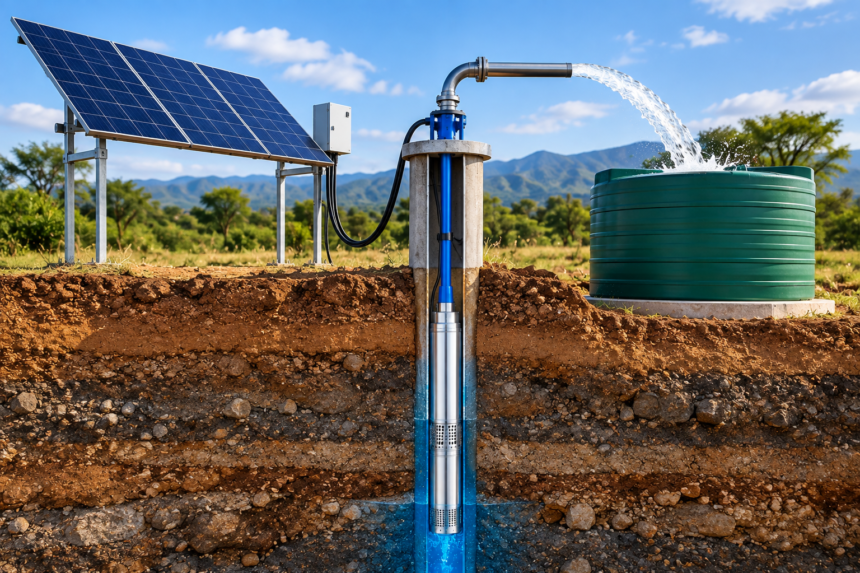
Solar Borehole Pumping Requires Integrated System Design
Solar energy is expanding the possibilities for decentralized water supply across Africa.
Solar-powered borehole pumps can support applications where grid electricity is unavailable, unreliable or expensive.
However, we should not treat the solar array and borehole pump as separate systems.
The hydraulic and energy requirements must be considered together.
We should assess:
- Daily water requirement
- Borehole yield
- Total Dynamic Head
- Pump flow rate
- Pump efficiency
- Motor efficiency
- Solar resource
- Pumping hours
- Solar array capacity
- Controller requirements
- Storage capacity
Water storage can play an important role.
Instead of using batteries to store all the energy required for later water consumption, the system can often use a storage tank to hold water pumped during periods of solar availability.
This approach can support reliable water delivery while reducing dependence on electrical storage.
Water Quality Also Influences Pump Selection
Groundwater quality varies significantly between locations.
Some boreholes produce relatively clear water, while others may contain sand, iron, manganese, salts or other dissolved substances.
We should therefore assess water quality before finalising the equipment.
Sand can be particularly damaging because abrasive particles may affect hydraulic components and reduce pump performance.
Water chemistry can also influence material selection.
Depending on the application, we may need to consider corrosion resistance and appropriate materials for the pump, motor, pipework and other components.
Where treatment is required, filters and treatment equipment should also be included in the hydraulic calculations.
Local Technical Support Is Part of the Specification
A borehole pump is not a fit-and-forget asset.
Even a well-designed installation will eventually require inspection, maintenance or replacement of components.
We should therefore assess local technical support before purchasing equipment.
Important questions include:
- Are genuine spare parts available?
- Are trained technicians available?
- Can the pump be serviced locally?
- Is warranty support accessible?
- Are controllers and protection components available?
- Can faults be diagnosed quickly?
For remote water projects, these considerations can have a major impact on system downtime.
A technically capable pump that cannot be supported locally may present operational challenges over its service life.
Why Correct Borehole Pump Selection Matters for Africa
Africa’s water infrastructure requirements are diverse.
A domestic borehole in a peri-urban settlement may have completely different requirements from an irrigation scheme in a farming region or a community water project serving thousands of people.
This makes application-specific design essential.
In many locations, boreholes also form part of decentralised infrastructure where reliable water supply is critical for households, agriculture, livestock and local businesses.
Energy availability adds another layer of complexity.
Solar pumping can provide an important alternative where grid infrastructure is limited.
But whether the system uses solar, electricity, diesel or a hybrid arrangement, the hydraulic design must remain sound.
The goal should be a system that delivers the required water volume reliably while controlling energy and maintenance costs.
Pumps Should Be Selected for the Application, Not the Catalogue
A pump catalogue can provide valuable technical information.
However, the catalogue should support the engineering decision rather than determine it.
We should first establish the application requirements.
Then we can identify pumps that meet those requirements.
The sequence should be:
Borehole data → Water demand → Flow requirement → Total Dynamic Head → Pump curve → Motor → Energy system → Controls → Installation
This approach helps ensure that every major component works toward the same operating objective.
The Bottom Line
Selecting the right submersible borehole pump requires more than matching a pump to borehole depth.
We need to understand the sustainable yield of the borehole, the static and dynamic water levels, required flow and Total Dynamic Head.
We also need to consider pipe friction, water quality, power availability, motor requirements, controls, storage and local technical support.
The biggest mistake is treating the pump as an isolated piece of equipment.
A borehole pump is one component of a complete water infrastructure system.
The right pump should deliver the required water volume at the required head while operating efficiently and within the sustainable capacity of the water source.
When we combine accurate borehole information, hydraulic sizing, efficient energy systems, suitable materials, effective protection and reliable technical support, we can build pumping systems that deliver greater reliability and better lifecycle value.
For Africa’s growing water, agricultural and industrial requirements, that systems-based approach will become increasingly important.