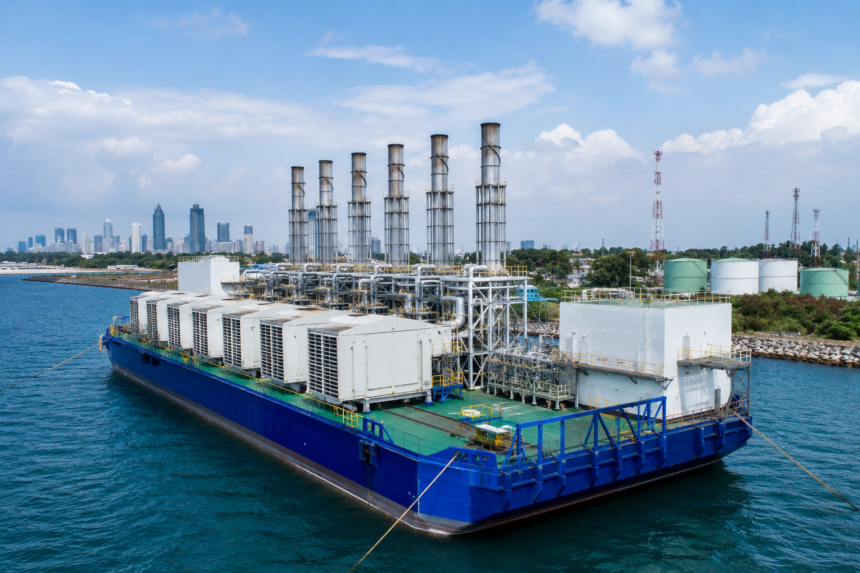
NAIROBI, Kenya – The Kenyan government is considering the deployment of floating power plants along the Coast as electricity demand surges and grid instability persists, a move that could significantly bolster the country’s water and industrial infrastructure.
Citing reports from Business Daily Africa, authorities are evaluating barge-mounted power generation units to address recurring blackouts and rising consumption. The initiative follows record peak demand levels surpassing 2,439 MW, while reserve margins remain below internationally recommended thresholds.
Unlike conventional power stations that require years to develop, floating power plants offer a fast-track generation solution, providing emergency response capacity during supply shortages or infrastructure gaps.
Water and industrial sectors face high stakes
The relevance of the proposed project extends well beyond the energy sector.
Industries that depend on electrically powered systems—including water treatment, wastewater management, mining, manufacturing, and irrigation—require stable electricity for operational continuity.
Frequent outages have increasingly disrupted industrial pumping operations across Kenya and the wider East African region. Utilities report pump failures, system pressure instability, and elevated operating costs linked to diesel-powered backup systems.
The introduction of floating power plants could therefore help stabilize operations in sectors where pumps and motor-driven systems are central to productivity.
Water utilities stand to benefit significantly. Municipal treatment plants require uninterrupted power for raw water abstraction, chemical dosing, filtration systems, booster pumps, and wastewater handling. Grid instability disrupts water supply schedules and places additional stress on aging infrastructure.
Demand pressures mount on Kenya’s grid
Kenya’s electricity demand has continued to rise due to rapid urbanization, industrial expansion, digital infrastructure growth, and increased household connectivity.
The country has increasingly relied on power imports from Ethiopia and Uganda to stabilize supply. However, energy experts note that mobile generation infrastructure—such as floating barges—can deliver faster emergency relief compared to constructing permanent thermal or hydropower facilities.
Globally, floating energy infrastructure is gaining traction for its speed of deployment and operational flexibility. Several African and Asian nations have adopted power barges as temporary or supplementary solutions, often linked to LNG-to-power projects, emergency generation, and mobile utility systems.
Key sectors positioned to benefit
The impact of Kenya’s floating power plant strategy could be particularly significant for sectors closely covered by Pumps Africa.
Mining operations require reliable electricity for dewatering pumps, slurry transportation systems, mineral processing, water recycling, and ventilation. Power instability risks production halts and damage to sensitive industrial equipment.
Water and wastewater utilities depend on constant pumping to maintain supply networks. Stable power improves pressure consistency, treatment efficiency, distribution reliability, and energy management performance.
Manufacturing and industrial processing facilities across Kenya continue to face high operational costs linked to power interruptions and diesel generator dependence. Additional generation capacity could reduce downtime and improve efficiency.
Agriculture and irrigation systems—especially large-scale commercial projects—increasingly rely on electrically powered pumping infrastructure. Reliable electricity remains critical for food production resilience.
Opportunity for energy-efficient pumping solutions
The proposed floating power plants may also accelerate demand for energy-efficient pumps, motors, and automation systems across Kenyan industries.
As utilities and manufacturers seek to optimize electricity consumption, suppliers are increasingly introducing variable speed drive systems, smart pumping technologies, predictive maintenance platforms, and energy monitoring solutions. These technologies can help reduce operational costs while improving infrastructure resilience.
Why Kenya’s decision matters for East Africa
Kenya’s consideration of floating power plants addresses not only short-term blackouts but also long-term industrial growth.
Stable electricity remains fundamental to water security, industrial productivity, mining expansion, manufacturing competitiveness, and infrastructure modernization. For East Africa’s rapidly growing economies, the relationship between reliable power and pumping infrastructure is becoming increasingly interconnected.
As Kenya moves forward with evaluating the floating power plant strategy, the outcome could reshape how utilities, industries, and infrastructure operators across the region approach energy resilience.