The World Bank has proposed a $250 million IDA credit for Kenya’s irrigation sector under the Kenya Resilient Irrigation for a Sustainable Economy (K-RISE) programme, together with a $2 million grant. The package, equivalent to about KSh 32.5 billion, was discussed at a 11 November meeting in Nairobi between Kenyan government officials and a World Bank delegation.
The proposal is intended to expand farmers’ access to water, improve irrigation-service performance and introduce financing and technology models designed to make irrigation infrastructure more sustainable after installation.
Financing package
Kenya’s Agriculture Principal Secretary Ephantus Kimotho said the discussions covered finalisation of the proposed $250 million International Development Association (IDA) financing and the $2 million grant. The grant is expected to be channelled through the Global Water Security and Sanitation Partnership (GWSP).
The World Bank’s project documentation lists total K-RISE costs at $400 million. The proposed $252 million package leaves an identified financing gap of $148 million, and the operation remains subject to final negotiations and formal approval before funds are disbursed.
| Component | Proposed allocation | Irrigation-pumping relevance |
|---|---|---|
| Farmer-led irrigation development | $120–150 million | Supports smallholder adoption of irrigation systems, results-based financing and supplier-led delivery. |
| Improving existing schemes | $40–60 million | Funds performance-based management contracts, capacity building, flow measurement and automation upgrades. |
| Sustainable water-resource base | $30–50 million | Supports irrigation data systems, sensors, early-warning systems, governance reforms and storage preparation. |
K-RISE targets 60,000 hectares under new or improved irrigation, 0.8 million additional and better-paid jobs, and improved food and nutrition security for 1.5 million people.
Uptime, not units
For pump manufacturers, distributors, installers and maintenance contractors, the value of K-RISE will depend less on the number of pumps procured than on whether those pumps continue to operate reliably. Irrigation systems fail commercially when pumps are unavailable, energy costs are unmanaged, spare parts are delayed or maintenance responsibilities are unclear.
The programme is designed to address that lifecycle challenge. Its proposed results-based financing facility would pay certified suppliers only after verification that installed systems meet required standards, while performance-based management contracts are intended to improve the operation of existing schemes.
That model could reward suppliers that provide properly specified pumping equipment, commissioning documentation, local service coverage, spare-parts availability and preventive-maintenance programmes. It may also shift procurement conversations from lowest upfront cost toward total cost of ownership, energy performance and system availability.
Farmer-led irrigation
A central feature of K-RISE is farmer-led irrigation development. Farmers are expected to play a larger role in identifying, financing, installing and managing irrigation systems, with support from certified suppliers and financiers.
The proposed financing structure includes a blended-finance window combining a risk-sharing facility for bank lending to smallholders and irrigation SMEs with patient capital for suppliers expanding into underserved markets.
For the pumping sector, this could increase demand for:
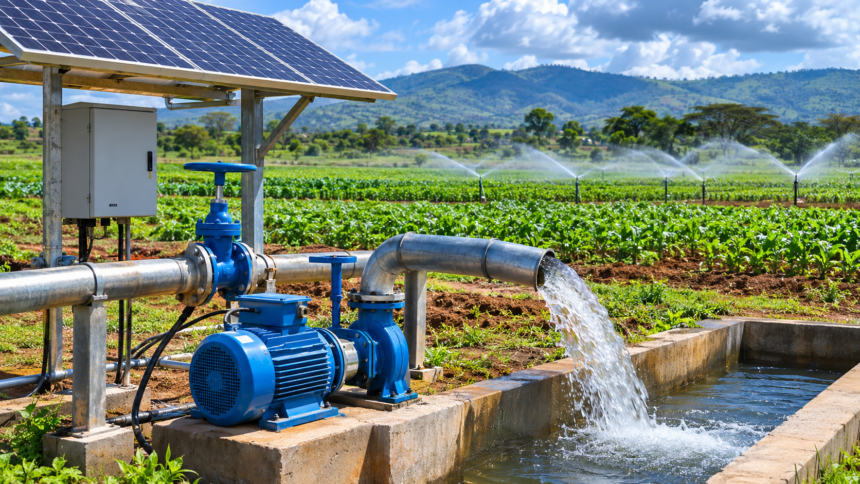
- Solar and grid-connected irrigation pumping systems.
- Variable-speed drives, pump controllers, protection relays and remote monitoring.
- Flow meters, pressure sensors, telemetry and automation equipment.
- Borehole pumps, booster pumps, storage systems and pressurised irrigation components.
- Local installation, commissioning, spare parts and preventive-maintenance services.
- Leasing, pay-as-you-go and performance-based financing models.
Suppliers able to demonstrate verified performance and dependable after-sales support are likely to be better placed under a results-based procurement model than suppliers competing only on equipment price.
Data will drive maintenance
K-RISE includes a planned National Irrigation Information Center, also described in Kenyan reporting as the National Irrigation Informatics Centre. The facility is intended to improve water-resource management, prioritise investment and monitor irrigation performance through sensor networks and early-warning systems.
For pumping infrastructure, this creates a practical role for measurable operating data. Flow rate, pressure, power consumption, running hours, fault alarms and maintenance histories can indicate whether a pump is delivering its design output or is at risk of failure.
The governance model will determine whether that data leads to action. Clear responsibility among farmers, water-user associations, scheme operators and service providers will be essential if K-RISE is to prevent pumps from becoming idle after commissioning.
What suppliers should watch
The proposed programme could create opportunities across Kenya’s irrigation value chain, particularly for companies offering energy-efficient pumping, monitoring, automation and lifecycle-service solutions. However, the financing remains a proposal rather than an approved, disbursed project.
The commercial test for K-RISE will be whether it converts capital into dependable water delivery: pumps that run when needed, farmers who can afford operation and maintenance, and scheme managers with the data and accountability needed to intervene before systems fail.