Denmark supplies drinking water to its cities and loses almost none of it along the way. National non-revenue water sits at roughly 7.6%, and in the three-city utility network covering Copenhagen, Odense and Aarhus, losses run as low as 6%. That performance did not arrive by accident. It was built over three decades through permanent data logging, remote metering and a culture that treats every unbilled cubic metre as a solvable engineering problem rather than an accepted cost of doing business.
- Why Denmark’s Water Sector Counsellor was in the room at Lake Naivasha
- Case study 1: HOFOR and the shift from patrol to permanent monitoring
- Case study 2: LEAKman and the nine-partner model for integrated water-loss control
- Case study 3: Universal smart metering as the foundation, not the finish line
- Case study 4: Pressure management as the cheapest lever available
- What this means for Kenya’s utilities after Naivasha
- Frequently Asked Questions
That contrast matters directly for Naivasha, Nairobi and every utility represented at Kenya’s inaugural Non-Revenue Water Management Conference. Kenya loses 48% of its treated water before it reaches a paying customer, according to figures shared alongside the conference, translating to roughly 13.7 billion KES (696 million DKK) in lost revenue every year. That is water that has already been abstracted, treated with chemicals, and pumped through the network, only to vanish through cracked pipes, illegal connections and faulty meters before anyone pays for it.
Why Denmark’s Water Sector Counsellor was in the room at Lake Naivasha
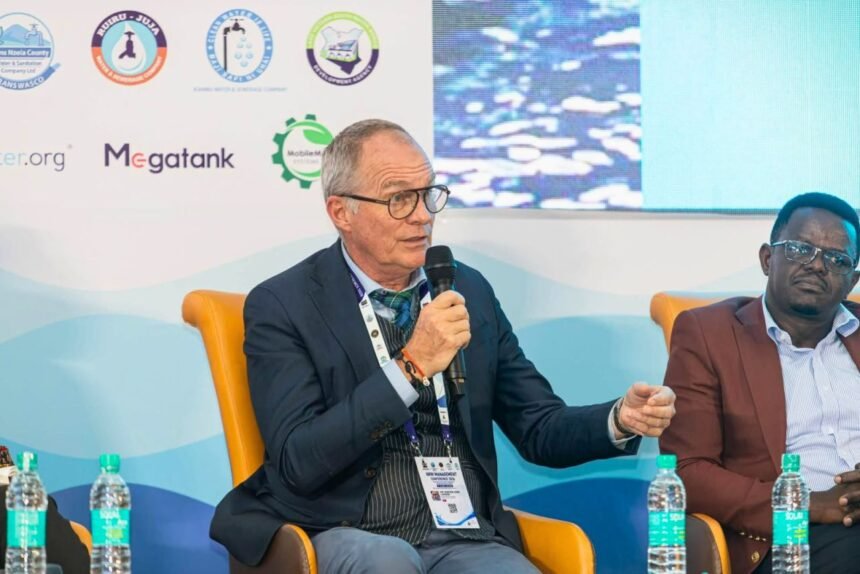
Last week, CS for Water Eric Mugaa, PS Julius Korir and Governor Joshua Irungu convened water sector leaders at Lake Naivasha Resort for a conference running through Friday, with technology and financing solutions dominating the agenda. Among the speakers was Jørgen Erik Larsen, Denmark’s Water Sector Counsellor, whose brief is precisely to move Danish non-revenue water expertise into markets like Kenya’s under a formal Strategic Sector Cooperation between the two governments.
Larsen’s presence was not symbolic. Denmark has spent years exporting its water-loss playbook to utilities across Africa, Asia and the Middle East, and its underlying method rests on a simple idea: you cannot fix what you cannot measure, and you cannot sustain fixes without permanent monitoring, not one-off audits.
Case study 1: HOFOR and the shift from patrol to permanent monitoring
Copenhagen’s utility, HOFOR, serves more than a million customers and once searched for leaks the way most utilities still do today, moving portable data loggers from site to site every 48 hours before relocating them elsewhere. In 2009, HOFOR abandoned that lift-and-shift approach in favour of permanent installations, placing around 185 data loggers across the city on a fixed, multi-year basis.
The shift changed what leak detection could deliver. Instead of a snapshot of one zone at one moment, HOFOR built a continuous, city-wide picture of network behaviour, catching leaks earlier and feeding pipe-condition data straight into long-term asset replacement planning.
For Kenyan utilities managing sprawling, ageing networks in towns like Naivasha, Nakuru or Nairobi, the lesson is structural rather than technological: leak detection works best as infrastructure, not as a project that ends when the consultant leaves.
ALSO READ: https://pumps-africa.com/kenya-water-losses-hit-106m-as-nrw-climbs-to-48/
Case study 2: LEAKman and the nine-partner model for integrated water-loss control
Denmark’s LEAKman initiative brought together nine partners, including the Technical University of Denmark, utility operator HOFOR, meter manufacturer Kamstrup and valve specialist AVK, to build one integrated solution rather than a patchwork of separate tools. Demonstration sites across Greater Copenhagen combined roughly 4,800 smart meters and pressure sensors, all read remotely, to prove that pressure management, active leak control, rapid repairs and pipeline rehabilitation work far better together than in isolation.
The programme’s target was ambitious by global standards: bringing non-revenue water below 20% within the first year of full deployment, in a world where average losses still sit near 40%. The model has since been packaged for export, precisely the kind of transferable framework Larsen’s counsellor role is designed to bring to African utilities.
The relevance to Kenya’s 48% loss rate is direct. WASREB’s own guidance already points utilities toward the same four pillars LEAKman formalised: pressure management, active leakage control, speed of repairs, and pipeline rehabilitation. What is often missing locally is the integration layer, the shared data platform that lets a meter reading, a pressure sensor and a repair crew act on the same information in real time.
Case study 3: Universal smart metering as the foundation, not the finish line
More than 80% of water meters in Denmark are now read remotely, combining drive-by collection with fully smart, always-on systems. That density of data is what makes Danish leak detection proactive rather than reactive. Acoustic loggers and noise sensors flag anomalies within hours, not the months it can take for a hidden leak to surface as a visible burst.
For many Kenyan water service providers, meter reading still depends on physical visits, and non-revenue water calculations rely on estimates rather than continuous measurement. Larsen’s message to conference delegates, drawn from three decades of Danish practice, is that metering investment pays for itself through earlier leak detection long before it improves billing accuracy alone.
Case study 4: Pressure management as the cheapest lever available
One of the least capital-intensive tools in the Danish toolkit is also one of the most effective: reducing excess pressure in the network. Lower, more stable pressure reduces the rate at which existing cracks leak and slows the formation of new ones, extending pipe life without a single kilometre of new pipe being laid.
This is a lever Kenyan utilities can pull immediately, ahead of the multi-year capital programmes that full network rehabilitation requires. It also fits directly into the financing conversations on this week’s Naivasha agenda, since pressure management delivers measurable loss reduction at a fraction of the cost of pipe replacement, making it an easier case to bring to lenders and development partners.
What this means for Kenya’s utilities after Naivasha
Kenya’s NRW challenge is not a knowledge gap. WASREB has already defined water-loss standards, and several Kenyan water service providers have demonstrated meaningful reductions through targeted interventions. The challenge, as Denmark’s experience shows, is sustaining those gains through permanent monitoring infrastructure rather than periodic audits, and integrating metering, pressure management and repair response into one system instead of three disconnected departments.
With technology and financing solutions still on the table for the remainder of the conference, the Danish case studies discussed at Lake Naivasha offer utilities a template that is already proven at scale, not a theoretical model. The 13.7 billion KES lost annually is not a fixed cost of running Kenya’s water sector; Copenhagen’s own history shows it is a solvable engineering and management problem.
Frequently Asked Questions
- What is non-revenue water? Non-revenue water is treated water that is pumped into a distribution network but never billed to a customer, lost through physical leaks, illegal connections, or meter inaccuracies.
- How much water does Kenya lose to non-revenue water? Kenya loses an estimated 48% of its treated water before it reaches a paying customer, costing the sector roughly 13.7 billion KES annually.
- How does Denmark keep non-revenue water so low? Denmark combines permanent data logging, near-universal remote metering, active pressure management and rapid, coordinated repairs, keeping national losses around 7.6% and as low as 6% in its largest metro utilities.
- Who is Jørgen Erik Larsen? Jørgen Erik Larsen is Denmark’s Water Sector Counsellor, tasked with sharing Danish water-loss management expertise with partner countries, including Kenya, through government-to-government cooperation.
- What is the LEAKman project? LEAKman is a Danish partnership of nine organisations, including utilities, technology providers and the Technical University of Denmark, that built an integrated leak-detection and network-management system now used as a model internationally.