

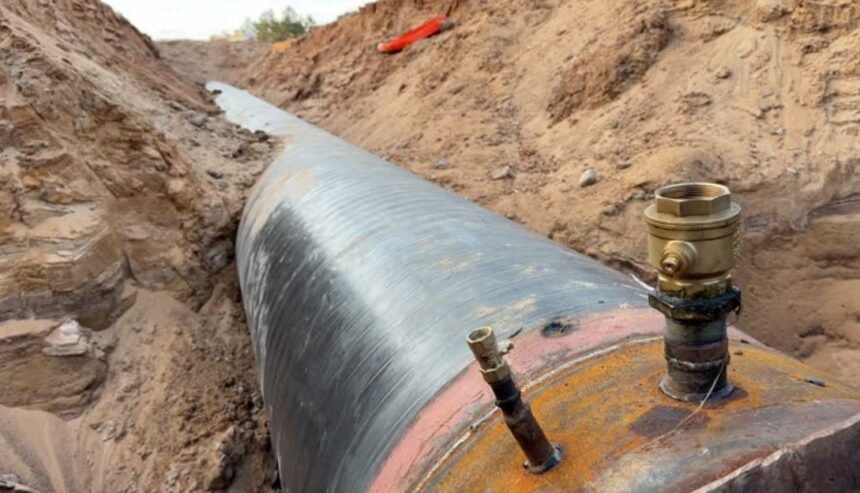
The Nigerian National Petroleum Company Limited (NNPCL) has reached a significant milestone in Nigeria’s energy sector with the successful completion of the River Niger crossing on the Obiafu–Obrikom–Oben (OB3) gas pipeline, a key project aimed at strengthening the country’s gas transmission network.
The crossing—constructed two kilometres beneath the River Niger using advanced horizontal directional drilling (HDD) technology, marks one of the most technically complex segments of the 130-kilometre pipeline. The project was delivered by the NNPC Gas Infrastructure Company in collaboration with engineering contractor PCE Nig. Limited.
READ: Ghana Water Resources Commission, University of Johannesburg ink Mou for water management
Economic, energy boost
With this milestone, the OB3 pipeline can now operate at full capacity, transporting over 2 billion standard cubic feet of gas per day. This is expected to significantly enhance energy reliability, boost domestic gas utilisation, and support power generation and industrial expansion across Nigeria.
NNPCL Group Chief Executive Officer Bashir Bayo Ojulari described the achievement as a defining moment for Nigeria’s gas infrastructure development. He noted that it builds on prior success from the AKK pipeline River Niger crossing completed in 2025, reflecting improved engineering capability and project execution.
The OB3 pipeline plays a strategic role in integrating Nigeria’s gas network by linking eastern gas-producing regions with the western corridor, while also extending connectivity northern markets through the AKK pipeline. This enhanced interconnection is expected to improve nationwide gas distribution efficiency.
In the near term, the project is projected to unlock over 500 million standard cubic feet of additional gas supply for the domestic market. This will support electricity generation, industrial activities, and exports within the West African region. NNPCL also credited the achievement to strong collaboration among stakeholders, including support from the Federal Government under Bola Ahmed Tinubu and the company’s board chaired by Ahmadu Musa Kida. The OB3 pipeline is considered a backbone infrastructure within Nigeria’s broader ambition to build an integrated and resilient gas network, underpinning long-term energy security, economic growth, and improved living standards.