

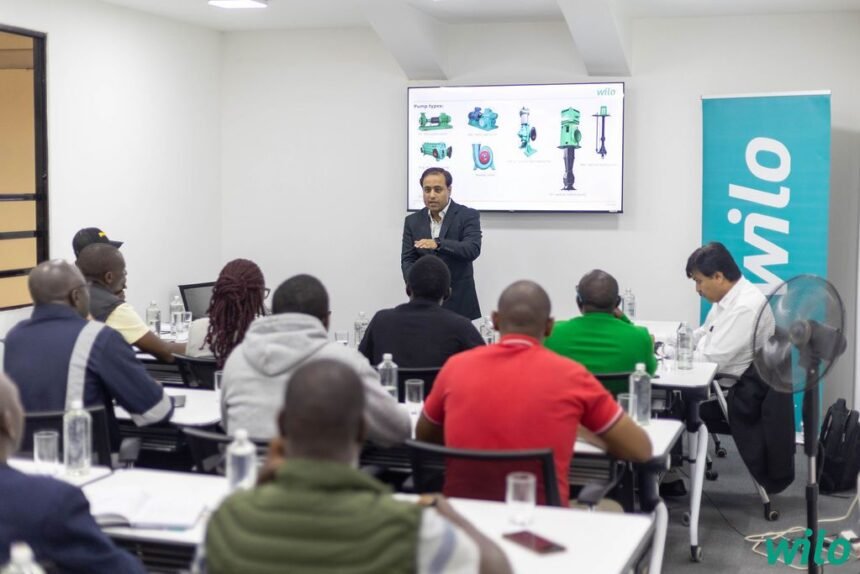
EAST AFRICA — Wilo East Africa in collaboration with Wilo Mather and Platt Pumps Pvt. Ltd., has led a technical exchange session on high-efficiency Smart Pumping solutions, highlighting both progress and persistent challenges in the region’s water sector.
The session brought together engineers, utility operators, and water professionals to evaluate the real-world performance of Smart Pumping systems. Even after the formal presentations concluded, discussions continued among participants, focusing on practical outcomes and field-level applications.
Engineers at the session pointed to the growing adoption of Variable Frequency Drives (VFDs), noting that the technology is a key enabler of Smart Pumping. Participants reported that VFD integration is delivering measurable reductions in energy consumption while improving the stability of water distribution networks across both urban and rural schemes.
However, discussions also revealed a recurring issue. Pump oversizing remains common in many projects, with several engineers warning that incorrect specifications are undermining the benefits of Smart Pumping by increasing operational costs and contributing to system failures.
Across both utility and consulting perspectives, there was strong consensus that proper pump selection and accurate system design are essential to fully realizing Smart Pumping benefits. Participants emphasized that optimized sizing and system-level planning directly influence efficiency, reliability, and long-term performance.
“When design decisions are right, operations become predictable, efficient, and sustainable,” one engineer noted during the exchange.
Technical Exchange Strengthens India–East Africa Link
The engagement forms part of a broader collaboration between Wilo East Africa and Wilo Group’s India-based manufacturing operations. India continues to serve as a key production hub for high-capacity pump systems supporting Smart Pumping deployments across global markets, including Africa.
Officials said the collaboration is built on three strategic pillars. The first is engineering capacity building, with regional knowledge-sharing initiatives aimed at strengthening expertise in solar water pumping. The second focuses on integrated system solutions, moving beyond standalone pumps to advanced configurations such as vertical execution systems for fire protection and intelligent water treatment technologies.
The third pillar centers on resource sharing, with Wilo’s Kesurdi manufacturing facility—home to one of Asia’s largest pump testing basins—serving as a primary source for high-capacity systems exported to Africa and Southeast Asia.
‘Local for Local’ Strategy Gains Momentum
The initiative aligns with Wilo’s “local for local” strategy, which adapts global engineering standards to regional requirements. In East Africa, this approach leverages India’s manufacturing capabilities to support localized Smart Pumping solutions in water management, energy efficiency, and related infrastructure.
Sustainability remains central to the collaboration. Officials highlighted the integration of WATER AI, which enhances Smart Pumping by enabling early fault detection, optimizing energy use, and reducing lifecycle costs.
Participants also noted that the exchange supports ongoing infrastructure modernization. Utilities are transitioning from outdated systems to digitalized networks where Smart Pumping plays a critical role in handling complex challenges, including wastewater with high solid content.
Sector Leaders Highlight Practical Impact
The session drew participation from key institutions, including Athi Water Works Development Agency, Water and Sanitation Providers Association, Nairobi City Water and Sewerage Company, and Wilo Middle East & Africa, reflecting strong regional collaboration across public and private sector stakeholders in advancing water infrastructure and operational efficiency.
Industry professionals such as Manoj Bafna, Azharuddin Tamboli, Belete A. Matebe, Christine Amira, Francis Munyao, and David Mugo contributed insights from engineering, consulting, and utility operations, emphasizing the need for continuous knowledge exchange, improved system diagnostics, and adoption of globally proven Smart Pumping technologies tailored to local conditions.
For the East African water sector, the technical exchange signals a clear shift toward Smart Pumping systems that are data-driven and properly engineered. Participants noted that these systems are already delivering lower energy costs, fewer breakdowns, and more reliable water supply—benefits expected to extend well beyond the session, particularly as utilities scale deployment and integrate digital monitoring tools.