

For the first time in nearly two decades, South Africa’s energy equation has fundamentally inverted. As of April 2026, the country has recorded more than 300 consecutive days without load shedding. Available generation capacity regularly exceeds 28,000 MW against peak demand of approximately 26,500 MW, with nearly 4,000 MW held in cold reserve due to excess supply.
The duck curve—a midday collapse in grid demand driven by rooftop solar—is now a measurable operational reality in the Western Cape and Gauteng.
For the water sector, this is not merely a macroeconomic footnote. It is a technical inflection point.
The question posed by Benoit Le Roy, Co-founder of Nexus Water Alchemy (Pty) Ltd and Water Ledger Global Ltd, cuts directly to the engineering and economic logic of the moment:
“Will we take heed? The water sector is not immune and needs to adapt or continue its slippery slide downwards, not an option surely? Why are we not using our 4GW surplus electricity to drive the pivot?”
Le Roy’s response to a recent open letter on South Africa’s draft AI policy—which warned that “AI-driven automation is already eliminating jobs globally in precisely the sectors that employ SA’s most vulnerable workers”—frames the water industry’s challenge in stark terms: the same surplus energy that could power a new generation of smart water networks is being ignored, while the sector continues to leak both water and opportunity.
The Technical Case: 4GW as a Water Infrastructure Lever
Non-revenue water (NRW) in many South African municipalities exceeds 40%. A significant portion of this loss is driven by two interrelated failures: pumping systems operating outside optimal efficiency curves, and undetected leaks that run for weeks before manual intervention.
Surplus electricity—particularly during solar midday hours when grid prices can turn negative—creates an engineering opportunity to address both simultaneously.
1. Time-shifted pumping for energy arbitrage
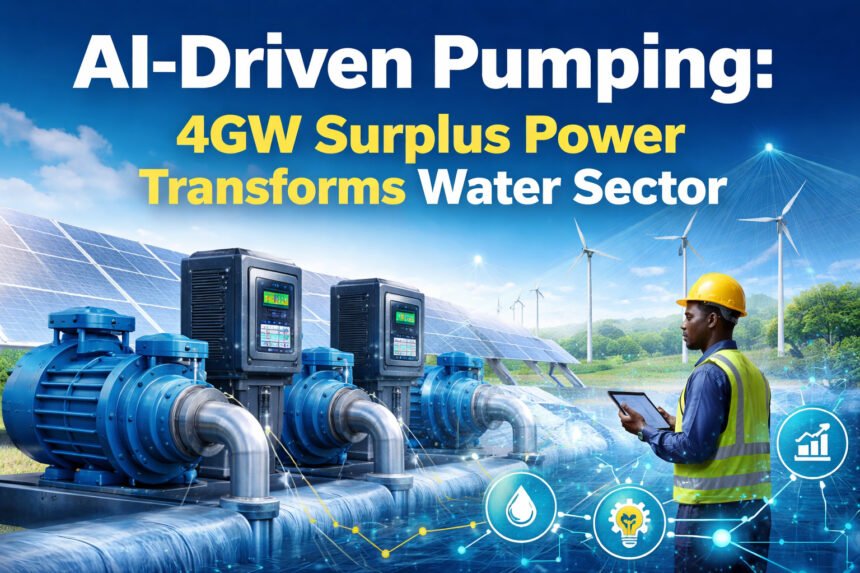
Variable frequency drives (VFDs) on raw water and treated water pumps can be programmed to ramp up during surplus solar hours (10:00–15:00), filling elevated storage reservoirs or balancing tanks. This shifts energy consumption from evening peak periods to times when electricity is abundant and near-zero marginal cost. For a typical 500 kW pumping station, this can reduce annual energy expenditure by 25–35% while actually increasing total daily pumped volume.
2. AI-driven leak detection powered by surplus baseload
Real-time acoustic sensors, pressure loggers, and flow monitors require continuous low-voltage power. The 4GW surplus represents a standing baseload that could run thousands of distributed IoT sensor nodes across municipal water networks. When combined with lightweight AI models deployed at the edge (e.g., open-weight models fine-tuned on local pipe material and soil conditions), these systems can localise leaks to within 5–10 metres within minutes of occurrence.
3. Desalination and advanced re-use become economically viable
Energy is the single largest operating cost for desalination (reverse osmosis) and advanced wastewater treatment (membrane bioreactors, ozonation). Surplus electricity at marginal cost changes the unit economics fundamentally. A 10 ML/d desalination plant consuming 3.5–4 kWh per cubic metre requires 35–40 MWh daily. At standard industrial tariffs (R1.20–R1.50/kWh), this is prohibitive. At surplus solar rates (projected as low as R0.20–R0.30/kWh for non-peak wheeling), it becomes a viable option for mines, industrial parks, and coastal municipalities.
The Governance Trap: Regulating a Vacuum
The water sector faces the same structural misalignment that the AI policy debate has exposed. Le Roy’s comment was made in direct response to an open letter by investor Stafford Masie, which argued:
“The draft policy mentions job displacement in passing and proposes reskilling programs as the remedy. This fundamentally understates the scale and urgency of the threat. The correct response is not to reskill people for jobs that may no longer exist; it is to ensure that SA is where AI companies build, train, deploy and employ. That requires infrastructure, incentives and speed. It does not require seven new government bodies.”
Translate this to water: new water ethics boards, smart water ombudspersons, or yet another municipal water restructuring committee will not fix a single burst main. What would fix it is:
- A national energy allocation framework that prioritises water pumping and treatment during surplus hours.
- Compute credits for water startups to train AI models on local pipe break data.
- Regulatory sandboxes allowing municipalities to test AI-controlled pressure management without tender delays.
- Special Economic Zone provisions for water technology clusters that assemble smart pumps and sensors locally.
None of these appear in current water policy drafts. The sector is at risk of governing a smart water future it has not yet built.
The Job Creation Engine: Pumps as a Platform for Employment
Masie’s warning that “mass displacement of low and mid-skilled workers without a corresponding AI-driven job creation engine is not an economic adjustment. It is a social detonation” applies directly to the water sector’s workforce.
Traditional pumping station operators, meter readers, and manual leak inspectors face automation risk. But a deliberate pivot to AI-driven water networks creates new, local jobs:
- VFD and smart controller technicians to retrofit thousands of existing pump stations.
- IoT sensor installers for distributed leak detection networks.
- Water data analysts to interpret AI-generated pressure and flow alerts.
- Local pump assemblers in Special Economic Zones, reducing import dependence.
A single 50 MW AI compute facility—powered by surplus electricity, hosting water analytics models—directly employs 100–200 high-skilled workers, and indirectly supports 500–1,000 mid-skilled installation and maintenance jobs. This is not reskilling for hypothetical futures. It is building tangible infrastructure that hires people now.
The Sovereign Imperative: Open-Source Water AI
Le Roy’s Water Ledger Global points toward a strategic capability that the water sector has not yet articulated: open-source, locally deployed AI for water reconciliation and pump optimisation.
Instead of paying per-token to offshore cloud providers for leak detection or pump efficiency analytics, South African water utilities could run open-weight AI models on domestic infrastructure powered by surplus energy. These models would be fine-tuned on local data: the specific failure modes of KSB, Grundfos, and Wilo pumps under South African water quality conditions; the pressure transient behaviour of asbestos cement and PVC pipes in Highveld soils; the consumption patterns of low-income households versus industrial users.
This is not a technical luxury. It is a sovereignty and cost-control measure. Every rand spent on offshore AI inference for water is a rand that could have been spent on local compute, local technicians, and local model development.
Measurable Targets for a Pivot
The water sector does not need another strategy document. It needs quantified commitments. Borrowing from Masie’s recommendations for AI, a water-specific scorecard would include:
| Metric | Baseline (2025) | Target (2028) |
|---|---|---|
| Municipal NRW (national average) | 41% | 25% |
| Pump stations retrofitted with VFDs | <10% | 50% |
| Water AI models trained on local data | 0 | 10+ (open-source) |
| Surplus MW allocated to water pumping | 0 MW | 500 MW |
| Jobs created in smart water O&M | N/A | 15,000 |
What gets measured gets managed. What gets left vague becomes another failed pilot project.
Conclusion: The Water Sector as the Test Case
Benoit Le Roy’s question is not rhetorical. The 4GW surplus is real. The AI tools are mature. The water sector’s decline is measurable in megalitres lost and pumps failed. The only missing element is a deliberate decision to connect surplus electricity to smart water infrastructure as a national priority.
The alternative—continued reliance on manual leak detection, fixed-speed pumps running at night, and imported AI models trained on European pipe networks—is not sustainable. The slippery slide downwards is a choice. So is the pivot.
The water sector can either wait for governance frameworks to catch up, or it can use the 4GW surplus to build the smart, AI-driven, job-creating network that South Africa’s water reality demands.
This technical analysis was developed from industry discussions following the open letter by Stafford Masie (April 2026) and the response by Benoit Le Roy, Co-founder of Nexus Water Alchemy and Water Ledger Global.
References:
- Masie, S. (2026). Open letter to Minister Malatsi on the Draft SA National AI Policy. Daily Maverick.
- Eskom System Status Report, April 2026.
- Department of Water & Sanitation, NRW Technical Report, 2025.