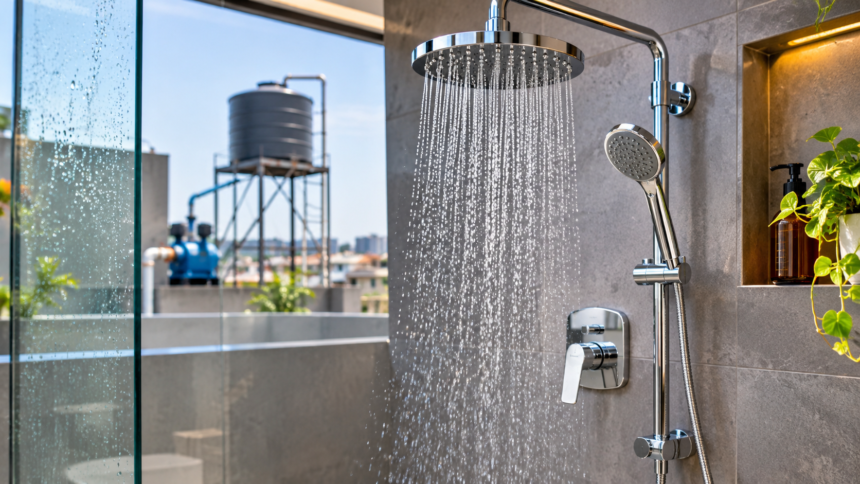
A shower or mixer can work well in a factory test and still disappoint once it is installed. In many African buildings the reason is not a defective fitting. It is a mismatch between the pressure the product was chosen for and the pressure the building actually delivers at the outlet.
Importers, distributors and project buyers who write those conditions into the order — and who test a sample under local supply — avoid most of the complaints that otherwise appear after the container has been paid for and the goods are already on site.
Why pressure varies so much from one building to another
There is no single “African water pressure.” Conditions change by city, by neighbourhood and even by floor.
In low-rise housing and in many peri-urban developments, cold water is often stored in a roof tank and reaches the shower by gravity. On the top floor, the height difference between the tank and the shower may be small, so the available pressure is modest. The same model that feels strong in a ground-floor showroom can feel weak in the unit just under the tank.
In growing cities, mid- and high-rise apartments and hotels more often use booster pumps and zoned supplies. Pressure can be adequate at one part of the day and fall when many units draw water at once. Hot and cold supplies are not always balanced: a local water heater, a long hot-water run or a partly closed valve can leave the mixer with two very different inlet pressures.
Hard water and sediment are a separate, common issue in some municipal and borehole supplies. They do not replace a pressure problem, but they affect how long a cartridge or a shower nozzle keeps working as intended.
None of these situations is unusual, and none of them can be guessed from a catalogue photograph.
What to write into the specification and the purchase order
Before confirming a model, agree at least the following in writing with the supplier:
Minimum working pressure at the shower outlet. Not only the pressure at the street or at the pump. Ask for the figure that applies to the most difficult location — the top floor under a roof tank, or the end of a long branch. If the buyer cannot obtain a measured figure, state the typical arrangement (gravity roof tank, booster zone, or mixed) so the supplier can recommend products that are intended to work in that range.
Balance of hot and cold supplies. Some mixer cartridges need reasonably similar inlet pressures to hold temperature. If the project uses individual heaters or long hot-water pipework, say so.
Head size and number of outlets. A large rain head, or a set with a rain head, a hand shower and body jets, needs more water than a single hand shower. On a weak supply, a simpler set usually performs better.
Flow regulators. Restrictors that are useful on a high-pressure system can make a low-pressure shower feel poor. They should be specified for the actual conditions, not fitted by default.
Cartridge type and operating range. Note whether the mixer is a straightforward ceramic-disc mixer, a pressure-balancing mixer or a thermostatic mixer, and check the stated operating range against the site conditions.
Thread standard and inlet size. Confirm the thread used in the destination market (for example BSP/G1/2, which is common in many African and Gulf plumbing systems, versus NPT in some others) so connections, nipples and hoses match what local plumbers already stock.
These points belong on the specification sheet and on the purchase order, not only in a WhatsApp message.
Test a sample on the most difficult outlet
The most reliable check is also the simplest. Before mass production or a large repeat order, install a pre-production sample in a real bathroom — ideally the weakest outlet the goods will face — and run it with other taps open. The distributor or the contractor, not only the supplier, should see the result.
If the spray is weak, the temperature is unstable, or the diverter does not hold, it is far cheaper to change the model or the configuration at this stage than after a full container has been shipped inland. Keep the approved sample, or a sealed twin, as the reference for later deliveries.
A practical discussion of how to match shower heads, mixers and regulators to a weak or uneven supply is set out in this guide to sourcing showers for low water pressure (https://qualitysanitaryware.com/resources/low-water-pressure-shower-sourcing). Editors may of course omit the link.
After-sales: cartridges, nozzles and hard water
Even a well-chosen set will need parts. Cartridges, hoses, hand-shower holders and nozzles are the items that usually wear first, especially where the water is hard or carries sediment. Agree, before the first shipment, which spare parts travel with the order, how replacement claims will be handled, and how long the same cartridge or hose will remain available for that model.
For hard-water areas, ask whether nozzles can be descaled or replaced, and whether the supplier can advise on a simple maintenance routine the distributor can pass on to plumbers and facilities teams. This is not a substitute for correct pressure specification, but it reduces avoidable service calls.
A short checklist for the next import order
- Describe the building water system, not only the product finish and the price.
- Record the expected minimum outlet pressure and whether hot and cold supplies are balanced.
- Choose head size, outlets and any flow regulator to suit those figures.
- Confirm thread standard, inlet size and cartridge type in writing.
- Approve a sample on the weakest real outlet before bulk production.
- Include spare parts and a simple plan for hard water or sediment.
Uneven pressure is a building issue before it is a product issue. Importers who treat it that way — and who make the supplier treat it that way in the paperwork — give their customers showers that work in the buildings they actually serve, not only in the showroom.
About the author: The Quality Sanitary Ware Team works for Quality Sanitary Ware, a Ningbo, China sourcing and trading company founded in 2011. With 15 years of industry experience and long-term partner factories, the team supplies shower sets, shower heads and mixers to wholesale and OEM/ODM buyers in Africa, the Middle East and the GCC.