Why the pump decides the energy bill
Seawater at about 35,000 mg/L has an osmotic pressure of roughly 26 bar, and SWRO membranes are typically fed at 55–70 bar depending on salinity, temperature, recovery and membrane choice. The brine leaving the membranes still carries a large share of that energy, around two-thirds of the energy delivered to the membranes in a typical example [1]. Recovering it, or throttling it across a valve, is the biggest energy decision in a small plant.
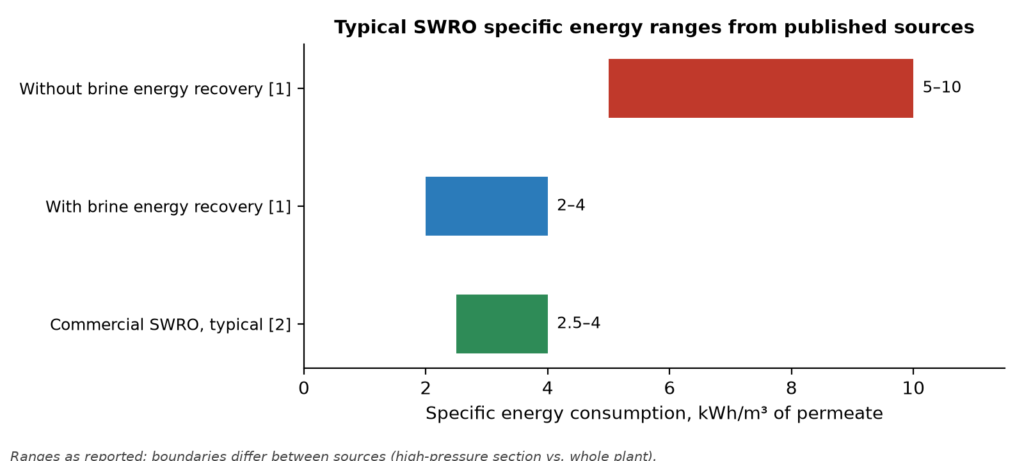
Published figures show the gap. Commercial SWRO typically uses about 2.5–4 kWh/m³ [2], with feed salinity, target quality and equipment efficiency all influencing the figure [3]. Typical values for conventionally powered SWRO are 5–10 kWh/m³ without brine energy recovery versus 2–4 kWh/m³ with it, and small motors and pumps are less efficient than large ones [1]. A review of plants of 100 m³/d or less found that energy recovery devices are rarely installed at this scale, a main reason small units consume more energy [4].
High-pressure pump types
Multistage centrifugal pumps give smooth, pulse-free flow and have few wearing parts. At small flows and high heads, however, their efficiency is modest, and flow drifts as membrane pressure changes with fouling and temperature. Verify performance by a factory test to an ISO 9906 acceptance grade [6]; API 610/ISO 13709 is the usual reference where heavy-duty construction is specified [7].
Positive-displacement pumps, axial-piston or crankshaft-driven plunger designs, deliver flow nearly proportional to speed and largely independent of pressure. At the small end they are generally more efficient; one test of a small plunger pump measured overall efficiency above 88% [1]. Plunger pumps need pulsation dampeners, every positive-displacement pump needs a relief valve, and water-lubricated axial-piston pumps depend on good cartridge filtration. API 674 covers reciprocating pumps [8].
There is no universal crossover point. Ask for guaranteed pump and motor efficiency at your actual duty point, not the catalogue best-efficiency point.
Energy recovery devices
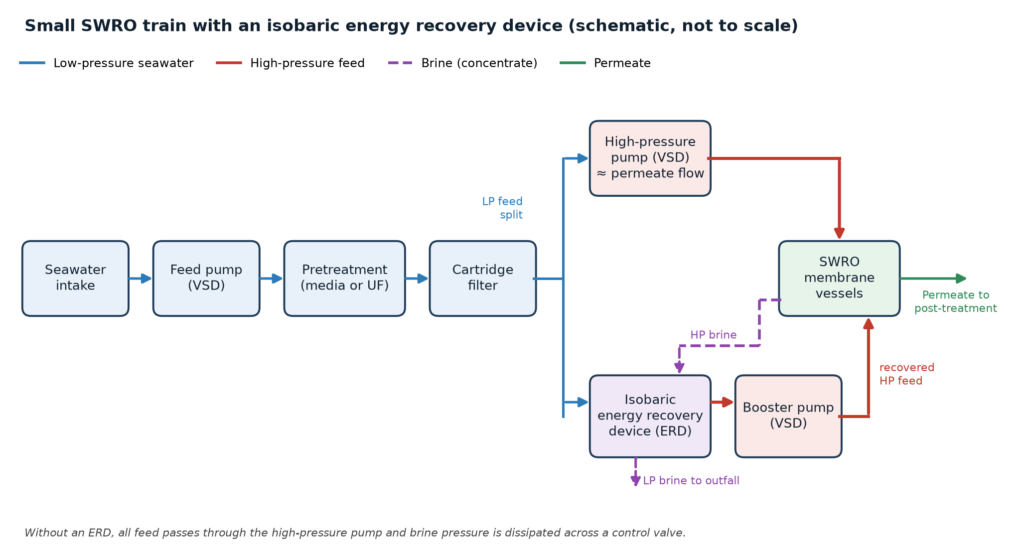
Isobaric devices (rotary pressure exchangers and piston work exchangers) transfer brine pressure directly to incoming seawater. Field data report transfer efficiencies up to about 98%, cutting energy use by half or more versus no recovery and by 15–30% versus centrifugal recovery devices [5]. The high-pressure pump then delivers only about the permeate flow, while a booster pump makes up the small pressure loss on the recovered stream. Mixing slightly raises membrane feed salinity.
Turbochargers use a brine-driven turbine on a shaft with a pump impeller to boost feed pressure. They are simple and tolerant of operating swings, but less efficient than isobaric devices [5].
Small positive-displacement recovery units have long been used on very small watermakers; one laboratory and modelling study reported below about 3.5 kWh/m³ over a wide flow range [9].
When do small plants skip recovery? At very small capacity, with intermittent operation, cheap power or high recovery (which leaves less energy in the brine [1]), the payback may not justify the added cost and spares. A simple test: annual kWh saved × local cost per kWh, compared with added capital and maintenance. On diesel power, recovery deserves serious evaluation even at modest sizes.
Sizing feed and booster pumps
Feed flow equals permeate flow divided by recovery: 100 m³/d at 40% recovery needs 250 m³/d (about 10.4 m³/h), plus backwash or flushing water. Feed pump head must cover intake lift, pretreatment and cartridge-filter losses, and the minimum inlet pressure of the high-pressure pump: adequate NPSH for centrifugal pumps, stable positive suction for positive-displacement pumps. A low-pressure trip protecting the high-pressure pump is essential.
With an isobaric device, the feed pump supplies the full feed flow, the high-pressure pump roughly the permeate flow plus device leakage, and the booster pump roughly the brine flow at a few bar differential, though its casing and seals must be rated for full system pressure. Avoid oversizing: throttling wastes energy every operating hour.
Materials for seawater service
Seawater contains about 19,000 mg/L chloride, and brine more. Grades such as 316L are vulnerable to pitting and crevice corrosion in high-pressure seawater, especially where water stagnates during shutdowns. Duplex and super-duplex stainless steels are widely used for high-pressure piping and pump wetted parts, ranked by the Pitting Resistance Equivalent Number, PREN = %Cr + 3.3(%Mo + 0.5%W) + 16%N; super-duplex grades typically have PREN of 40 or above [10]. Specify a minimum PREN on mill certificates and require qualified duplex welding procedures [10]. Flush the high-pressure section with permeate before extended shutdowns.
Variable-speed drives
Variable-speed drives give a soft start, which matters on generators, and let operators match pressure to temperature and membrane condition instead of throttling. With positive-displacement pumps, speed sets flow directly; with isobaric recovery, separate drives on high-pressure and booster pumps balance flows. Specify harmonic mitigation consistent with IEEE 519 [12] and a motor efficiency class under IEC 60034-30-1 [11].
Reliability at remote African sites
Spares: seal and valve kits, bearings, cartridge filters, key instruments and, for single-train plants, a spare high-pressure pump assembly. Without them, a small part can stop production for weeks.
Power quality: voltage dips and phase loss damage motors and drives. Fit phase-failure and under-voltage protection, and size generators for motor starting.
Solar: RO is designed for steady inputs, and intermittent power is a recognised challenge [2]. Options are battery or diesel buffering, or variable-flow designs with positive-displacement pumps and drives, demonstrated on small PV-powered seawater units without batteries [13]. Frequent stops need automatic permeate flushing.
Operations: log pressures, flows and conductivity daily; normalized data reveal fouling or pump wear before failure.
Checklist for buyers and engineers
- Feed salinity, temperature range, turbidity/SDI and intake type confirmed.
- Specific energy (kWh/m³) stated, with its boundary: high-pressure pump only, or the whole plant.
- Pump type, duty-point efficiency and ISO 9906 test grade defined.
- Energy-recovery decision backed by a payback estimate at local power cost.
- Feed, booster and high-pressure pump duties shown on a process diagram.
- Wetted materials and minimum PREN specified.
- Drives, harmonic mitigation and motor efficiency class specified.
- Power source, generator rating and protection agreed.
- Two-year critical spares list and local service arrangements confirmed.
- Operator training, flushing procedure and data logging included.
Final design depends on a complete feed-water analysis and confirmed project requirements, but asking these questions early avoids most costly surprises.
References
[1] Thomson, M., Bermudez, A. (CREST, Loughborough University) (2006). ADU-RES Work Package 6, Deliverable 6.1: Energy Consumption Modelling. EU INCO-CT-2004-509093. https://www.adu-res.org/ADU-RES%20Deliverables/ADU-RES_D6_1.pdf
[2] Jenne et al. (2024). NREL Marine Energy Desalination Research and Development Portfolio (conference presentation). National Renewable Energy Laboratory. OSTI ID 2305470. https://www.osti.gov/biblio/2305470
[3] Kim, J., Park, K., Yang, D.R., Hong, S. (2019). A comprehensive review of energy consumption of seawater reverse osmosis desalination plants. Applied Energy, 254, 113652. https://doi.org/10.1016/j.apenergy.2019.113652
[4] Song, J., Li, T., Wright-Contreras, L., Law, A.W.-K. (2017). A review of the current status of small-scale seawater reverse osmosis desalination. Water International, 42(5), 618–631. https://doi.org/10.1080/02508060.2017.1330841
[5] Stover, R., Martin, J. (2009). Titan PX-1200 energy recovery device: test results from the Inima Los Cabos, Mexico, seawater RO facility. Desalination and Water Treatment, 3, 179–182.
[6] ISO 9906:2012. Rotodynamic pumps — Hydraulic performance acceptance tests — Grades 1, 2 and 3. International Organization for Standardization.
[7] API Std 610 / ISO 13709. Centrifugal pumps for petroleum, petrochemical and natural gas industries. American Petroleum Institute / ISO.
[8] API Std 674. Positive Displacement Pumps — Reciprocating. American Petroleum Institute.
[9] Thomson, M., Miranda, M.S., Infield, D. (2003). A small-scale seawater reverse-osmosis system with excellent energy efficiency over a wide operating range. Desalination, 153. https://doi.org/10.1016/S0011-9164(02)01141-4
[10] International Molybdenum Association (IMOA). Practical Guidelines for the Fabrication of Duplex Stainless Steels, 3rd ed. https://www.imoa.info/download_files/stainless-steel/Duplex_Stainless_Steel_3rd_Edition.pdf
[11] IEC 60034-30-1. Rotating electrical machines — Part 30-1: Efficiency classes of line operated AC motors (IE code). International Electrotechnical Commission (Ed. 1 2014; Ed. 2 2025).
[12] IEEE Std 519-2022. IEEE Standard for Harmonic Control in Electric Power Systems. IEEE.
[13] Thomson, M., Infield, D. (2003). A photovoltaic-powered seawater reverse-osmosis system without batteries. Desalination, 153, 1–8. https://doi.org/10.1016/S0011-9164(03)80004-8
Further reading: Voutchkov, N. (2018). Energy use for membrane seawater desalination – current status and trends. Desalination, 431, 2–14. https://doi.org/10.1016/j.desal.2017.10.033
About the author
Victor Zhang works in membrane water treatment and has been in the industry since 2009. He is Sales Manager at Guangzhou Globaluf Water Treatment Co., Ltd., Guangzhou, China.