

In mineral processing, operational efficiency is often determined by how well critical process streams are managed. From reagent dosing circuits that demand pinpoint accuracy to thickener underflow applications handling highly abrasive slurries, mining operations rely on pumping technologies that can perform consistently under demanding conditions.
As mines face increasing pressure to improve productivity, reduce downtime, optimise water use, and control operating costs, selecting the right pump technology and OEM components has become a strategic decision rather than simply a maintenance consideration.
Tackling two of mining’s toughest pumping challenges
Reagent dosing and thickener underflow transfer represent two of the most demanding applications in mineral processing.
Reagent dosing systems handle a wide range of chemicals across the mineral processing circuit, from collectors and frothers for flotation, depressants and activators to control selectivity, pH correction, and flocculants or coagulants for thickening and water treatment, amongst others. Accurate dosing of each of these directly impacts recovery and concentrate grade, process stability, and environmental compliance. Even small variations in dosing rates can affect downstream metallurgical performance and drive-up reagent consumption.
Thickener underflow, by contrast, presents a very different pumping challenge. These slurries typically combine high solids content, elevated viscosity with abrasive particles, placing considerable stress on conventional pumping equipment. Wear on wetted components, increased maintenance requirements, and unplanned failures can quickly impact production targets and increase operating expenses.
Why peristaltic technology continues to gain traction
In underflow applications, peristaltic pumps are becoming more widely used across the mining sector because of their ability to handle abrasive, corrosive, viscous, and solids-laden media while maintaining accurate and consistent flow rates.
Unlike many conventional pump technologies, the hose is the only component that comes into contact with the pumped fluid. This significantly reduces wear on mechanical components and simplifies maintenance requirements.
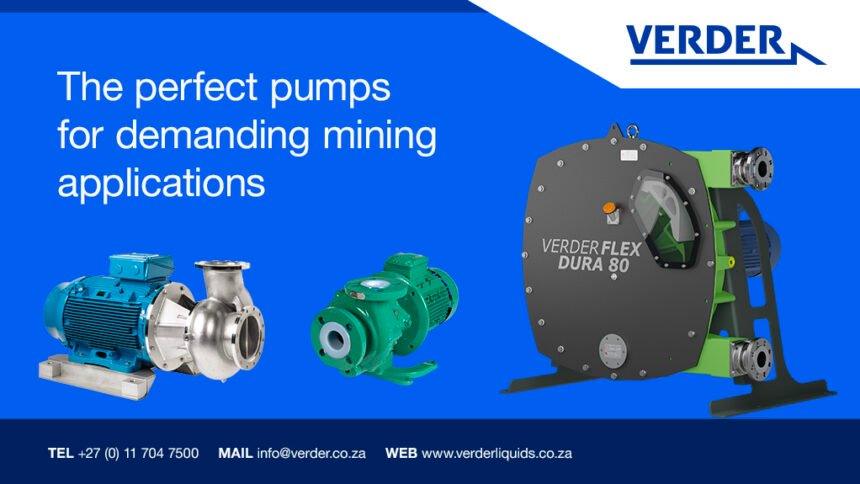
Verder’s range of pumping solutions, including the Verderflex Dura series, has been engineered specifically to meet the challenges of reagent dosing and slurry transfer applications. Delivering volumetric accuracy of up to 99.9%, these pumps provide the consistency required for efficient reagent utilisation while reducing waste and improving process control.
The Dura series has established a strong reputation for combining reliability, compact design, and operational simplicity. With a closed-coupled vertical motor design, the pump requires up to 70% less floor space than conventional alternatives while delivering comparable or higher performance.
Additional features such as dry-run capability, self-priming operation to 9.5 metres, simplified hose replacement, and discharge pressures up to 16 bar make the Dura well suited to the demanding conditions commonly encountered in mining operations.
The importance of OEM hoses
While pump selection is critical, hose selection is equally important.
In peristaltic pumps, the hose is the critical link in the system. It directly influences performance, efficiency, reliability, and operating life. Yet many operations continue to be tempted by lower-cost aftermarket alternatives that often fail to meet the stringent manufacturing and material standards required for demanding mining applications.
Verderflex OEM hoses are engineered with durability and performance in mind. Precision manufacturing ensures consistent wall thickness throughout the hose, while reinforced fibre construction enhances mechanical strength and fatigue resistance. A textured outer surface optimises lubricant distribution, reducing friction, operating temperatures, and wear.
The financial impact of choosing the wrong hose can be substantial. In one Southern African copper mining operation, the installation of a non-OEM hose resulted in multiple failures each week, creating costly downtime and production losses. After reverting to a genuine Verder OEM hose, the system operated reliably.
This illustrates an important lesson for mining operations: the perceived savings of non-OEM components can quickly disappear when maintenance costs, production losses, and downtime are taken into account.
Enabling progress through reliability
As mining operations continue to pursue greater efficiency and sustainability, pumping systems must deliver more than fluid transfer alone. They must support process optimisation, minimise maintenance requirements, and contribute to overall operational resilience.
Whether managing critical reagent dosing applications or transporting highly abrasive thickener underflow slurries, the combination of advanced peristaltic pump technology and OEM-engineered hoses can significantly improve reliability, reduce lifecycle costs, and maximise plant performance.
For mining operators preparing for the future, investing in proven pumping technologies is not simply about maintaining production today, it is about creating more efficient, reliable, and sustainable operations for the years ahead.