

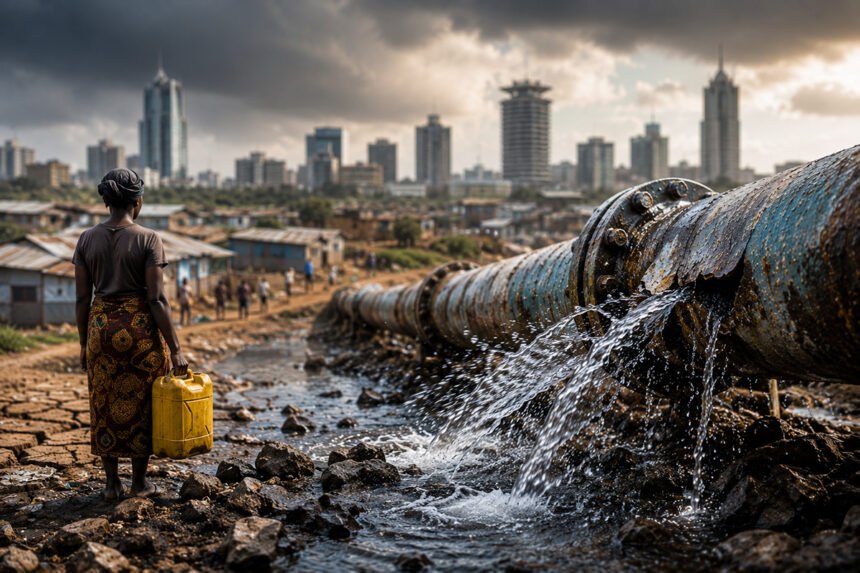
Water utilities worldwide lose an estimated 126 billion cubic metres of treated water every year before it reaches a paying customer, a drain on revenue that the World Bank has long flagged as one of the most fixable inefficiencies in urban infrastructure. Kenya’s own numbers now sit well above that global picture. From Nairobi’s ageing mains to county schemes in Naivasha, Nakuru and Meru, the same treated, paid-for water is disappearing into leaks, theft and faulty meters at a rate that regulators say has become unsustainable.
- The Numbers Behind the Alarm
- Diagnosis Is Over — What Delivery Looks Like
- Meru’s Case for What Discipline Actually Delivers
- Financing the Fix: Why Innovative Capital Matters
- Governance as the Missing Layer
- Why It Matters for the Broader Industrial and Infrastructure Sector
- Frequently Asked Questions
- The Bottom Line
That gap between global best practice and local performance was the backdrop for this year’s Non-Revenue Water Management Conference, hosted by the Water and Sanitation Providers Association (WASPA) at Lake Naivasha. The event drew utility chiefs, regulators, financiers and development partners around a single, uncomfortable data point: Kenya is not primarily short of water. It is short of the discipline to stop losing the water it already treats.
The Numbers Behind the Alarm
The scale of the problem was laid out in WASREB’s newly released Impact 18 Report, the regulator’s flagship annual assessment of the country’s water services sector. Non-revenue water that is produced but never generates income for utilities increased from 44 percent to 48 percent during the 2024/25 financial year.
The report, the 18th edition of WASREB’s Impact series, assessed the performance of 94 water service providers across all 47 counties. The 48 percent loss figure is more than double the roughly 20 percent global benchmark utilities are typically measured against.
Translated into physical volumes, the losses amount to roughly 242 million cubic metres of treated water every year, enough to have supplied millions of households currently facing persistent shortages in both urban and rural areas. On the financial side, various estimates presented alongside the conference put the annual revenue loss in the range of KSh 13.7 billion to KSh 14.8 billion, depending on tariff assumptions used, a scale that dwarfs many counties’ entire annual development budgets for water infrastructure.
The picture is not uniformly bleak. Cost coverage for utilities improved from 98 percent to 103 percent, meaning water service providers are increasingly generating enough revenue to cover operational costs without relying on external support. But the growing burden of non-revenue water remains one of the biggest threats to the sector’s long-term sustainability, even as coverage, water quality and financial resilience show gains elsewhere.
WASPA’s own leadership has been blunt about how long this has been building. Non-revenue water in Kenya has remained above 40 percent for two decades, and figures now closer to 48 percent signal that the sector is not doing well and is losing significant sums of money. Contributing factors cited include ageing infrastructure, unreliable electricity supply for water pumping, rising treatment costs and inadequate funding for network rehabilitation.
Diagnosis Is Over — What Delivery Looks Like
The conference theme captured the mood in the room: the sector has spent years studying non-revenue water and now needs to act on what it already knows. Kenya’s own technical guidance already sets out the fundamentals. WASREB’s NRW Management Standards, developed with support from the Japan International Cooperation Agency (JICA), define pressure management, active leakage control, faster repair turnaround and systematic pipeline rehabilitation as the four pillars any utility needs to bring losses down toward internationally acceptable levels.
The gap in Kenya is rarely a knowledge gap. It is an execution gap: dedicated NRW units are still the exception rather than the rule, district metering areas are only partially rolled out, and many utilities still rely on periodic physical meter reads and estimated consumption rather than continuous, real-time monitoring. That combination makes it difficult to catch losses early, prioritise repairs, or hold any single team accountable for a falling — or rising — loss rate.
Meru’s Case for What Discipline Actually Delivers
Amid the national numbers, one utility was repeatedly cited as proof that sustained reduction is achievable within Kenya’s own institutional and financing constraints, not just in better-resourced systems abroad. Meru Water and Sewerage Services has put in place a dedicated department focused solely on non-revenue water, aligned with WASREB’s guidelines, an organisational choice that has allowed the utility to build capacity, run staff sensitisation and instil a proactive rather than reactive culture around water loss.
The utility treats teamwork and regular collaborative review as central to its results, using structured discussions to identify root causes and implement corrective measures rather than one-off fixes. Strategic partnerships, particularly through WASPA, have also given the utility access to leased NRW equipment at affordable rates alongside reduction techniques and skills training that would otherwise be out of reach for a mid-sized county utility.
Meru’s schemes were also among the original nine pilot water service providers selected nationally for Kenya’s structured NRW capacity-building programme, alongside Embu, Kisumu, Eldoret, Nyahururu, Mavoko, Nakuru, Kilifi-Mariakani and Ruiru-Juja — utilities chosen specifically to test and refine reduction methods before wider rollout. The lesson utilities elsewhere in the country are meant to take from Meru is structural: a permanent, accountable NRW function embedded in the organisation outperforms rehabilitation projects that end once a donor-funded phase closes.
Financing the Fix: Why Innovative Capital Matters
Technical fixes for non-revenue water — leak detection equipment, district metering, network rehabilitation, smart metering — all require upfront capital that many Kenyan water service providers cannot raise through tariffs alone. That financing gap was a central theme of the conference’s session on innovative financing for NRW management, where the Kenya Innovative Finance Facility for Water (KIFFWA) set out how blended and early-stage capital can unlock investment that utilities could not otherwise access.
KIFFWA’s model is built around co-development rather than conventional lending. The facility provides early-stage capital, technical expertise and transaction support to help water initiatives reach financial close, taking on shared risk with developers rather than requiring repayment upfront. Since its establishment, the KIFFWA model — backed by the Netherlands Water Partnership and the Embassy of the Kingdom of the Netherlands in Kenya — has supported water initiatives across counties including Nakuru, Naivasha, Kajiado, Nairobi, Machakos and Kiambu, several of which fall within the same water basins under discussion at Naivasha.
For NRW specifically, the pitch is straightforward: every cubic metre of water saved through reduced losses is revenue a utility can reinvest in further loss reduction, creating a virtuous cycle that reduces dependence on donor grants over time. Whether county-owned water service providers can structure NRW rehabilitation as investable, bankable projects — rather than perpetual budget line items — will likely determine how fast national loss rates come down from 48 percent toward WASREB’s long-stated target of below 20 percent.
Governance as the Missing Layer
Ministry and regulatory leadership at the conference repeatedly returned to governance rather than technology as the sector’s binding constraint. Solving Kenya’s water losses, officials argued, requires stronger institutional accountability at water service providers, disciplined operational management, strategic capital allocation and collective ownership of loss reduction targets across county governments, water works development agencies and utility boards.
That framing matters because Kenya’s sector debt problem and its NRW problem are closely linked. Widespread non-repayment by water service providers to water works development agencies has left several agencies unable to meet their own financing obligations, contributing to an estimated sector debt exceeding KSh 225 billion nationally. Reducing non-revenue water is one of the few levers utilities can pull to improve cash flow without raising tariffs or waiting for new capital projects to come online — which is precisely why regulators are treating it as an urgent governance issue rather than a purely technical one.
Why It Matters for the Broader Industrial and Infrastructure Sector
For industry players across pump manufacturing, water infrastructure, and industrial engineering, Kenya’s NRW crisis is directly relevant to procurement and investment decisions. Every percentage point of non-revenue water reduction Kenyan utilities achieve translates into deferred demand for new bulk water production capacity, since recovered losses effectively expand supply without new boreholes, treatment works or transmission pipelines. That has direct implications for pump manufacturers, valve suppliers, SCADA and metering technology providers, and engineering consultancies bidding into county water projects across East Africa.
It also reframes non-revenue water reduction as a bankable infrastructure category in its own right — one that leak detection technology firms, smart metering vendors and pressure management specialists operating across Kenya, Tanzania, Uganda and Rwanda should be positioning toward, rather than treating water loss reduction as an afterthought bundled into broader network rehabilitation contracts.
Frequently Asked Questions
- What is non-revenue water (NRW)? Non-revenue water is treated water that is produced and pumped into a distribution network but never generates revenue for the utility, because it is lost to physical leaks, stolen through illegal connections, or unbilled due to faulty or absent metering.
- How high is Kenya’s non-revenue water rate? Kenya’s non-revenue water rate rose from 44 percent to 48 percent during the 2024/25 financial year, according to WASREB’s Impact 18 Report.
- How much money does Kenya lose annually to non-revenue water? Estimates presented at the 2026 NRW Management Conference put annual revenue losses in the range of KSh 13.7 billion to KSh 14.8 billion, depending on the tariff assumptions applied to lost volumes.
- Which Kenyan utility is cited as a model for reducing NRW? Meru Water and Sewerage Services is frequently cited as a benchmark, having built a dedicated NRW department, embedded WASREB-aligned reduction practices, and sustained measurable improvements over several WASREB Impact reporting cycles.
- What is WASREB’s long-term target for non-revenue water? WASREB’s national guidance aims to bring non-revenue water down toward globally acceptable levels, generally understood in sector guidance as below 20 percent.
The Bottom Line
Kenya’s water sector does not lack diagnosis. Two decades of WASREB Impact reports, a dedicated national NRW unit, published reduction standards and multiple pilot programmes have already identified what needs to happen. What Naivasha’s 2026 conference made clear is that the sector’s next chapter has to be measured in litres recovered and shillings reinvested, not in further studies. Utilities that copy Meru’s model of dedicated ownership, and financiers willing to structure NRW reduction as a bankable investment rather than a grant-dependent project, will decide how quickly Kenya’s 48 percent loss rate starts moving in the other direction.