

The demand for large-diameter steel pipes has never been higher. Across Africa and the world, governments and private investors are accelerating water transmission, wastewater infrastructure, hydrogen networks, oil and gas pipelines, mining slurry systems, desalination projects, and renewable energy developments. Behind these megaprojects sits a manufacturing revolution driven by robotics, and mid-2026 is proving to be an inflection point rather than a plateau, with a major industry conference, fresh market data, and a $125-million pipe plant announcement all landing within weeks of each other.
- The Labour Math Driving Adoption
- Why Large-Diameter Pipe Resisted Automation For So Long
- Robotic Welding Is Setting New Standards — And the Numbers Now Prove It
- Laser Seam Tracking and Gantry Welding Are Reaching Longer, Heavier Seams
- AI-Powered Vision Systems Are Closing the Quality Gap
- Material Handling, Digital Twins, and the Rise of the Connected Plant
- Smart Coating and Predictive Maintenance Extend Pipeline Life
- Robotics Is Becoming a Sustainability Story Too
- The African Opportunity
- Challenges Remain
- Looking Ahead
- Final Thoughts
- Frequently Asked Questions
In 2026, robotics is no longer confined to automotive production lines. Pipe manufacturers are increasingly deploying intelligent robotic systems that weld, handle material, inspect dimensions, prepare bevels, apply coatings, and manage logistics with a level of precision manual crews cannot sustain shift after shift. Combined with artificial intelligence, machine vision, digital twins, and industrial IoT, robotic manufacturing is reshaping how large-diameter pipes get made, from Amman to Nairobi.
For manufacturers supplying Africa’s expanding infrastructure market, robotic automation is becoming a strategic investment rather than a luxury.
The Labour Math Driving Adoption
The clearest sign that robotics has stopped being optional for pipe manufacturers came out of June’s AWS Welding Automation Exposition and Conference (WAEC) in Minneapolis. The event drew end users, integrators, and technology developers against a backdrop industry leaders described as unforgiving: roughly 477,000 unfilled manufacturing jobs in the US alone, and an estimated 80,000 welding positions that need filling every year. Manufacturing engineers from Polaris and senior weld managers from marine fabricators who attended described automation not as a productivity add-on but as the only realistic way to meet contract volumes their existing workforces cannot deliver.
That labour gap is not unique to the US. Fabricators across Africa, the Gulf, and Southeast Asia report similar strain on certified welders qualified for pressure-pipe and pipeline work, which is a large part of why robotic cells are now being installed at production volumes that would once have justified only a manual line.
Large-diameter steel pipes often exceed one metre in diameter and can weigh several tonnes. Producing them involves a long chain of high-precision operations: plate preparation, edge milling, forming, tack welding, internal and external welding, non-destructive testing, surface treatment, coating, and final inspection. Much of that chain traditionally depended on highly skilled operators working under demanding conditions, and while craftsmanship still matters, manufacturers are now squeezed from several directions at once — skilled labour shortages, rising production costs, stricter quality standards, faster delivery schedules, tighter traceability requirements, and higher worker-safety expectations. Robotics is one of the few investments that addresses all of these pressures simultaneously.
Why Large-Diameter Pipe Resisted Automation For So Long
Large-diameter pipe manufacturing has resisted full automation longer than most heavy industries, and for good reason. Welds must hold under high internal pressure for decades underground or undersea, so codes such as ASME Section IX, ISO 15614, and PED demand certified procedures with full traceability on every seam. A single flawed weld on a transmission main can mean a costly failure years after installation, long after anyone can trace it back to a bad pass.
Geometry compounds the difficulty. Intersecting pipes and irregular joints create a three-dimensional weld seam with constantly changing curvature, a shape that has traditionally forced manual welding despite the physical strain and inconsistent quality that comes with it. A widely cited 2026 academic review of three decades of research found the field only recently gained the sensor-based perception and adaptive control needed to handle that complexity reliably, which explains why the current wave of adoption feels sudden even though the underlying research has been building for years.
Robotic Welding Is Setting New Standards — And the Numbers Now Prove It
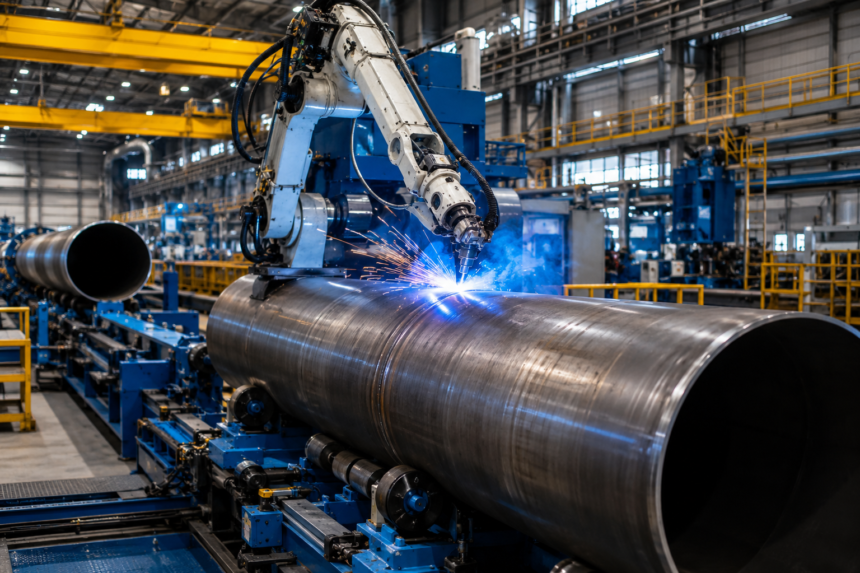
Welding remains the most critical, and the most automated, stage of pipe manufacturing. Modern robotic welding cells hold torch angle, travel speed, heat input, wire feed rate, and arc length steady in a way fatigue-prone manual welding simply cannot match over a long shift, and they increasingly pair that consistency with AI algorithms that watch weld-pool behaviour in real time. Cameras and laser sensors detect deviations and adjust welding parameters before a defect forms, cutting rework, scrap, inspection failures, and production delays in one motion.
The numbers back up why manufacturers are moving so quickly. Welding remains the single largest application for industrial robots worldwide, accounting for roughly 22% of all installations, with the International Federation of Robotics recording more than 450,000 industrial robots deployed globally in 2024. Buyer-side data sharpens the case further: current industry benchmarks put robotic weld defect rates at around 0.1%, against 3–5% for manual welding, with a typical robotic welding cell costing $50,000–$350,000 and paying back its investment in 18–36 months at medium-to-high production volumes.
Spiral-weld pipe mills, which form and join large-diameter steel pipe in a single continuous process, illustrate the shift clearly. Robotic welding adoption on these lines grew by roughly a third in a recent year, and mills can now produce pipe up to 144 inches in diameter for water transmission projects, a range that matches the specifications utilities across Africa are increasingly ordering for bulk water and treated effluent lines. Modern spiral mills pair multiple submerged-arc torches, typically two on the outer diameter and three on the inner, with automated seam tracking so the weld head follows the joint precisely as the pipe rotates. For manufacturers producing longitudinal submerged arc welded (LSAW), spiral submerged arc welded (SSAW), and large fabricated steel pipe, that precision has become a genuine competitive advantage.
Laser Seam Tracking and Gantry Welding Are Reaching Longer, Heavier Seams
The fastest-moving technical development through mid-2026 sits on the sensing side. Laser vision seam tracking now projects a line ahead of the torch and reads its shape to calculate seam position, misalignment, and gap changes in real time, and a 2026 refinement combining adaptive algorithms with fixed-geometry laser triangulation has pushed tracking precision closer to sub-millimetre accuracy. The honest limitation on any seam-tracking system is still the weakest link in its sensor chain, from arc glare and spatter interference to standoff stability and the robot’s own repeatability, so integrators now spec tracking accuracy at roughly a third of a joint’s allowable weld tolerance rather than trusting a single headline number.
Gantry-mounted welding systems, once mostly associated with shipbuilding, are being adapted to structural and pipe-adjacent fabrication at widths up to 5,000mm, holding fit-up tolerances near 1.5mm on long runs. Wind tower manufacturing, which shares large-diameter, thick-plate, long-seam characteristics with pipe fabrication, has emerged as one of the fastest-growing markets for this class of heavy-duty robotic welding, as net-zero commitments push fabricators to automate kilometres of weld seam per tower that manual crews cannot deliver at contract volume.
AI-Powered Vision Systems Are Closing the Quality Gap
Inspection has traditionally been one of the slowest stages of pipe manufacturing, and machine vision is where that is changing fastest. High-resolution cameras, laser scanners, and structured-light sensors now measure pipe diameter, roundness, wall thickness, weld geometry, surface defects, and dimensional tolerances continuously through the production run rather than only at final inspection. Artificial intelligence analyses thousands of inspection images within seconds, so manufacturers catch a developing problem immediately instead of discovering it after a batch of flawed pipe has already left the line.
Robotic inspection platforms are extending the same logic into non-destructive testing, increasingly performing ultrasonic testing, phased-array inspection, laser scanning, magnetic particle inspection, and automated radiographic positioning. Beyond consistency, these systems keep operators out of hazardous radiographic and confined-space environments, and the data they collect feeds automatically into digital quality records that simplify customer certification and regulatory compliance — a shift that matters as much for a Nairobi water utility as for an offshore energy operator.
Explosion-proof, certified collaborative robots are also opening automation to hazardous fabrication environments that conventional industrial robots could not enter safely, extending robotic manufacturing into pressure-vessel and process-equipment work that previously stayed fully manual.
Material Handling, Digital Twins, and the Rise of the Connected Plant
Large steel plates and finished pipes carry serious handling risk, and that stage of the plant is automating too. Automated guided vehicles, robotic cranes, and intelligent lifting systems, coordinated through centralised manufacturing execution software, are increasingly replacing manual transport between production stations, cutting workplace accidents, equipment damage, and idle time while improving inventory tracking. Collaborative robots now work alongside human operators during assembly, taking on repetitive or awkward lifting tasks while people handle judgment-heavy work.
Digital twin technology has become one of the most consequential additions to the modern pipe plant. A digital twin builds a virtual replica of the manufacturing facility, continuously updated with live production data, letting engineers simulate scheduling, robot movements, equipment wear, material flow, maintenance planning, and energy consumption before touching the physical line. Before a new pipe specification goes into production, engineers can validate it digitally, which dramatically shortens commissioning time and lifts overall plant efficiency. Manufacturers are pairing this with virtual commissioning of new welding cells specifically, testing weld paths and cycle times in simulation before equipment ever reaches the factory floor.
Smart Coating and Predictive Maintenance Extend Pipeline Life
Protective coating determines how long a pipeline actually lasts in the ground or under the sea, and robots now apply fusion-bonded epoxy, three-layer polyethylene, polypropylene coatings, internal linings, and specialised anti-corrosion systems with a uniformity manual spraying struggles to match. Automated inspection verifies coating thickness and quality before curing, catching problems that would otherwise surface as expensive field repairs years after installation.
Behind the scenes, the equipment doing all of this welding, inspecting, and coating increasingly monitors its own health. Embedded sensors track vibration, temperature, torque, motor current, bearing condition, and hydraulic pressure, feeding AI-powered predictive maintenance platforms that flag a developing fault before it becomes a failure. That shift, from reacting to breakdowns to scheduling maintenance during planned windows, is quietly one of the biggest contributors to higher equipment availability and lower lifecycle cost on a modern pipe line.
Robotics Is Becoming a Sustainability Story Too
Sustainability has moved from a nice-to-have to a purchasing criterion on pipeline projects, and robotic manufacturing contributes directly: less steel waste, more efficient use of welding consumables, lower electricity consumption per pipe, fewer rejected products, and better recycling efficiency across the plant. Energy-monitoring software layered on top of these systems now tracks carbon intensity for every pipe produced, generating the kind of data international financiers and infrastructure developers increasingly ask for as part of environmental reporting.
The African Opportunity
Africa is investing heavily in bulk water transfer systems, mining infrastructure, irrigation, oil and gas pipelines, hydrogen transport, urban water networks, wastewater treatment, and renewable energy development, and every one of those projects eventually needs certified large-diameter pipe. Kenya’s own water and energy sector is a clear example: bulk water transmission schemes, non-revenue water reduction programmes flagged at forums such as the 2026 NRW Management Conference in Naivasha, and regional projects like the East African Crude Oil Pipeline linking Uganda’s Hoima fields to Tanzania’s Tanga coast all depend on high-integrity pipe supply.
Locally, manufacturers such as Eslon Plastics, General Industries, Danco Plastics, and Kirin Pipes have expanded HDPE and structured-wall pipe capacity to serve municipal, sewerage, and irrigation projects across Kenya, Uganda, Rwanda, and South Sudan. But steel capacity on the continent still lags demand. Current market analysis puts the Middle East and Africa region at only around 5% of the global pipe-manufacturing-machines market, with African demand still project-based and heavily reliant on imports even as pan-African frameworks like the AfCFTA and PIDA push for local value addition. The global steel pipes and tubes market itself is forecast to grow from roughly $139 billion in 2026 to nearly $210 billion by 2033, with automation, digital quality control, and sustainable production named as the technologies that will separate competitive mills from the rest.
Jordan’s government offers a useful preview of what state-backed, automation-ready capacity can look like. In May 2026 it announced a $125-million metal pipe manufacturing plant, backed by US and Indian partners, targeted at producing roughly 500,000 tonnes of pipe annually for the country’s National Water Carrier Project and gas infrastructure, with 95% of the new workforce trained locally. It is the kind of water-security-driven investment African governments are also weighing as they look to cut import dependence on large-diameter steel pipe. As project specifications across the continent become more demanding, manufacturers serving African markets will increasingly need to compete on quality, delivery speed, and traceability, and robotic manufacturing is what lets regional producers meet international standards while still controlling cost. As industrialisation investment grows, robotics looks set to become a defining feature of the continent’s next generation of steel processing facilities.
Challenges Remain
None of this comes without friction. High capital investment, workforce upskilling, cybersecurity exposure, integration with legacy equipment, ongoing software maintenance, and data management are all real obstacles standing between a manufacturer and a fully automated line. But falling automation costs and wider availability of industrial robotics are steadily making adoption accessible to medium-sized manufacturers, not just the largest global mills, which is precisely the segment much of Africa’s pipe industry sits in today.
Looking Ahead
The next phase of robotic manufacturing will move beyond automation toward genuine autonomy. Self-learning robotic welders, AI-driven process optimisation, autonomous inspection robots, fully connected smart factories, generative-AI production planning, and cloud-connected manufacturing ecosystems are all emerging in parallel, and together they will let manufacturers respond faster to changing project requirements while holding quality steady. For pipeline infrastructure supporting water security, mining, energy, and industrial development, robotics is becoming the foundation of resilient manufacturing rather than an optional upgrade to it.
Final Thoughts
Robotics is redefining the future of large-diameter pipe manufacturing. In 2026, intelligent automation is delivering higher productivity, superior weld quality, enhanced worker safety, predictive maintenance, and greater sustainability across the entire production lifecycle. For Africa’s rapidly expanding infrastructure sector, these technological advances offer more than manufacturing efficiency — they offer the capability to produce world-class pipeline systems that support economic growth, water security, mining expansion, energy transition, and industrial development. Manufacturers that embrace robotics today will be best positioned to supply the increasingly complex pipeline projects shaping Africa’s future.
Frequently Asked Questions
How are robots used in large-diameter pipe manufacturing? Robots perform welding, inspection, coating, material handling, and quality control, improving precision, safety, and production efficiency at every stage of the line.
Why is robotic welding important for pipelines? Robotic welding delivers consistent weld quality, reduces defects, minimises rework, and improves long-term pipeline reliability. Current benchmarks put robotic weld defect rates around 0.1%, against 3–5% for manual welding.
What role does AI play in pipe manufacturing? AI analyses production data, detects defects in real time, optimises welding parameters, predicts equipment failures, and improves overall manufacturing efficiency.
Is robotic manufacturing suitable for African pipe producers? Yes. As African infrastructure projects demand higher quality and faster delivery, robotic manufacturing helps regional producers compete globally, and typical cell costs of $50,000–$350,000 with 18–36 month payback periods are bringing that automation within reach of mid-sized regional mills, not just the largest global plants.
Does robotic welding replace human welders entirely? Not yet. Current systems still rely on a human to set up and supervise the process; industry figures at 2026’s AWS Welding Automation Exposition framed automation as a way to close a labour gap, not eliminate the welding workforce.
What diameters can modern robotic pipe mills produce? Spiral-weld mills using robotic and automated welding now produce pipe up to 144 inches in diameter for water transmission and industrial applications.
Should East African fabricators prioritise robotic welding investment for steel pipe, or does the region’s near-term opportunity sit more with automating HDPE and structured-wall pipe lines? Share your take in the comments, or get in touch with the Pumps Africa desk with tips from your own plant floor.