

Israel turned a desert nation with almost no natural fresh water into the largest user of recycled effluent water for agriculture among OECD countries, reusing more than 87% of its wastewater while desalination supplies over 80% of domestic urban water. That track record is now on the table for East Africa.
- What Happened at Naivasha
- Why Israel Is the Reference Case
- Six Israeli Case Studies Kenya’s Utilities Can Adopt
- 1. Mekorot’s National Water Loss Model
- 2. TaKaDu’s Central Event Management for Leak Detection
- 3. Aquarius Spectrum’s Acoustic Leak Prediction
- 4. BioCastle’s Membrane Bioreactor Wastewater Reuse
- 5. Shafdan’s Wastewater-to-Agriculture Reuse Model
- 6. Precision Drip Irrigation for Arid and Semi-Arid Farming
- What a Formal Water Forum Could Unlock
- Frequently Asked Questions
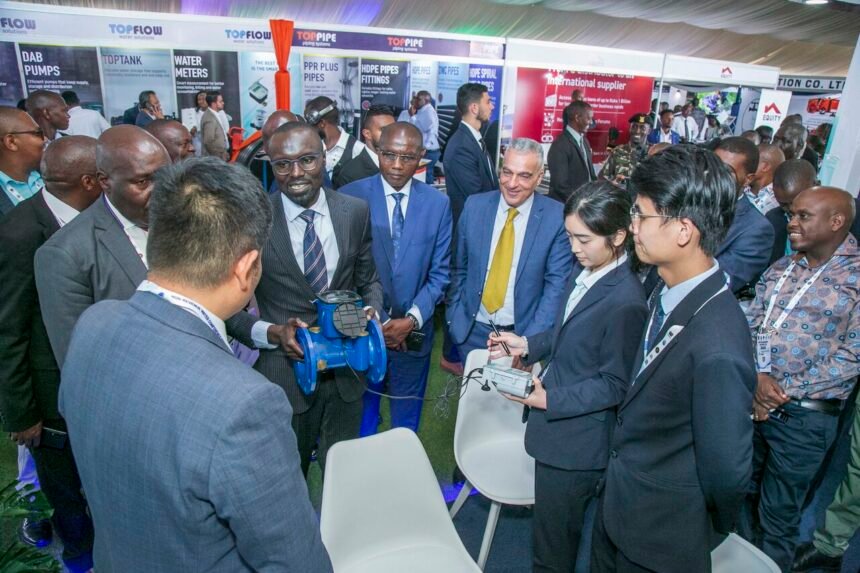
Kenya and Israel are moving to formalise that relationship. A Kenya-Israel Water Forum is under discussion following a roundtable between Israeli Ambassador Gideon Behar and Water Cabinet Secretary Eric Mugaa, held on the sidelines of the Non-Revenue Water (NRW) Management Conference 2026 at Lake Naivasha, Nakuru County.
What Happened at Naivasha
The NRW Conference 2026 ran as a three-day event hosted by Kenya’s Ministry of Water, Sanitation and Irrigation, the Water and Sanitation Providers Association (WASPA), the Council of Governors, Nakuru County Government, and the Kenya Water Institute. The gathering’s stated goal was direct: improve NRW management by leveraging innovation and technology.
Cabinet Secretary Mugaa used the opening session to frame the scale of the problem plainly. Kenya can no longer afford to lose nearly half of its treated water while millions of households continue to experience unreliable supply, he told delegates. Citing the Impact 18 Report, he noted that Kenya’s non-revenue water level has climbed to 48%, meaning close to one in every two litres of the 504 million cubic metres treated annually generates no income for utilities, lost to leaking pipelines, illegal connections, faulty meters and billing errors.
Mugaa framed the losses as physical, commercial and operational, arguing that proven technologies already exist and the priority is scaling them and strengthening utility performance rather than searching for new solutions. He also stressed that cutting NRW is one of the fastest, cheapest ways to repair utility finances without raising tariffs or committing to expensive new water sources.
It was against this backdrop that the Israeli delegation, led by Ambassador Behar and coordinated through TradeIL Kenya, made its pitch. In a statement following the conference, TradeIL Kenya described the Naivasha gathering as an “excellent platform for the Israeli Delegation led by the Ambassador to share Israel’s experience in water management.”
The Israeli Export Institute’s Kenya-facing trade arm brought two Israeli water-tech companies into the conference programme: Nura Global Innovation Lab (formerly the Pears Program for Global Innovation), whose representative Sophia Baranes joined a panel on WASH innovation, and BioCastle Water Technologies, a membrane bioreactor and wastewater treatment specialist. TradeIL Kenya said the two firms were recruited “as part of efforts to promote Israeli expertise and foster business opportunities.”
The roundtable between Behar and Mugaa that followed centred on a proposed Kenya-Israel Water Forum. According to TradeIL Kenya, the discussion focused on “the importance of developing a Kenya-Israel Water Forum that will promote water tech collaboration, knowledge exchange and investment in resilient water infrastructure to address growing water challenges in Kenya.”
TradeIL Kenya also credited WASPA’s leadership for the platform, thanking “CEO WASPA, the organizers and all participants for the valuable exchanges,” and said it looked forward to “strengthening partnerships that will contribute to improved water security and sustainable growth in Kenya.” More broadly, TradeIL Kenya’s framing of the engagement was that water security depends on combining policy dialogue, technology, and business partnerships rather than relying on infrastructure spending alone — a message that positions the proposed Forum as a bridge between conference-floor discussion and implementable projects on the ground.
Why Israel Is the Reference Case
Global framing matters here because Israel’s water story is not incremental — it is a full reversal of a resource-scarcity trajectory that many African utilities are still fighting. Facing decades of structural water scarcity and a location on the edge of a desert, Israel built its entire economy around treating water as an engineered, closed-loop system rather than a natural inheritance to be managed passively.
READ: https://pumps-africa.com/non-revenue-water-kenya-nrw-2026-solutions/
That bridge from global lesson to local application runs directly through Naivasha, Nairobi and every water service provider represented at Kenya’s inaugural NRW Conference this year.
Mekorot, Israel’s national water company, now operates with a water loss rate of under 3%, against an OECD average of about 15% — a gap that puts Kenya’s 48% NRW rate in sharp perspective. The OECD’s 2023 Environmental Performance Review of Israel credits the country’s combination of large-scale wastewater reuse, efficient desalination, and improved water allocation between sectors for cutting freshwater overexploitation even as the economy and population have grown. That performance is not accidental. It rests on decades of infrastructure discipline, monitoring investment and a national policy environment that treats water loss as a solvable engineering problem rather than a fixed cost of doing business — precisely the framing Mugaa himself used at Naivasha.
Governance matters as much as technology
Technology transfer alone will not close Kenya’s NRW gap. Academic research on Kenyan water service providers has repeatedly found that non-revenue water reduction strategies succeed or fail depending on internal controls, metering discipline, revenue collection efficiency and institutional accountability, not just the hardware deployed. Strathmore University’s Water Governance and Innovation Hub, established to build a data-driven water governance culture in Kenya and the wider East African region, reflects the same conclusion from the policy side: utilities that pair new technology with stronger governance structures see more durable NRW gains than those that treat equipment as a standalone fix. Any Kenya-Israel Water Forum will need to fund governance capacity alongside pilot hardware if Israeli technology is to deliver Mekorot-level results rather than another underused donor pilot.
Six Israeli Case Studies Kenya’s Utilities Can Adopt
1. Mekorot’s National Water Loss Model
Mekorot supplies roughly 80% of Israel’s drinking water and operates about 13,000 kilometres of pipelines, 1,200 boreholes, 1,000 reservoirs, and around 20 desalination facilities as a single, vertically integrated national operator. The lesson for Kenya is structural: consolidating technical standards, monitoring protocols and repair response under one coordinating framework — even where county-level utilities remain independently run — closes the gap between policy intention and field-level execution. WASREB has already set water-loss standards; what Kenya’s utilities need next is Mekorot-style integration between metering, pressure management and repair crews, rather than three departments working in isolation.
2. TaKaDu’s Central Event Management for Leak Detection
TaKaDu, an Israeli cloud-based monitoring platform, analyses network data around the clock to automatically detect leaks, water quality events and pressure failures, then prioritises them through to resolution. Utilities using the system have reported catching leaks overnight, sometimes repairing them before customers even notice supply issues. For Kenyan water service providers still relying on periodic manual audits, a Central Event Management layer over existing meters and sensors would convert leak response from a reactive scramble into a continuous, prioritised workflow — directly addressing the “operational challenges” Mugaa flagged at Naivasha.
3. Aquarius Spectrum’s Acoustic Leak Prediction
Rather than waiting for pipes to burst, Aquarius Spectrum’s acoustic sensors monitor pipe networks nightly and flag developing weak spots before they fail. In one documented case, a utility’s non-revenue water losses in a single district metering area fell by 90% after the technology pinpointed a leak that had gone undetected for five years. For counties managing ageing colonial-era pipe networks in towns like Nakuru, Naivasha and parts of Nairobi, this predictive-maintenance model would let utilities plan repairs on a schedule instead of digging up entire streets during emergencies.
4. BioCastle’s Membrane Bioreactor Wastewater Reuse
BioCastle Water Technologies, one of the two Israeli firms that exhibited at the NRW Conference, has developed compact membrane bioreactor (MBR) capsule systems designed as an eco-friendly, cost-effective way to treat wastewater for reuse. This matters for water-stressed counties beyond Nairobi’s sewer network, where decentralised, modular treatment units could recycle greywater for irrigation and industrial use without requiring the capital outlay of a full municipal treatment plant — a realistic near-term option for peri-urban Kenya.
5. Shafdan’s Wastewater-to-Agriculture Reuse Model
At national scale, Israel’s Dan Region Wastewater Treatment Plant, known as Shafdan, treats roughly 130 million cubic metres of wastewater annually, with the treated effluent reused in agriculture using natural sand filtration. The plant was cited by the United Nations as a global model. Israel now recycles water through nine treatment and reuse facilities that supply about 85% of the water used in its agricultural sector. For Kenya, where agriculture consumes the largest share of freshwater withdrawal, a Shafdan-style regional wastewater reuse scheme around Nairobi or Lake Naivasha’s flower and horticulture belt could ease pressure on Lake Naivasha’s already-stressed freshwater ecosystem while giving farmers a reliable, drought-resistant irrigation source.
6. Precision Drip Irrigation for Arid and Semi-Arid Farming
Israel pioneered modern drip irrigation to stretch scarce freshwater across an agricultural sector that consumes more than half its water use, delivering water directly to plant roots instead of flooding fields and losing volume to evaporation and runoff. For Kenya’s arid and semi-arid counties — where erratic rainfall already constrains crop yields — the same approach could raise water-use efficiency in horticulture and high-value crop zones without requiring new abstraction or costly bulk infrastructure. It is also the most farmer-level, low-capital entry point of the six case studies here, making it a realistic early pilot for county governments and agribusinesses ahead of larger utility-scale reforms.
What a Formal Water Forum Could Unlock
A standing Kenya-Israel Water Forum would move these case studies from conference-floor demonstrations into structured, government-backed pilots. Based on the roundtable discussions in Naivasha, three priorities appear likely to anchor the forum’s early agenda:
- Technology pilots with Kenyan water service providers, starting with NRW hotspot counties identified in the Impact 18 Report.
- Knowledge exchange programmes pairing Kenyan utility engineers with Mekorot’s WaTech innovation centre and Israeli water-tech startups.
- Investment facilitation, channelling Israeli water-tech financing and Kenyan public-private partnerships toward infrastructure that reduces NRW without raising consumer tariffs.
None of this guarantees rapid results. Israel’s low-loss performance took decades of sustained investment, tariff reform and institutional consolidation to achieve, and Kenya’s devolved county water structures present a different governance challenge than Israel’s centralised model. Political will, financing terms and technology-transfer costs will determine how much of Israel’s playbook is genuinely transferable versus aspirational.
Frequently Asked Questions
- What is the Kenya-Israel Water Forum? It is a proposed bilateral platform, discussed at the NRW Conference 2026 in Naivasha, intended to promote water technology collaboration, knowledge exchange and infrastructure investment between Kenya and Israel.
- Why is Kenya’s non-revenue water rate a national concern? Kenya’s NRW rate has risen to 48%, meaning nearly half of the 504 million cubic metres of water treated annually generates no revenue for utilities, straining their financial sustainability.
- How low is Israel’s water loss rate by comparison? Mekorot, Israel’s national water company, reports a water loss rate of under 3%, compared with an OECD average of around 15%.
- Which Israeli companies participated in the NRW Conference 2026? Nura Global Innovation Lab and BioCastle Water Technologies both took part, facilitated by TradeIL Kenya alongside Ambassador Gideon Behar’s delegation.
- Is technology alone enough to fix Kenya’s non-revenue water problem? No. Research on Kenyan water service providers shows that governance, metering discipline and revenue collection efficiency determine whether NRW reduction technologies deliver lasting results, meaning any Kenya-Israel Water Forum would need to build institutional capacity alongside equipment pilots.
- Can Israeli-style drip irrigation work in Kenya’s arid counties? Yes, in principle. Israel developed drip irrigation to conserve water in agriculture, which consumes over half its water use; the same low-capital, farmer-level approach could improve water efficiency in Kenya’s ASAL counties and horticulture zones without new bulk infrastructure.
This article draws on public statements from TradeIL Kenya, reporting related to the NRW Management Conference 2026 in Naivasha, OECD Environmental Performance Review data on Israel (2023), and publicly available information from Mekorot and Israeli water-technology firms. Readers should treat cross-country comparisons as illustrative rather than like-for-like, given differences in governance structure between Israel’s centralised water system and Kenya’s devolved county utilities.
Subscribe to the Pumps Africa newsletter for ongoing coverage of Kenya’s water-sector partnerships and NRW policy developments.