

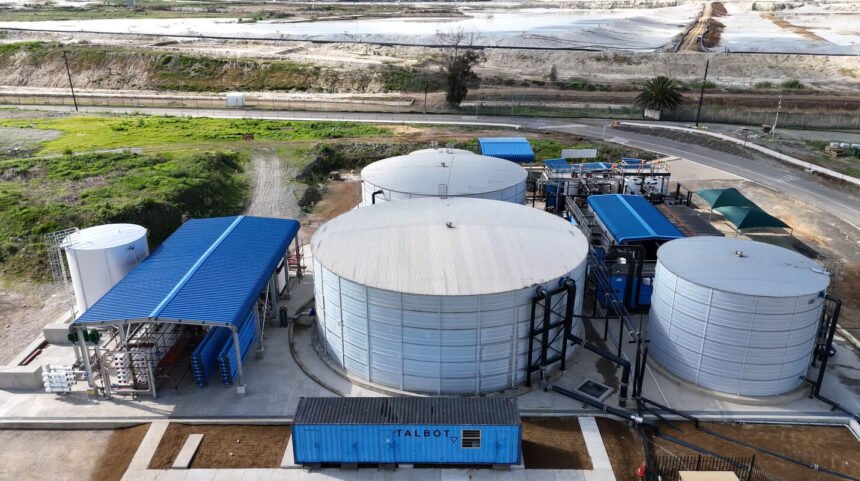
Industrial water security specialist Talbot has successfully completed a Phase 2 expansion of the water treatment plant at Pan African Resources’ Evander Gold Mine, doubling treatment capacity from 3 million litres per day to 6 million litres per day while keeping the existing plant operational throughout.
The upgrade was driven by rising water demand and increasing operational risk from municipal water supply disruptions. Following the completion of Phase 1 in 2023, Phase 2 was initiated to address these vulnerabilities. The expanded facility now treats underground mine water to SANS 241 drinking water standards, enabling safe reuse within mining operations.
Zero-disruption delivery in a live environment
A fundamental requirement of the project was seamless integration with the existing Phase 1 facility while keeping the plant fully operational during construction and commissioning. Talbot adopted a phased implementation strategy, carefully sequencing mechanical completion, wet commissioning, and performance ramp-up activities.
Water is a production-critical resource in gold mining operations. At Evander Gold Mine, ongoing and unplanned interruptions to municipal supply had created a vulnerability that threatened production continuity. This accelerated the need for infrastructure capable of recovering and treating underground mine water to potable standards.
“The objective of Phase 2 was not only to scale capacity, but to do so without disrupting an already critical operational asset,” said Talbot project manager Kieran Govender. “From the outset, our focus was on ensuring that every engineering and execution decision supported long-term operability, reliability and ease of use for the teams who would ultimately run the plant.”
The project achieved first water on schedule, validating both installation quality and integration methodology. Construction and commissioning were completed without any unplanned downtime.
Compact design with advanced treatment technology
Talbot delivered the upgrade under a full Engineering, Procurement and Construction (EPC) model, encompassing detailed design, fabrication, installation, integration, and commissioning. A compact, bespoke design with an optimised layout saved an estimated 65% to 70% of space compared with traditional expansion approaches.
The upgraded facility incorporates a multi-stage treatment process integrating ultrafiltration, reverse osmosis, and chemical dosing to ensure consistent water quality and process stability. A centralised automation and control system enables real-time monitoring, process optimisation, and reduced operator dependency.
Operational and environmental outcomes
The completed plant has delivered tangible results, according to Talbot and Pan African Resources. These include improved water security, enhanced production reliability, and doubled treatment capacity to meet increasing demand. The facility now produces SANS 241-compliant potable water, supporting regulatory compliance and safe reuse.
Additionally, the project has lowered the mine’s environmental footprint by increasing the recovery and reuse of underground water.
“The Phase 2 upgrade has significantly strengthened our operational resilience and water security,” said Wayne Allen, Pan African Resources Group consulting engineer for surface operations.
Broader significance for African mining
Implementation manager Jutta Dedekind highlighted the team’s execution quality: “I’m incredibly proud of the way our team executed the design, installation, commissioning and handover process on this plant.”
The project demonstrates how established mining operations can transform water management challenges and improve resilience in an environment increasingly impacted by water scarcity. Talbot’s successful delivery under complex operational constraints reinforces the company’s ability to deliver high-impact water infrastructure for mining water independence.
Beyond site-specific outcomes, the Evander project highlights that capacity upgrades to critical water assets can be achieved without halting production — a relevant consideration for mining operations across Africa facing similar water security pressures.