

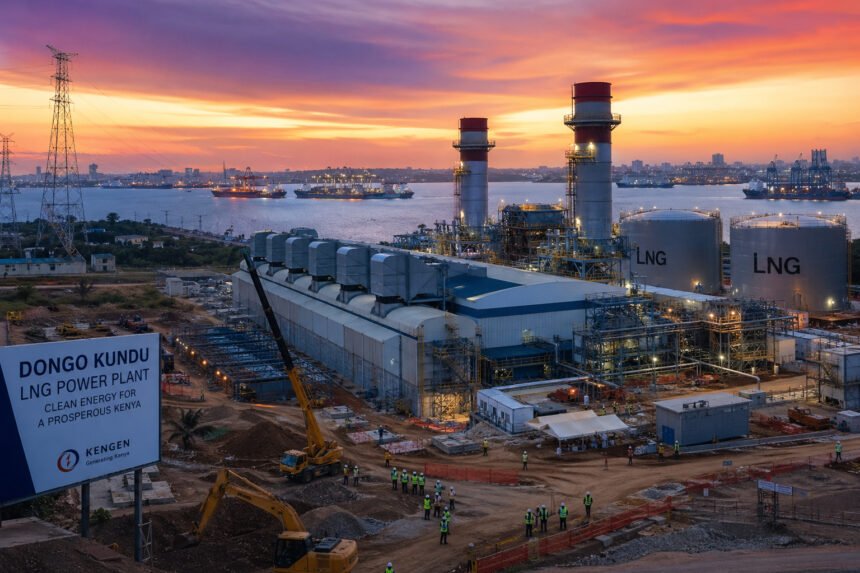
Kenya is set to test the commercial viability of a planned liquefied natural gas (LNG) power plant as it steps up efforts to remove expensive diesel-powered thermal plants from the national grid and offer consumers cheaper electricity.
The Public-Private Partnership (PPP) Unit of the National Treasury is recruiting an expert to test the commercial viability of the planned 1,200 megawatt (MW) plant, according to a statement from the unit.
“The feasibility study is intended to determine the commercial viability and PPP suitability of implementing the proposed project from a technical, economic, social, environmental and financial perspective,” the PPP Unit said.
Plant location and strategic importance
The planned LNG plant will be located in Dongo Kundu, Mombasa. It is key to easing Kenya Power’s reliance on expensive thermal power plants and will be constructed via the PPP model.
Electricity from thermal plants is the most expensive of all sources to Kenya Power, with a kilowatt-hour (kWh) averaging Sh35.09, largely due to the fuel cost charge, which is the single biggest component on consumer monthly power bills. Thermal power is 11 times costlier than locally-generated hydropower, which averages Sh3.27 per unit.
The LNG plant will lower the amount of thermal power that Kenya Power taps to stabilise power supply in the Coast region and countrywide when demand peaks in the evening. Reduced use of thermal power is key to lowering electricity prices for consumers.
Project timeline and phases
Kenya targets to have the first 300MW delivered this year, another 300MW in 2028, and 600MW in 2032. The project will be built via the Build-Own-Operate or Build-Own-Operate-Transfer model.
Current power generation mix
Thermal power supplied 706.9 gigawatt-hours (GWh), or 9.05 percent of total output to the national grid, in the six months to December last year. This compares to wind (12.98 percent), locally-generated hydro (22.36 percent), and geothermal power (40.06 percent).
Monthly electricity bills for consumers traditionally go up whenever fuel prices rise and generation from thermal power plants is high, underscoring the impact of the fuel cost charge on bills.
Fuel supply and regional cooperation
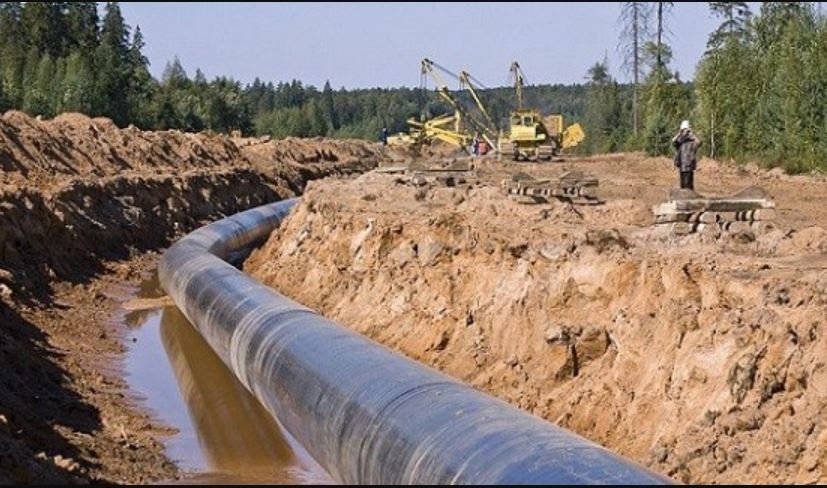
Kenya does not have any confirmed reserves of LNG and is counting on Tanzania or other countries to supply the commodity. The country signed an agreement with Tanzania to build a pipeline to evacuate LNG from Mtwara in southeastern Tanzania to the port of Mombasa. The two nations inked the deal in 2021.
Environmental and cost benefits
The PPP Unit says an LNG plant will offer Kenya cheaper power compared to thermal plants and also lower environmental pollution.
“LNG Single Cycle Gas Turbines or Combined Cycle Gas Turbine (SCGT/CCGT) generation offers a lower-cost and more environmentally efficient alternative to existing diesel-based thermal generation,” the PPP Unit said.
Beyond direct cost savings, LNG combustion produces significantly lower emissions of sulfur dioxide, particulate matter, and nitrogen oxides compared to diesel or heavy fuel oil. This reduction in air pollutants translates to improved public health outcomes for communities living near power generation facilities. Additionally, modern CCGT technology achieves higher thermal efficiency—exceeding 60 percent—meaning more electricity is generated from the same fuel volume. For Kenya, this efficiency gain reduces per-unit fuel import requirements, improving energy security and lowering exposure to global commodity price volatility. The transition from diesel to LNG therefore supports both economic and environmental objectives simultaneously.
Current thermal power landscape
Kenya has for years been forced to rely on expensive thermal power plants to shore up supply when demand spikes in the evening. The plants are also integral to stabilising electricity supply in the Coastal region.
There are eight thermal plants currently supplying electricity to Kenya Power. Two are owned by Kenya Electricity Generating Company (KenGen), while the rest are independent power producers.