

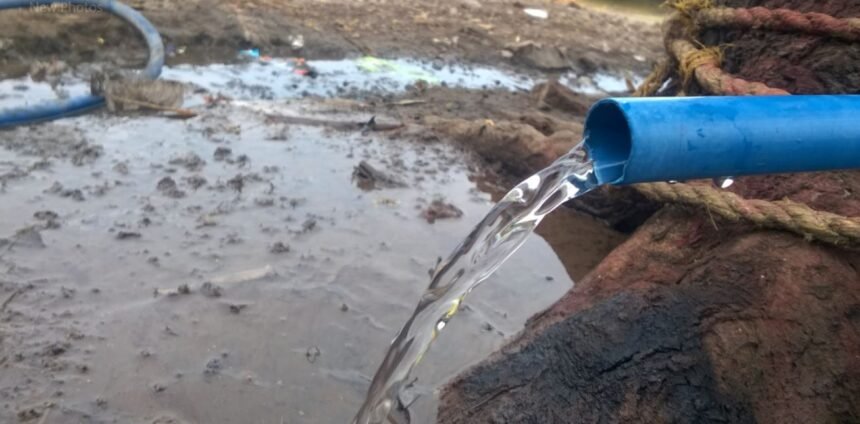
Development works on the Mwala Cluster Water Project in Machakos County Kenya nears completion. During an inspection visit, Water, Sanitation and Irrigation Cabinet Secretary Eric Muriithi Mugaa confirmed that construction now nearing completion at 93% and commissioning expected within the next two months.
The project is part of the government’s broader development framework under the Bottom-Up Economic Transformation Agenda (BETA), which prioritises investments in essential infrastructure to enhance livelihoods. CS Eric Muriithi Mugaa highlighted that chronic water shortages continue to affect communities across the Ukambani region, stressing the importance of long-term solutions to improve access.
READ: Ghana inks tripartite MoU for water project in Accra
Project’s benefits
The CS also underscored the need for strong cooperation between national and county governments, pointing out that water services are devolved and require joint efforts to ensure efficient delivery and sustainability. Once complete, the project will transport water over a distance exceeding 100 kilometres and supply about 6,600 cubic metres of clean water daily. It is expected to benefit roughly 150,000 people by improving access for homes, institutions and businesses.
The initiative, being implemented by the Tanathi Water Works Development Agency, is valued at Sh1.7 billion and is designed to significantly boost water availability in Mwala and surrounding areas. Key infrastructure includes water abstraction from River Ndarugu, an intake weir, a 5-kilometre raw water pipeline, linkage to the Gatuanyaga Water Treatment Plant, treatment facilities, storage tanks in Muthei Hill, Syathani and Kyuluni, as well as a pumping station to facilitate distribution.
Accompanied by Tanathi CEO Sammy Naporos and Mwala MP Vincent Musyoka, the CS called for the speedy completion of the remaining works to ensure the project delivers its intended benefits. The project is expected to enhance water reliability, support economic activities, and improve resilience to drought in the wider Ukambani region, marking a significant step forward in strengthening water security.