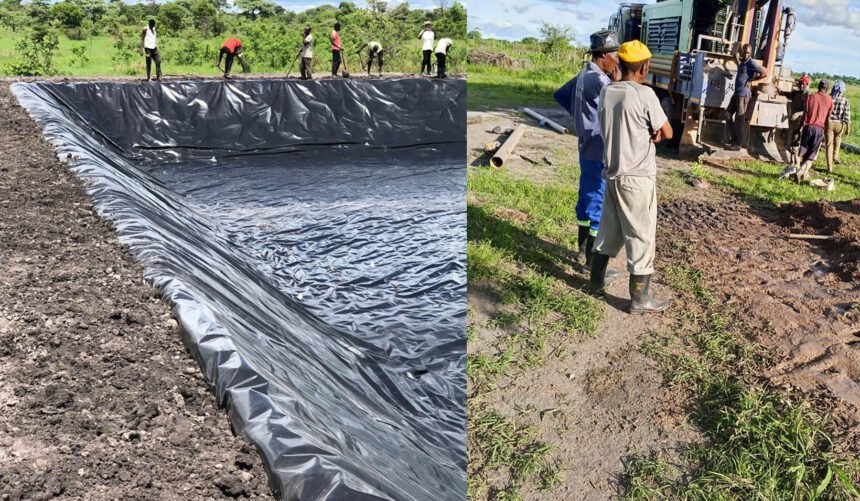
A communal water reservoir developed under the Water and Soil Accelerator (WASA) project is creating new irrigation opportunities for smallholder farmers in Zambia’s Central Province.
- Communal water storage strengthens agricultural resilience
- Irrigation support targets women and young farmers
- Inclusive water governance critical to long-term sustainability
- Soil management and efficient irrigation to maximise water use
- WARMA highlights the importance of water storage infrastructure
- Partnerships support sustainable agricultural water access
Located in Chief Mulendema’s area in Mumbwa District, the reservoir has the potential to provide approximately 1.62 million litres of water every five to six weeks under the current pump installation.
The project targets 50 households, representing approximately 250 people, in the Nalusanga Game Management Area (GMA). It aims to improve agricultural water access, reduce production costs and support farming during increasingly unpredictable rainfall.
The initiative demonstrates how community-scale water storage infrastructure can help rural farming communities manage seasonal water shortages and improve agricultural resilience.
Communal water storage strengthens agricultural resilience
The reservoir was established through the Water and Soil Accelerator (WASA) project.
Solidaridad Southern Africa is implementing the initiative with financial support from the International Water Management Institute (IWMI).
Other partners include GreenCare Eco Solutions, Zambia’s Ministry of Agriculture, the Water Resources Management Authority (WARMA) and traditional leadership.
The partnership combines water infrastructure development with sustainable farming practices, responsible water management and inclusive community decision-making.
For farmers in Nalusanga, the reservoir provides an opportunity to retain harvested water for agricultural use during dry periods.
It also creates opportunities to improve crop planning and reduce dependence on unpredictable rainfall.
“This reservoir allows our community an opportunity to plan beyond the next rainfall. We must protect it, share its benefits fairly and ensure that women and young people have a voice in how it is managed,” said His Royal Highness Chief Mulendema of Mumbwa District.
“What we build around this water will depend on what we do together.”
Dr Jonathan Atkinson, Managing Director of Solidaridad Southern Africa, said unpredictable rainfall continues to expose smallholder farmers to significant production risks.
“When rainfall becomes less predictable, a dry spell can undo months of work on a small farm. The reservoir gives farmers in Nalusanga more room to plan when to plant and keep crops growing through dry periods,” he said.
Through WASA, Solidaridad is combining investment in water storage with practical support for integrated water and soil management.
Irrigation support targets women and young farmers
The project also seeks to address the challenges women and young people face in accessing agricultural resources.
Sheila Garakara, Solidaridad’s Country Manager for Zambia, said water shortages often restrict farmers’ production choices and income opportunities.
The reservoir could help women expand agricultural activities and strengthen household incomes.
Community members have also received compost and fertiliser to support improved agricultural production.
A vegetable demonstration garden is planned for later this year. It will provide practical learning opportunities in vegetable production and efficient water use.
Lydia Banda, Programme Manager at Solidaridad, said infrastructure investment must be supported by agricultural knowledge.
“A reservoir can hold water, but farmers need the skills and support to put it to work,” she said.
The programme will therefore connect water harvesting with soil management, practical training and community ownership.
Inclusive water governance critical to long-term sustainability
The International Water Management Institute identifies gender equality and social inclusion as important considerations for the reservoir’s long-term success.
Dr Ojong Enokenwa Baa, Gender, Social Inclusion and Youth Researcher at IWMI, said equitable water access requires meaningful participation in management decisions.
Women, young adults and other underrepresented community groups must have a role in establishing the rules governing water use.
The existing women’s club provides a foundation for participation. However, further support will be necessary to translate representation into measurable economic benefits.
Dr Everisto Mapedza, Senior Gender and Institutional Governance Consultant at IWMI, said participation should extend beyond membership in community groups.
He highlighted the importance of ensuring women can access water, attend training, influence crop choices and benefit from agricultural income.
Proposed interventions include sustainable farming practices, crop selection, financial literacy, record-keeping and market access.
A Village Savings and Loan Association (VSLA) is also being considered to help farmers save and reinvest in their agricultural activities.
Community representatives have welcomed the initiative.
Beatrice Mununza, a lead farmer from Mutti Village and treasurer of the horticultural group, said the reservoir represents an important development for the surrounding communities.
She also highlighted positive results from demonstrations using organic fertiliser on watermelons and vegetables.
According to Mununza, farmers observed improved crop growth, healthier plants and better flowering in fruit crops.
Remu Kawenya, Vice-Chairperson of the horticultural group, said farmers are eager to expand production and improve market access.
The group also plans to establish savings arrangements as vegetable production begins.
Soil management and efficient irrigation to maximise water use
The productivity of the reservoir will depend on how efficiently farmers manage the available water and agricultural land.
Wana Ngalande of GreenCare Eco Solutions Ltd said healthy soil is essential for productive farming.
The planned training will introduce farmers to soil management techniques, organic inputs and biochar.
It will also cover sustainable water management practices around the reservoir.
Dominic Phiri, Technical Officer for Irrigation at Zambia’s Ministry of Agriculture, emphasised the importance of agricultural extension services.
He said crop selection, production planning and efficient irrigation must accompany water infrastructure investments.
These measures will help farmers maximise the available water while improving agricultural productivity.
WARMA highlights the importance of water storage infrastructure
Zambia’s Water Resources Management Authority (WARMA) also highlighted the importance of developing water storage infrastructure to improve agricultural resilience.
Goodfellow Mphande, Catchment Manager at WARMA, explained that the Authority operates under the Water Resources Management Act No. 21 of 2011.
Its mandate includes managing, regulating, developing, protecting, preserving and conserving Zambia’s water resources.
The Authority also regulates groundwater use and monitors groundwater levels and surface water flows.
Mphande encouraged the development of more dams and reservoirs to support water availability during dry periods.
He noted that farmers with access to stored water were less exposed to the challenges experienced by those relying directly on river abstraction.
Partnerships support sustainable agricultural water access
Humphrey Nxumalo, Regional Head of Programmes at Solidaridad Southern Africa, said collaboration between development organisations, government institutions, researchers and traditional leadership is essential.
He highlighted the importance of combining technical expertise with local knowledge and community participation.
The next phase of the WASA intervention will focus on establishing the demonstration garden and connecting water availability with practical agricultural training.
For the 50 participating households, the reservoir offers an opportunity to strengthen agricultural production beyond the rainy season.
Its long-term impact will depend on effective water management, efficient irrigation, maintenance arrangements and equitable community governance.
For Zambia’s water-stressed farming communities, the project illustrates the potential of decentralised water storage to support more resilient agricultural systems.